Traps
Posted: Tue Aug 07, 2012 5:50 pm
I've come to thinking, how would traps work? Do they insta-kill, heroic feats to disarm? 1d4-6 roll on detection? How do you guys think traps would work? Thanks!
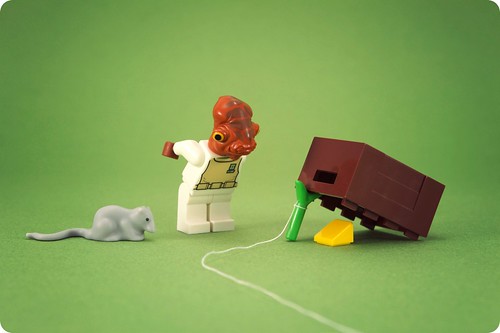

Mine Turtle.Thesson wrote:It depends: Mine turtle or slow sheep?
But what if it says 'Hello!' , detaches from the ceiling and hits the floor, button first?Thesson wrote:1d10 explosive as soon as he TOUCHES it.
Long story short: most traps have 1d4 skill when skill comes into play, and triggers will be pretty specific to whatever trap is set up. I'm guessing the trigger for the pictured trap is anyone knocking over the stick, and once that happens they become encased in box.the chapter about traps wrote:Mechanisms
Devices and Creations purchased as normal, default 1d4 Skill where applicable
Triggers and Mechanisms free
Not all battlefield hazards are based on environmental conditions. Every once in a while, minifigs have the time and attention span to assemble something more deliberate and specific. Defense turrets, slamming blast doors, rolling boulders, strategically positioned sleeping tigers, auto-flushing toilets - any Creation, Weapon, or Device that can be activated can be engineered into a custom Mechanism, operating independently or in coordination with other Field Hazards.
Mechanizing an activatable object costs nothing extra - once the object itself is paid for, the Mechanisms are free. Mechanisms are not capable of initiative or independent thought, so players have to be specific about the exact conditions that activate a Mechanism, and its behavior once activated.
Triggers
Mechanisms are often attached to Concealed Hazard Fields - hidden pressure plates, motion detectors, tripwires, or some equivalent are scattered throughout the area, and tripping one of them will set off the device. (By default, concealed weapon traps are automatically pointed at the spot where the Hazard happens to be tripped. Even if the players don't know in advance exactly where the tripwires are, the minifigs who built the trap presumably did.)
Other Mechanisms are activated by specific Triggers. Any object physically represented on the battlefield can be designated as a Trigger for one or more Mechanisms. Minifigs may be required to interact with the object in a certain way (typing the proper code into a keypad, turning the arming keys before pulling the self-destruct lever, or playing a particular tune on a skeletal pipe organ), or the Trigger may be set off by any interaction at all (a doorknob wired with a mercury switch). Like all Mechanisms, Triggers have no extra cost.
Some triggers are obvious ( the comedically oversized power switch, or the giant red "DO NOT PUSH" button), but many are not (the disguised torch lever that opens the secret door, the doorknob that sets off the hidden fireball trap). In theory, opposing minifigs won't know the location of these secret Triggers, but in most cases all the players will, unless the game has an impartial moderator to keep secrets secret. Often, the easiest workaround for secret Triggers (as well as other types of hidden objects) is to build a large number of potential Triggers, and roll dice whenever one is tried to see if it's the real one.
Multiple Mechanisms
Mechanisms can be bought in multiples, and, depending on the Hazard concept, the multiples can be handled in different ways. If a player buys three tigers for his Field of Concealed Hazard pit traps, then all three might be waiting in the first pit an enemy falls into, there might be one in each of the first three pits encountered, or the player might roll randomly for each pit until all three tigers have been located. This is largely up to the player setting the trap, but should be spelled out in advance of starting the battle.
Alternately, the same Trigger might activate a series of different Mechanisms each time it's set off. For example, the first pull of a suicide lever might slam the doors and lock you into the chamber, while the second deploys a row of motion-tracking rifles from the wall. The third pull extends a mechanical arm to offer a cigarette and a blindfold, and so forth.
Deadly Mechanisms
Any Mechanism designed to directly damage or attack a target should be purchased as a Weapon. A two-story granite sphere is just a big rock, but once it's rigged up as part of a rolling boulder trap, it becomes a Size 5" Melee Weapon and should be purchased as such.
Deadly Mechanisms are, for the most part, single-use (until reset by a minifig technician - those hidden crossbows don't re-arm themselves), and they make their Attacks with an inanimate object's default 1d4 Skill. A Smart Weapon, equipped with simple robot brains or magical enchantments, can Attack with a Skill of 1d6 and can often be re-used from turn to turn. Smart Weapons can be treated as a kind of Simple Half-Minded Creature (10.1: Minds), but for simplicity's sake it's easier to just say that a Smart Weapon costs +1CP more than the dumb variety.