Chapter One: Gameplay

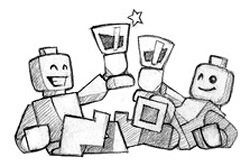
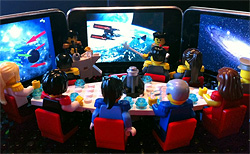
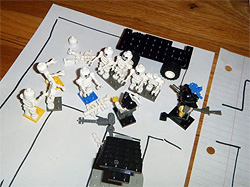
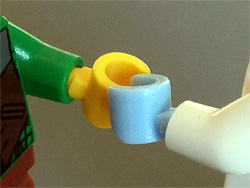
| Almighty Benny and Major Natalya settle their BrikWars differences over a high-stakes game of Nano-BrikWars, proving themselves to be deadly metagamers. |
| Elements shown: LEGO, Nanoblock, die |
|
| "Thus, a prince should have no other object, nor any other thought, nor take any thing else as his art but that of war and its orders and discipline; for that is the only art which is of concern to one who commands." |
| - Niccolo Machiavelli |
The purpose of BrikWars is to provide a safe and comfortable setting
in which groups of like-minded minifigs can gather to mutilate and slaughter
one another for the entertainment of their Humans. Their conflicts can be large or small, balanced or skewed,
orderly or chaotic; the important thing is that they deliver the mindless
violence on which minifig happiness depends.
1.1: Overview of Play
Setup
| "If our most highly qualified General Staff officers had been told to work out the most nonsensical high level organization for war which they could think of, they could not have produced anything more stupid than that which we have at present." |
| - Claus von Stauffenberg |
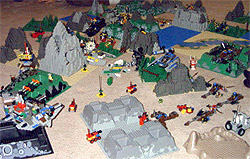
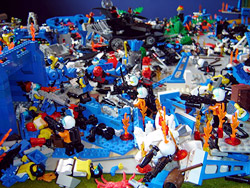
Players prepare for BrikWars by building armies, landscaping, scenic fortifications, and whatever else they think might add to their battlefield enjoyment. The only limits are the imagination and construction abilities of the Humans involved. It's best if the forces and scenery are built from plastic bricks, so that soldiers and structures can be disassembled or modified to show damage, posturing, or equipment loadout, but it's by no means necessary - an army of action figures and stuffed animals can march over a landscape of book-stack mountains and shoebox buildings using the same rules.
A typcial BrikWars army is mustered through the in-depth military strategy of dumping bins out onto tables and grabbing whichever random units come most immediately to hand. Depending on how serious the players are pretending to be, however, they may sometimes find themselves concocting structured scenarios, setting genre guidelines, and spending hours crafting formations of
vehicles and infantry.
They even have the option of imposing balanced budgets
of Construction Points if they suffer from the notion that
their armies should be equivalent or that battles should be "fair."
Once the battlefield and armies are assembled, players can pick their
starting locations according to the requirements of the scenario or by any combination of mutual agreement and dice-rolling.
If one player designed the battlefield, it’s customary to allow
the other players to have first pick of starting locations.
Taking Turns
| "First I kick you in the nuts as hard as I can, then you kick me in the nuts as hard as you can, and we keep going back and forth until somebody falls." |
| - Eric Cartman |
Once the battlefield and armies are in place, combat can begin. Each player takes
a turn, maneuvering forces and conducting attacks for all of the units
under his or her control, and then play passes to the next player. When all
surviving players have taken their turns, the cycle begins again with the first
player.
While it's easiest to pick a turn order and stick with it, players can mix the sequence up as they see fit. Some players like to roll dice to randomize the order of each cycle of turns. When multiple players are allied, or their forces are too far apart to interact, it can save time to run them all simultaneously until they're ready to try to kill each other again like civilized minifigs.
If forces start too far apart at the beginning of a battle, it can help to give them all double or triple turns to get into fighting range more quickly. On the other hand, it can help even more not to start the forces too far apart in the first place. |
Victory
| "It's never 'just a game' when you're winning." |
| - George Carlin |
It's not especially important for any one player or
team to "win" a battle. Dying horribly
in some ridiculous fashion is always funnier than surviving horribly in some ridiculous fashion, and BrikWars
is set up to favor the optimum result of a complete massacre of all
participants, along with all bystanders and scenery.
You should expect
your BrikWars battles to end with final victory going to
a force of nature or deadly catastrophe as often as to any of the players.
'Fire,' 'explosive decompression,' and 'I told you to put your toys away twenty minutes ago' have winning
records that no Human strategist can hope to match.
The classic ending for a BrikWars battle is for the entire battlefield
to be destroyed in a cataclysmic fireball. This is considered a victory
for all sides except those whose sad objective was to prevent destruction
(e.g., "protect the doughnut supply ").
Objectives
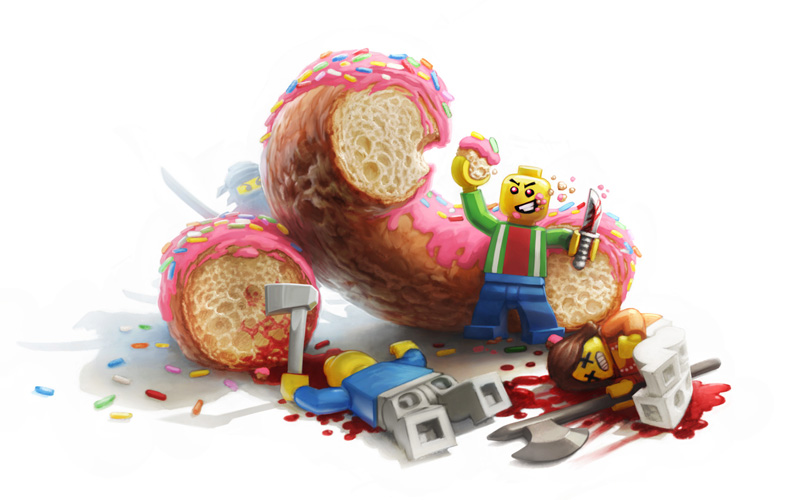
| Minifigs are notoriously poor at sharing. There is nothing in the world they won't use as an excuse for mutual homicide. |
|
The simplest types of battles have no military objectives. Minifigs with weapons don't need any excuse to run around whacking other minifigs with them, and there's no reason not to just send them out on the field and let them go crazy. When the dust and body parts settle, it's irrelevant which side won or lost. Success is measured by whether events on the battlefield were more crazy than those of the battle before, and by how much.
In (marginally) more serious battles, minifigs fight for a higher Objective - stealing the enemy's secret taco recipe, assassinating a meddling peace delegation, or heaping the largest pile of skulls for the glory of the Stud God.
Objectives work best when they're aggressive and focused - specific targets to destroy, murder, or steal make for exciting battles. Passive goals like defense or escape, if they're tolerated at all, should only be considered if they're made secondary to more target-oriented Objectives.
| "Survival" is never a worthwhile Objective. Any minifigs saddled with such a repugnant goal should ignore their Humans' orders and kill themselves immediately in protest. |
1.2: Numbers
Units in BrikWars are defined by their physical construction and placement. Players don't need to refer to charts and graphs to see if a minifig policeman has a chainsaw spear in his hand, or if it's long enough to messily eviscerate a nearby jaywalker, or if the fair and balanced cable news channel has cameras in position to catch the patriotic video of justice being served. The plastic figures speak for themselves.
Some attributes aren't obvious from the physical models, however. In-game abilities like a civilian's running speed, a policeman's spear-handling skill, or a chainsaw's effectiveness versus intestines are represented by a small handful of abstract numbers. BrikWars relies heavily on mayhem and chaos in the big picture, but moment-to-moment details are made up of orderly numerical comparisons.
Taking Measurements
In BrikWars, distances are measured in inches. If you don't like inches,
you can use any alternate system of measurement that seems reasonable
- an inch is about three centimeters, the length of three construction brick
studs, or the height of three construction bricks. It's not important
whether or not the conversion is exact, as long as everyone's using
the same system.

| Keychain mini-measuring tapes are great for winding around narrow spaces. |
|
As with most aspects of BrikWars, flexibility is key: bendable measuring
tape is going to be a lot more useful than a rigid ruler, since you'll
often want to measure around corners or in tight spaces. If you haven't
got a measuring tape handy, a simple ribbon or piece of string marked
off in inches will work as well.
Rolling Dice
| "Jacta alea est.” |
| - Julius Caesar |
BrikWars uses dice to add unpredictability to events in the battle.
If a minifig fires a rifle at an opponent, sometimes he'll hit and
sometimes he'll miss; if the enemy minifig is struck by the bullet,
he might survive the damage, or he might not. Die rolls determine
the outcome of actions whose success isn't guaranteed.

d6 |

d10 |
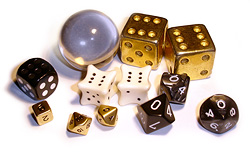
For the Core Rules, dice come in two flavors: the d6 and the d10, named according to how many faces are on each die. The
six-sided d6es ("dee-sixes") are regular cube-shaped
dice, much like you might find from raiding any lesser board game, except
that when you call them d6es it sounds 1d100 times as geeky. The ten-sided
d10s ("dee-tens") are a little more unusual; you'll
have to do some shopping at your local gaming store or website to
stock up. The d6es are used for almost all normal action in BrikWars,
while d10s are reserved for certain types of high-powered combat.
| If you don't have any ten-sided dice, you can replace any d10 roll with 2d6-2 - that is, roll two six-sided dice and subtract two from the result. Is this statistically equivalent? Not really. Does anyone care? Refer to The Law of Fudge later in this chapter. |
Die rolls are described according
to the number of each type of dice involved, plus or minus a modifier (if any). 4d6 means a roll of four six-sided dice, all added together. 1d10+2 means you roll one ten-sided die and add two to the
result. 17d6 + 23d10 + 0937 means rolling seventeen six-sided dice
and twenty-three ten-sided dice together, and adding the holy number zero thousand nine hundred
thirty-seven to the result, which you will hopefully never have to
do.
| Some people like to refer to dice with a "die" rather than a "dee" prefix. But how, then, do you refer to multiples? With the utilitarian "die-sixes," or the more erudite "dice-six?" The solution is this: whenever someone refers to a die-anything, kick them in whichever shin is most convenient. This will forestall further arguments about proper nomenclature and pluralization. |
No matter how negative a modifier may be, the lowest possible result
for any die roll is zero. A roll of 1d6-100 will almost always
have a simple result of zero, for instance, unless a player's luck
with Critical Rolls defies belief.
Critical Rolls
Rolling dice in BrikWars is never a sure thing. No matter how easy
or how difficult the task, there’s always at least a tiny chance
of failure or success, thanks to a couple of special cases when rolling
dice.
 |
Critical Failure
If the die in a roll comes up ‘1,’ then the
roll is an automatic Critical Failure, regardless of other modifiers. Whatever task a player or unit was
attempting fails completely, no matter how easy it might have
been.
If there are multiple dice in a roll, it's only a Critical Failure if all of the dice come up '1.' |
 |
Critical Success
Luckily, rolls can also turn out unexpectedly well. When rolling
any number of dice, for each die that comes up on its highest-numbered
face (a six on a d6, a ten on a d10), the player may add +1d6
to that roll as a Bonus Die. The same holds true for
the additional dice rolled – any sixes rolled on the Bonus
Dice continue earning additional Bonus Dice.
A player may elect
not to roll a Bonus Die that he or she earned, for whatever
reason. |
1.3: Supplies Checklist
| "The very existence of flamethrowers proves that some time, somewhere, someone said to themselves, 'You know, I want to set those people over there on fire, but I'm just not close enough to get the job done.'” |
| - George Carlin |
Besides the obvious items like armies, a battlefield, and opponents, players should make sure to have the following.
Things You'll Need
- Fun
First and most importantly: fun. It seems obvious,
but this item is so often strangely forgotten by all types
of gamers that it bears repeating: don't play a game
if you don't mean to have fun.
And remember that it's not all about you! BrikWars caters to a wider range of play styles than most wargames, and other players may have entirely different ideas than you do about what counts as fun. If you're having a fantastic time but everyone else is frustrated or bored stiff, then the game is a failure and it's probably your fault. Make sure you know what kind of game everyone else showed up to play, and pay attention to what flavor of fun they're trying to get out of it.
- Measuring Devices
BrikWars is won or lost by its ranges and measurements, and you'll want enough measuring tools to go around. Flexible measuring tape is best, but in a pinch you can put together brick-built measuring sticks instead, measuring distances at three studs per inch.
- Dice
You'll need a good supply of dice - the more, the better. The Core Rules are written entirely for two types of dice: regular cube-shaped six-sided dice (d6es) for regular units, and the
more unusual ten-sided dice (d10s) for siege- and hero-level
units.
| In the advanced rules (Book Two: MOC Combat), rules are given for using a greater variety of exotic dice, but these also have equivalent d6 conversions if necessary. |
- Cameras
An ancient curse among minifigs warns: "Pics or it didn't happen!" By nature, BrikWars games are full of amazing constructions,
crazy action scenes, and hilarious mishaps, but without photographic evidence even the most glorious triumphs will never achieve Kanon status outside their local group of Humans.
- Doughnuts and Beer
Pizza, chips, and Mountain Dew are the traditional
food of tabletop gamers since time immemorial, but the proper BrikWars mindset is
less Gary Gygax and more Homer
Simpson. Cheeseburgers are an acceptable compromise.
| Which Bricks Should I Use? |
Most people associate construction bricks with The LEGO Company, but there are many other fly-by-night toymakers riding on LEGO's coattails. The knockoff products from these "clone brands" can cost much less than genuine LEGO bricks. This is no coincidence: Regular toymakers use less expensive toy molds to make toy-quality bricks, while LEGO uses super-precise (and super-expensive) engineering to create building elements with accuracy measured in microns.
The difference is impossible to miss once you start trying to build anything. Two clone bricks can sometimes fit together without trouble (depending on the brand), and it's not unusual to find a third that fits onto the first two. But the inconsistencies compound with each brick added, and soon it's a struggle to force additional bricks together at all. With LEGO, by contrast, thousands of parts snap together as a matter of course.
Here, LEGO is the victim of its own excellence - people are so used to bricks that "just work," they assume that any similar-looking brick will function just as well. Ignorant grandparents think the clone bricks give more value for the dollar. Unlucky grandkids, frustrated by trying to get the knockoffs to function at all, grow up never wanting to play with construction toys again, and become murderers, drug dealers, and politicians. Or, worst of all, adults.
By counterfeiting and betraying the good will built up by LEGO over the course of generations, the clone brand parasites sabotage the very market they're leeching off of. To give them a single dollar of support is an act of unjustifiable perversion, and any Human who knowingly buys a clone product is doomed to burn in Human Hell in a richly-deserved fiery torment lasting for all eternity.
That being said, clone brands offer specific advantages to the pragmatic BrikWarrior.
Because they aren't limited by LEGO's anti-war ethics, or by the need for each element to earn back the hundreds of thousands of dollars it costs to make a single LEGO mold, the clone elements and sets can be much more single-purpose and morally dubious. Historically, the clone brands' most successful playthemes have looked like they could have come straight out of a traditional miniatures wargame.
For minifig and weapon elements, this is fantastic, since their use doesn't depend as heavily on precision or buildability. For contruction elements, the results are less usable, but even crappy clone bricks can have a role to play. By sandwiching them between layers of genuine LEGO elements, they can in many cases be used to build stable structures while still keeping a lower overall cost. |
Things You Probably Won't Need But Might
Want Anyway
If you're not making up bizarre and crazy ad hoc rules on the fly,
you're not really playing BrikWars. As such, you might want to bring
extra gear just on the off chance that you think of funny things to
do with it.
- Pencil and Paper
In case you want to pass love notes to the cute player
on the other team.
Or to all of the other players at once, if you're into that kind of thing.
- Spare Parts
It's often nice to be able
to whip up a costume change for your hero, craters and
random debris from explosions, a support stand to hold a
minifig in a precarious position between turns, or any number of other
objects that might appear as the result of unexpected
events.
- Stat Cards
Even if you think you've got all your units' stats memorized,
it's good to keep their stat cards handy, if for no other
reason than to reassure your opponents that you're not
making up numbers off the top of your head. (Even if that's exactly what you're actually doing.)
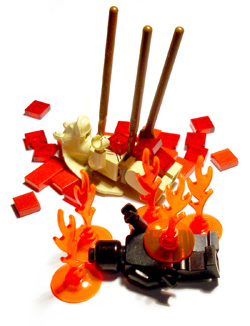
- Blood and Fire
While not completely necessary, it really adds to the
ambience if you have a healthy supply of little red plates and
flame elements to scatter around whenever it seems like
the battlefield could use more blood or more fire. And
seriously, when could a battlefield not use more blood
and more fire?
- Funny
Dice
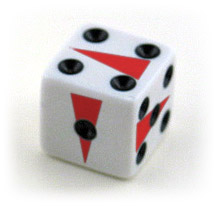 Nothing says gaming like funny dice. A Stumble die, for
instance, is easily made by taking a marker and dashing
off a quick arrow on each face of a regular d6. Now with
every roll you get both a direction and a number of inches,
good for ad hoc rulings on wind direction, shrapnel trajectories,
and drunken staggering. Nothing says gaming like funny dice. A Stumble die, for
instance, is easily made by taking a marker and dashing
off a quick arrow on each face of a regular d6. Now with
every roll you get both a direction and a number of inches,
good for ad hoc rulings on wind direction, shrapnel trajectories,
and drunken staggering. |
 Pips Pips
If you've ever played a collectible card game, you've
got piles of these: colored beads or beans or chits or
little pewter brains. Even if you haven't got some counting
pips set aside already, it's easy to improvise some with
a pile of plastic bricks. Pips let you make up conditions
like "everyone remove one blue pip at the end
of your turn - when they run out, the nuke goes off."
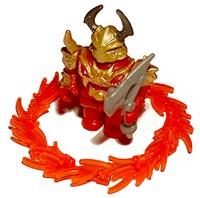
- Fire Rings
Complicated and arcane-looking gear with no real purpose
is great for intimidating newbies. More experienced players
may just laugh at you whether the things actually have
a purpose or not, so be careful.
1.4: The Spirit of the Game
| The MultiPantheon |
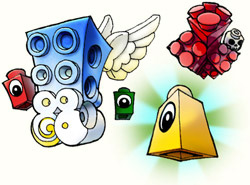 Minifigs hold faith in any number of greater and lesser powers that inspire their fear, worship, and adulation. Minifigs hold faith in any number of greater and lesser powers that inspire their fear, worship, and adulation.
Some abandon rationality in obeisance to BrikThulhu, the nine-tentacled RagnorOktopus of Chaos.
Others are seduced by the corruption of the Nega-Bloktrix and her promises of cheap Cloan-brik assembly. These blasphemers are opposed by purist orders of Legiti Knights and fraternal legions of BrikMasons who devote themselves to acts of brutal oppression and self-righteous douchebaggery in the name of an unseen Great Builder.
On the fringes, Rainbowist cultists pursue the ecstatic anti-sentience of the baseball-capped Dimmy swarms, while ascetics at the opposite extreme abandon all hygiene in a quest to harness the forces of deconstruction and rebirth that sustain the poop-worshipping Dungans. Some put their faith in the impossible figure of the Dodekube, ascribing all events to the random dice rolls of disinterested Human gods. There are even isolated minifig hermits who hold a laughable belief in an omnipotent personal Player who oversees their every move.
No matter how ridiculous, all minifig belief systems are true. The Farce ensures that no faith goes unrewarded.
|
Proper Observance of Rules
| "The secret we should never let the gamemasters know is that they don't need any rules." |
| - Gary Gygax |

The right answer is the wrong answer if it takes more than thirty seconds to look it up. When checking a rule isn't worth the effort, it's better to axe a stupid question than to get the stupid answer. |
Rules are for the small-minded and weak. Let some little kids loose among
your collection of bricks sometime, and watch the way they play. In
their hands, those minifigs will have all kinds of crazy battles and
adventures. There'll be all the drama, death, and explosions you could
ever want, and the whole time those kids won't have to crack open a rulebook even once.
How is it that they're so much smarter than we are?
The answer is that most of us have had a lot more years of schooling
than they have. Wait until they're eighteen; they'll have become just as slack-jawed
and dull-eyed as the rest of us.
BrikWars has a lot of rules. If the mandatory education system has
had the chance to get its hooks in you, then you'll respect the authority
of those rules, because they're all written down in a book and some
of them are capitalized.
If things went so badly that you ended up
going to college as well, then you'll not only shackle yourself
to those rules in a masochistic fever, but also start twisting them to your own
ends, weaseling out loopholes and exploits to cleverly frustrate the
other players and ingeniously prevent fun for the entire group.
If you find yourself engaging in that kind of rules-lawyering and
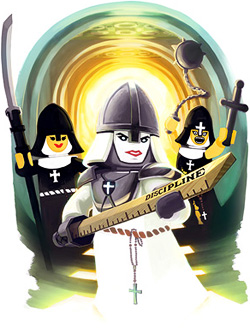
munchkinism, then you have just failed at BrikWars. Stamp a big F
on your report card, schedule a get-together between your face and
the Hammer of Discipline, and see if you can't spend a little time
afterwards with a couple of six-year-olds to remember all the things
you've forgotten about having fun.
| "The more laws and order are made prominent, the more thieves and robbers there will be." |
| - Lao Tzu |
The reason BrikWars has so many rules is that it's a lot more fun
to flout a large rules system than a small one. Hopefully you can
use these rules as a springboard for the imagination rather than as
manacles with which to enslave yourself. However, not everyone is ready to live without the safety net that such a system
provides, especially while in competition with others. So,
before going any further, here are the three most important rules in
the book.
THE RULE OF FUDGE

Fudge
everything your opponents
will let you get away with. |
| "Hell, there are no rules here - we're trying to accomplish something." |
| - Thomas Edison |
|
|
BrikWars provides pages and pages of rules to calculate
events down to the tiniest detail. If a player tries to follow all
of them to the letter, their turns will take hours, everyone will
lose interest, and no one will want to play a second time. This is
for the best. Those players should give up on construction
bricks and donate them to someone with an imagination.
Just because you can assign die rolls to every sneeze and determine
landing trajectories for every blown-off body part, doesn't mean you
should. The most probable results are very often the least ridiculous,
and why bust out the calculators just to spend more time having less
fun? Except where your opponents insist otherwise, you should resolve
the bulk of your actions with rough estimates, arbitrary decisions,
and an abundance of vague hand-waving. Given the opportunity, always
Fudge in favor of mayhem.
Don't waste time on stuff nobody cares about. Following the rules
should be an even lower priority than worrying about who's winning. Getting some
laughs during the battle and having a good story to
tell afterwards are your primary goals.
| Remember that while you're fudging everything your opponents aren't objecting to, they're trusting you to set the limits on their fudging in return. They won't know what level of rule-minding you're most comfortable with if you don't tell them. |
WHAT I SAY GOES
Players
are smarter than rulebooks. Especially the ones with the
highest dice rolls. |
| "Any commander who fails to exceed his authority is not of much use to his subordinates." |
| - Arleigh Burke |
|
|
There
will be many times when players will have a difference of opinion,
when the best course of action isn't clear, or when no one remembers
the details of a rule but they don't care enough to waste time looking
it up. “Can a zombie bite convert bears into zombie bears?”
“Can that archer really fire at the petting zoo from inside a hedge?” “Magnets, how do they work?”
If players can’t come to a quick consensus, then it’s time
for a What I Say Goes Roll. Every interested player (and, in some cases, any sufficiently opinionated bystander) states
their position. All participating players roll dice, re-rolling
ties if necessary. The player with the highest roll wins, and What
They Say Goes.
| If one player takes a position that’s an obvious
and deliberate attempt to cheat, their opponents are obligated to beat
the crap out of them. The player should then revise their position, although
you might let them get away with keeping it if the beating
was good enough. |
The first What I Say Goes Roll in many games is to decide the order
of play. The winner decides who goes first and in what order the players
will take their turns.
EVERYONE'S THE BOSS
OF THEIR OWN TOYS
Don't break other people's toys
without their blessing. |
| "You guys don't get it, do you? Once we go into Sid's house, we won't be coming out!" |
| - Woody |
|
|
BrikWars works best when the game effects are reflected in the physical objects. When a soldier gets decapitated, the minifig's head is removed and knocked aside. When a tank gets blown apart, the model is smashed to pieces and scattered across the battlefield. When land mines explode underfoot, holes are chainsawed into the dining room table surface to show where the craters are. When the doomsday nuke goes off, players set the house on fire.
Sadly, not everyone is happy to see their prized constructions, furniture, or home equity destroyed for the sake of BrikWars realism. They may doubt their ability to put their favorite models back together again after the battle, or they might worry about losing valuable elements when all the pieces get mixed up. They may be thinking ahead and wondering how they'll explain their completely justifiable arson to the insurance adjuster.
No matter how lame the excuse, Everyone's the Boss of Their Own Toys. If they don't want you breaking their stuff, don't break it. There are other ways to track damage to enemy units and structures and players besides busting pieces off of them, even if it's not as much fun.
Even more important than the physical models,
players can be very protective of their personal Kanon. If a player comes to the table with the characters and storyline that sustained him and his brother through a desperate childhood thirty years earlier, don't What I Say Goes them into a black hole for the sake of making the half-assed army you invented over your lunch break seem two percent cooler. Regardless of what happens on the battlefield, players are the bosses of their own storylines. If they don't feel that you're treating their Kanon with respect, your contributions will be vetoed.
The Farce
| The Farce |
The Farce is a mass satire created by all laughing things. Its jokes surround and penetrate the bricks, and its punchlines bind them together. With a Lite side, a Snark side, and a regrettably stupid Dim side, Farce-attuned minifigs attest that "everything is funny... from a certain point of view."
The Farce unsubtly alters reality and events to extract more chaos, mayhem, and hilarity from victors and victims alike.
The Farce ensures that characters and factions exist only as their own worst straw-man plastic caricatures, and Farce-influenced events are rarely accompanied by any more logical justification than "wouldn't it be funny if," often going to absurd lengths to avoid one. Instead, the Farce acts through the power of gratuitous and inescapable Koincidence.
Koincidences occur according to how entertaining they are, rather than respecting any normal rules of probability. No matter how unlikely or impossible, new elements of hilarity become all but inevitable if they can Koincidentally spark a fresh paroxysm of minifig-on-minifig violence, disrupt a well-laid and rational plan, or amplify the worst possible consequences of a harmless error.
|
BrikWars takes place in a rigged BrikVerse, whose fundamental laws are set up to make sure the most improbable thing that could possibly happen usually does. The ends justify the means, and if the Humans need a medieval castle and breathable atmosphere to mysteriously appear in an asteroid field in order to play out their battle of dragons versus starfighters, then that's exactly what happens. The forces of Koincidence put the castle where it needs to go, and its arrival requires no explanation, any more than does the Non-Euclidean Space Pony invasion force does when it arrives two turns later.
The Farce accomplishes this by putting the power of Koincidence into the hands of those least interested in using it responsibly. Specifically, the Humans. And more specifically, whichever Humans are most opposed to the well-being of the minifigs affected.
Enemies
| "Oceania was at war with Eurasia; therefore Oceania had always been at war with Eurasia." |
| - George Orwell |
Koincidence is a wonderful tool, but it must never be allowed to fall into the insufficiently wrong hands. When it comes time for Koincidence to affect events in battle, the power must be granted by a Human player to one of his or her Enemies, preferably to use against them.
Which players are Enemies at any given moment is usually obvious. When it isn't, proper Enmity can be determined by the following criteria:
- Not Enemies: You
Players can never be their own Enemies, no matter what their own terrible die-rolling skills seem to indicate.
- Not Enemies: Your Allies
Players cannot be Enemies with their current allies, no matter how viciously they may have battled in the past. Happily, alliances are easily canceled by a well-timed Inevitable Betrayal.
- Not Enemies: Non-Players
Without an agenda to pursue, inanimate objects and neutral bystanders have no way to ironically benefit from a player's errors, making them worthless as Enemies. Neutralized opponents and absent players are included in the Non-Players category.
- Enemies: Any Players Trying to Kill You Right At This Moment
First and foremost, a player is Enemies with any player with whom he's engaged in direct combat.
In situations where this isn't clear, two players are considered to be engaged in direct combat if either of them has attempted at least one attack on the other since the beginning of their previous turn.
- Otherwise: Enemies: Any Players That Tried to Kill You, or Your Allies, Ever
If a player is not currently directly engaged in combat, then his Enemies are any players who have engaged in combat with him or his current allies at any point in the battle.
- If all else fails: Enemies: Everybody
If neither the player nor his current allies have engaged in combat at all, then every other player is an Enemy by default.
| Note that Enemies are not necessarily reciprocal - it's possible for a player to have clear Enemies who are too busy to consider him an Enemy in return, if they're focused on more pressing combat elsewhere. |
The Ossum

| The Triple Ossum: Comedy, Tragedy, and Stupidity |
|
ossum, n.; pl. ossa
1. bone
2. the germinating seed within a nut or fruit
3. the kernel, nucleus, or heart
Latin vulgaris, from Latin os 'bone.' |
No minifig can comprehend the ineffable mind of a Human. But minifig Osseologists have learned that the more they can get their Human talking about Ossum, the more likely they are to receive the Human's continued blessings of violence and destruction.
Ossum is a symbol of death, the bone from which a minifig skeleton is made. But Ossum is also the seed that remains when the fruit is peeled away, ready to germinate and grow again.
Destruction isn't Ossum if it's meaningless or sterile. Ossum is built up of vital and deadly risks taken on the knife edge between glory and death, risks that force ever-greater escalations of Ossum in response.
Minifig scolars of Osseology calibrate their osseometers by a metric of minifig skulls. The skulls of the innocent, collected and piled into a tyrant's throne to oppress the weak and timid, are Ossa. The skull of Two-By-Two is an Ossum. Warhead's fiery skull is a pure flaming Ossum.
But in the larger sense, everything is Ossum. There is nothing in a minifig's reality that can't be used for violence. Whatever can be coveted, whatever kindles a minifig's highest virtues of jealousy or hatred or lust or rampaging mass hysteria, whatever inspires homicide or assists in its execution, all contain a seed of Ossum that can be nursed into glorious conflict.
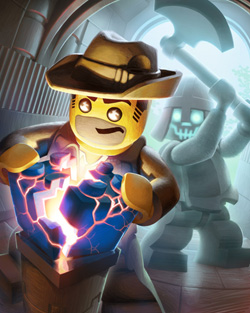
The Almighty Benny
"O Lord our Father, our young patriots, idols of our hearts, go forth to battle - be Thou near them! With them, in spirit, we also go forth from the sweet peace of our beloved firesides to smite the foe.
O Lord our God, help us to tear their soldiers to bloody shreds with our shells; help us to cover their smiling fields with the pale forms of their patriot dead; help us to drown the thunder of the guns with the shrieks of their wounded writhing in pain; help us to lay waste their humble homes with a hurricane of fire; help us to wring the hearts of their unoffending widows with unavailing grief; help us to turn them out roofless with their little children to wander unfriended the wastes of their desolated land in rags and hunger and thirst, sports of the sun flames of summer and the icy winds of winter, broken in spirit, worn with travail, imploring Thee for the refuge of the grave and denied it - for our sakes who adore Thee, Lord, blast their hopes, blight their lives, protract their bitter pilgrimage, make heavy their steps, water their way with their tears, stain the white snow with the blood of their wounded feet!
We ask it, in the spirit of love, of Him Who is the Source of Love, and Who is the ever-faithful refuge and friend of all that are sore beset and seek His aid with humble and contrite hearts. Amen." |
| - Mark Twain |
The force of Kanon ensures that Ossum within a BrikVerse compounds over time, and the Spirits of the Game act to cultivate and intensify the Ossum without regard for moderation or responsible conservation practices. They shine their favor on the Ossum more often than the sub-Ossum, and the Spirit who rewards the faithful most directly is the Almighty Benny.
For Humans, the majority of BrikWars is about humiliating their opponents and smashing their forces into small piles of plastic debris. When one of their Enemies does something Ossum that deserves a reward, on the other hand, the Almighty Benny exists to let a Human give that Enemy a brief ray of hope before heartlessly crushing them brutally underheel once again.
Any time a player's Enemy does something cool that makes the game better, the player can award them an Almighty Benny. Examples include:
- setting up an Ossum battlefield
- building Ossum models
- doing anything that causes everyone at the table to say "that was Ossum" and exchange high-fives
- doing anything Ossum that causes players at the table to laugh one or more butts off, especially when it results in Ossum self-inflicted casualties
- demonstrating extreme sportsmanship, character, enthusiasm, genius, bloodlust, hospitality, stupidity, brand loyalty, or any other attribute the player personally finds Ossum and would like to see more often
- acts involving awesome beers and/or doughnuts and the Ossum distribution of said beers and/or doughnuts
To create an Almighty Benny, a player grabs any pair of construction bricks, attaches them together, calls it an Almighty Benny, and gives it to his or her chosen Enemy, possibly giving it a name to commemorate the act that brought it about (e.g., "The Almighty Benny of Heroic Self-Decapitation.") At any moment from that point forward, the Enemy can break the two bits apart to add a one-time Almighty Bonus d6 to any standard roll or stat (but not Heroic Feats or What I Say Goes rolls).
The rules governing the Almighty Benny are as follows:
- Each Almighty Benny can be used exactly once to add a one-time Bonus d6 to any roll or stat, except when rolling for What I Say Goes or a Heroic Feat.
While each individual Benny can be used only once, if a player has multiple distinct Bennies they can spend as many of them in a single roll as they like.
- Players can only give Almighty Bennies to their Enemies, with the understanding that the Bennies will almost certainly be used against them.
Theoretically, the recipient can use an Almighty Benny against anyone at the table, but it's much more satisfying for everyone if they use it against the player who awarded it.
| Don't give an Almighty Benny to one of your Enemies with the intention that they'll use it against one of your other Enemies, because that's super lame. |
- Players cannot place any conditions on the use of an Almighty Benny. Once it's in Enemy hands, the Enemy can use it however they want.
It's nice if Benny recipients can find a way to spend their Almighty Bennies on units and actions related to whatever the Bennies were awarded for in the first place, but they can really use it for whatever they want (excluding Feats and What I Say Goes rolls, of course).
Instant Bennies
There's a Temporarily Mighty type of Benny which grants the same Almighty Bonus d6, but can't be saved for later. An Instant Benny represents a momentary advantage for the army that possesses it. An Instant Benny can be granted at any time, but if it isn't spent, it disappears at the end of the recipient's turn and the opportunity is lost.
| Instant Bennies can't be saved from turn to turn, so there's no point in trying to earn one if you're not in a position to spend it immediately. |
Unlike regular Almighty Bennies, Instant Bennies can be awarded automatically when certain conditions are met, and their use is subject to restrictions.
There are five situations in which Instant Bennies are traditionally awarded automatically: First Blood, Inevitable Betrayal, Deadly Ground, Last Man Standing, and King of the Hill. Groups of players are encouraged to add or subtract conditions from this list to support their scenario requirements or preferred playing style.
- The Instant Benny of First Blood is awarded to the first player to kill a minifig belonging to an Enemy.
- Instant Bennies of Inevitable Betrayal reward players who betray their allies.

Once the First Blood Benny has been handed out, all players acting in cooperation with one another, whether having agreed to simple non-aggression or committed to a full-blown military alliance, are vulnerable to the sting of Inevitable Betrayal.
For each alliance a player is involved in, they keep a pile of Betrayal bricks. (If players are in more than one alliance, they will have more than one Betrayal pile, preferably color-coded so that everyone can tell which is which.)
At the beginning of each of their turns, players with surviving allies must decide whether or not it's time to Betray them yet. If they decide to remain faithful to their allies for that turn, then they add a Betrayal brick to their own pile, and play continues as normal.
If they do decide to Betray their allies, then all their Betrayal bricks for that alliance turn into Instant Bennies that they can spend against their former allies. The more Betrayal bricks they have, the more tempting the Inevitable Betrayal becomes, so players should always keep one eye on their supposed "friends!"
Once a player has Betrayed an alliance, they are no longer part of it and can't be Betrayed in return. If they somehow rejoin the same alliance later in the battle, they must restart their own Betrayal pile for that alliance from scratch, while the previous allies' piles continue at full strength.
- The Instant Benny of Deadly Ground is awarded to any army that has at least one unit in Enemy territory. Each army can earn this Benny once per turn, and multiple opposing armies can be earning these Bennies at the same time.
In most battlefields, a unit is in Enemy territory if it's closer to that Enemy's starting position than it is to its own. The boundary can be easily marked by placing monuments or landmarks at the halfway points between players.
| Players can move the boundary closer or further away if one army is much larger than another. An army that's twice as large at the beginning of a battle can be considered to control twice as much territory. |
In scenario battles, territory is defined in more concrete terms - in a siege, for instance, the territory inside the defensive wall belongs to the defenders, while territory outside belongs to the besiegers.
Only the units that are in Enemy territory can use Instant Bennies of Deadly Ground, and they can only use them against the Enemy whose territory they're in.
- In scenario battles, Instant Bennies of King of the Hill are awarded to armies who achieve the scenario's special identified objectives.
The most common objectives are to seize and hold particular critical locations or pieces of equipment, often involving flags and the capture thereof. Once per turn, each held objective grants a King of the Hill Benny that can be used by the player with uncontested control over it.
- The Instant Benny of Last Man Standing is awarded to any player who only has one minifig or other unit left alive at the beginning of a turn. The minifig can continue to get a new Last Man Standing Benny at the beginning of each subsequent turn until he either dies or receives reinforcements.
|
|