|
|
RV.2
Propulsion Systems
|
For a Robotic Vehicle to move around, it will need at least
one propulsion system. A robot can only use one propulsion
system at a time, but it may have multiple propulsion systems
for adaptability or in case on is damaged or destroyed.
A propulsion system may have a higher or lower Power rating
than the robot's torso; the robot's Move will be determined
by the lower of the two Power ratings.
Each
propulsion system has a 'Max Move' rating, which varies according
to TekLevel. A propulsion system may have a Movement
rating much higher than its Max Move rating; this is perfectly
all right. The original Movement rating is used to determine
maximum acceleration and deceleration, and all Movement Penalties
are subtracted from the original Movement rating. However,
during play, the vehicle cannot travel further than its Max
Move in a single turn, regardless of how high its Movement
rating is.
RV.2.1 Standard
Propulsion
Each
propulsion system on a robot must be well-represented by at
least one PBB (wheels, propellers, jets, etc.). Different
types of propulsion systems cost different amounts, and vary
in performance.
|
| Ground
Propulsion |
| Cost |
(Power/4)
CP |
| Cargo
Capacity |
Power"
|
| Max
Accel/Decel |
1/2
Move
|
| Class#/Turnrate |
Armor/5
(min 1)
|
| Max
Move |
TL
x 4"
|
Ground
propulsion is most often represented by tires and wheels, but
can also include things like runners and skis. Larger
tires can overcome larger obstacles - for every two full Brix
of tire height, add 1 CP to the cost of the Ground propulsion
system. (Use the height of the largest tire - you don't
have to buy the height of each tire separately.) |
| Treaded
Propulsion |
| Cost |
(Power/2)
CP |
| Cargo
Capacity |
Power
x 1.5"
|
| Max
Accel/Decel |
1/3
Move
|
| Class#/Turnrate |
Armor/5
(min 1),
turns in place
|
| Max
Move |
TL
x 3"
|
Treaded
propulsion is any type of ground propulsion that allows a vehicle
to turn in place, such as treads, repulsor lifts, hovercraft
propellors, or robotic legs. If you have built a treaded
vehicle but don't have any tread PBBs, you can arrange long
rows of tires on the model and pretend that they have treads
on them. A robot that walks around on legs can also be
treated as a treaded vehicle, as long as the robot uses the
legs for walking only. If you want to use your robot's
legs for jumping, kicking, dancing, picking things up, etc.,
you will have to buy them as Limbs.
Larger
treads can overcome larger obstacles. For every two
full Brix in the height of the treads, add 1CP to the cost
of the Treaded propulsion system.
|
| Boat
/ Train Propulsion |
| Cost |
(Power/2)
CP |
| Cargo
Capacity |
Power
x 2"
|
| Max
Accel/Decel |
1/4
Move
|
| Class#/Turnrate |
Armor-8
(min 4),
rowed boats turn in place
|
| Max
Move |
TL
x 3"
|
Boat
propulsion can be represented by sails and masts, by an outboard
motor, by a sternwheel, or by an underwater propellor drive.
Train propulsion is represented by wheels or maglev bars on
the TrainTrax.
If
you are building a rowed boat, you can man the oars with galley
slaves. Galley slaves do not take any independent action
except to abandon ship when it catches on fire, and then only
if somebody forgot to chain them to the oars. Each galley
slave costs 1CP and provides one point of Power. A boat
rowed by minifigs, even the largest quadrireme, can turn in
place.
|
| Submarine
Propulsion |
| Cost |
(Power/2)
CP |
| Cargo
Capacity |
Power"
|
| Max
Accel/Decel |
1/4
Move
|
| Class#/Turnrate |
Armor-8
(min 4)
|
| Max
Move |
TL
x 3",
1 Story of depth
|
Submarine
propulsion is represented by underwater propellors or jets.
|
| Flyer
Propulsion |
| Cost |
(2
x Power)+3 CP |
| Cargo
Capacity |
1/2
Power"
|
| Max
Accel/Decel |
1/2
Move
|
| Class#/Turnrate |
Armor/4
(min 1)
|
| Max
Move |
TL
x 6"
|
Flyer
propulsion can be represented by propellers, jets, or rocket
thrusters.
|
| Hover
Propulsion |
| Cost |
(2
x Power) + 10 CP |
| Cargo
Capacity |
1/2
Power"
|
| Max
Accel/Decel |
1/2
Move
|
| Class#/Turnrate |
(Armor/4)
(min 1)
|
| Max
Move |
TL
x 5"
|
Hover
propulsion is any type of Flyer propulsion that allows a vehicle
to hover or turn in place. Hover propulsion can be represented
by propellers, jets, or rocket thrusters.
|
|
RV.2.2 Alternate
Propulsion
There
are many possible alternate propulsion systems - tunneling
underground, hyperspatial teleportation, inchworm gyrations,
transmogrification through tight spaces, and so forth.
For most of these, you're going to have to figure out the
point costs and statistics on your own; you can't expect us
to cover every little detail. However, two alternate
systems of propulsion come up often enough that they merit
special attention.
JumpJets
The first is the use of JumpJets (or 'Boosters' or 'Afterburners')
- thrusters that, while not always powerful enough to act
as a primary propulsion system for a robot or vehicle, are
useful to maneuver during a jump or to act as a secondary
propulsion unit in support of other primary propulsion units.
JumpJets cost 2CP per point of Power, and can never draw more
Power than half the primary engine's Power rating.
JumpJets
work differently from normal propulsion systems in that rather
than having Movement ratings and TurnRates and so on, a JumpJet
provides straight linear acceleration, and only in the direction
it is pointing. One unit of Power equals five Blok-inches
of acceleration, so the amount of acceleration a JumpJet can
provide in a single turn is five times the JumpJets' Power,
divided by the Mass of the vehicle. This acceleration
vector is added to the vehicle's current velocity, and may
allow the vehicle to exceed the Maximum Movement rating for
its TekLevel by up to fifty percent.
JumpJet
Linear Acceleration: (5 x JumpJet Power / Vehicle
Mass)"
If
JumpJets are used to slow a vehicle's fall, remember that
they have to fight the downward acceleration of gravity (4"
per turn, per round, straight down).
Limbs
Limbs are such an important part of robotic tomfoolery that
they get a chapter section all to themselves (see
RV.3: Robotic Limbs) - here we
will just discuss the use of limbs as a propulsion system.
If
the vehicle's legs are rudimentary, designed for nothing more
than staggering around, then just treat them as if they were
a Treaded propulsion system. If the vehicle's legs are
well-articulated, designed not just for walking but for running,
climbing, jumping about, and busting Robotic moves with Robo-Kung-Fu
action, then they count as proper Limbs and must be purchased
as such. (Their CP cost is discussed in the next section.)
| Limb
Propulsion |
| Cargo
Capacity |
Power"
|
| Max
Accel/Decel |
1/2
Move
|
| Class#/Turnrate |
Armor/5
(min 1),
turns in place
|
| Max
Move |
TL
x 4"
|
Movement
is determined as normal, based on the Power of the weakest
Limb. A robot can only support itself on limbs that
have enough Power to support the robot's weight (minimum Power
of at least half the robot's Mass in Blox). A Robot
can only stand, walk, run, jump, or shove itself about with
Limbs that end in Feet. If the robot loses one or more
Feet, then its Movement is halved. A robot can only
climb, swing, or drag itself around with Limbs that end in
Hands, and only if it can find (or make) decent handholds.
A
Robot with fully operational legs can step onto or over an
obstacle up to half the height of its legs (at 1/2 speed),
or jump onto or over an obstacle the full height of its legs
(at 1/4 speed). It may also make a Big Jump, launching
itself into the air with a maximum initial velocity of ((5
x Power)/Mass)", and it can absorb that much velocity
on landing with no damage (as long as it lands on its Feet).
When on a Big Jump, the robot will be in the air for a number
of turns. On the first turn following the Big Jump,
the robot will continue rising into the air at the same speed
at which he launched himself on the previous turn, minus 4"
of downward acceleration from gravity. The robot will
continue to feel a downward acceleration vector of 4"
every turn, which will eventually reverse the robots course
and return it to the ground. While in the air, the robot
cannot turn or modify its trajectory without the use of JumpJets.
A
robot with enough limbs to hold itself up without allowing
its torso to drag on the ground moves at full speed.
However, if a robot is unable to hold itself up, whether due
to damage sustained in battle or due to inexcusably poor Limb
design, it may find itself struggling to get around.
If the robot is dragging its torso or a rigid paralyzed Limb
along the ground using two or more functional Limbs, it moves
at half speed; if it is dragging itself using only one Limb,
it moves at one quarter speed. If one of a robot's legs
is paralyzed and rigid, it may prevent the robot from moving
entirely and have to be jettisoned (robots can automatically
jettison Limbs). If the leg is limp and dragging in
the dirt, but the robot has enough other legs to keep walking
around, each limp leg incurs a -2" Movement Penalty.
If a Robot has been reduced to a single leg but is still able
to support itself, then it hops around at one quarter speed
and must make a Piloting Skill Roll with a UR of 4 at the
beginning of every turn to avoid falling over.
If
a robot that walks upright fails any Piloting Skill Roll,
it falls over. It takes damage from a Collision with
the ground (see 3.6.5: Collisions) at whatever speed the Robot
was traveling when it fell. If a robot has enough Limbs
that it is able to get back up again, then getting up takes
one half turn.
|
RV.3
Robotic Limbs
|
Robotic Limbs come in all shapes and sizes - from the normal
forms of arms and legs to more unusual things like wings,
tails, and tentacles. Depending on the tools and objects
mounted on the limbs, the uses of most limbs fall into four
basic categories: manipulators, propulsion, weapons platforms,
and striking implements.
RV.3.1 Buying
a Limb
A limb's initial cost is determined by three factors:
the limb's flexibility, length, and Power.
 |
Flexibility:
1 CP for one axis of rotation; 2 CP for multiple axes
A rigid limb with freedom to move on one axis of rotation
has a base cost of 1 CP. A flexible limb, or one
with freedom to rotate on more than one axis, has a base
cost of 2 CP. A rigid limb that has no freedom of
rotation on any axis is a pretty sad excuse for a limb. |
|
Length:
1 CP per 5 dots of length or 4 Brix of height
A limb built horizontally costs 1 CP per 5 dots of
length. A limb built vertically costs 1 CP per 4
Brix of height. Weapons and tools may only be mounted
on limbs that are at least three-fourths the length of
the weapon or tool. |
|
Power:
1 CP per point of Power
A limb costs 1 CP for every point in its Power rating.
A limb cannot have a higher Power rating than the torso
of the robot it is mounted on. Weapons and tools
mounted on or held by a limb cannot be activated if their
Power requirement is more than the limb can supply. |
RV.3.2 Arming
a Limb
Weapons and tools are mounted on Limbs at the same
CP cost as if the weapon or tool were bought and mounted on
a regular vehicle. A weapon cannot be mounted on a Limb
if the weapon requires more Power than the Limb can supply.
The Robot's main Torso must be at least three-fourths the
length of any weapon mounted on a Limb, regardless of whether
the Limb is much longer or much shorter than the Torso.
A
couple of tools are Limb-specific:
|
Feet:
1 CP per Foot
If you would like to use a Limb to walk, run, jump,
or kick with, you must buy a Foot for the Limb.
A Foot costs 1 CP, and has the same Power rating as the
limb it is mounted on. A Foot incurs no Movement
Penalty. |
|
Hands:
1 CP per point of Power
Any tool mounted on a Limb to be used as a manipulator
(a mechanical hand, a claw, a multi-tool, a robo-surgery
kit, etc.) is considered to be a Hand. A Hand costs
1 CP for every point in its Power rating. The Power of
a hand will determine its ability to lift, carry, and
throw objects around, or crush them like walnuts.
A Robot can use its Hands to climb around or swing from
ropes and overhead objects. A Robot cannot walk
on its Hands unless those Hands are also Feet, which costs
1 extra CP. Due to the complex control mechanisms,
a Hand incurs a -1" Movement Penalty. |
|
Structural
Reinforcement: 1 CP per 2 points of Armor
Any Limb can be used to strike targets, but when
it hits a target, it does as much damage to itself as
it does to the target. If you plan on smashing a
Limb into things on a regular basis, or using a Limb to
parry or block attacks, you're going to want to toughen
it up a bit. Armor can be added to a Limb at a cost
of 1 CP per 2 points of Armor. Additional Limb armor
is added through a special process called BludgeonPlating,
which does not add to the Mass of the Robot or slow it
down in any way. The additional armor does not apply
to weapons or tools mounted on the Limb, but it does apply
to Hands and Feet. |
Whenever your Robot attacks a target with its Hands or Feet,
whether punching, kicking, squeezing, stomping, crushing,
or slapping the target, it does 1d6 Damage, times the Power
of the Hand or Foot.
|
RV.4
Control Systems
|
A Robotic Vehicle automatically comes with one manual control
unit that one minifig can use to control every weapon, tool,
and propulsion system on the robot. This control unit
must be represented by one or more PBBs (usually a computer
console, steering wheel, or lever). Additional control
systems for copilots or gunners may be bought for a cost of
as many CPs as are in the robot's Class number. If a
Robot has more than one propulsion system, it may have more
than one Class number. If so, then the additional control
system costs as much as the sum of the Class numbers of all
the propulsion systems it controls. A control system
does not have to include controls for every propulsion system
on the robot, but it must include controls for at least one
propulsion system.
If
you want a minifig to act solely as a gunner, you do not need
to buy a separate control system for him, as long as he is
within reach of the weapon he wishes to fire. All mounted
weapons include manual controls, and can be fired by any minifig
who has access to them.
RV.4.1 Robot
Brains
Robots do not need human Pilots for every function
or even any function. Any number of artificially semi-intelligent
RoboBrains can be used instead. RoboBrains can be used
as gunners to supplement a minifig Pilot, or a RoboBrain can
be used to replace the Pilot entirely. RoboBrains can
also be installed in bases, to control any base device that
can be remotely controlled. If a RoboBrain has the ability
to fire weapons, it may only focus on one target in a given
turn. However, it may fire as many weapons as it likes
at that target.
If
a RoboBrain controls propulsion systems as well as guns, then
it costs as many CPs as the sum of the Class numbers of all
the propulsion systems it controls, plus 3 points per 1d6
Skill. Otherwise, the RoboBrain just costs 3 points
per 1d6 Skill. A RoboBrain is represented by any computer
console PBB with lights, switches, or antennas on top, and
must somehow be accessible for minifigs to fiddle with it.
Any minifig that gains access to a RoboBrain console, friendly
or otherwise, can override or deactivate the RoboBrain and
use the console as a normal control system. If a given
propulsion system or weapon is under the control of more than
one RoboBrain or control system, then an enemy has to gain
control of or deactivate all the RoboBrains and controls in
order to gain control of that propulsion system or weapon.
| Maximum RoboBrain
Skill by TekLevel |
| TL |
Max.
Skill |
TL3
or
lower |
(none)
|
| TL4 |
1d6
|
| TL5 |
2d6
|
| TL6 |
3d6
|
| TL7 |
no
limit
|
Unfortunately,
a RoboBrain is not as flexible as a regular minifig brain.
It must be given a basic program, which it follows extremely
literally. The program may be any length, but the specifics
should be written down somewhere. There are no 'secret'
programs - a RoboBrain's program is known to all players,
since RoboBrains constantly repeat their current instruction
set out loud.
Any
friendly unit may give a verbal instruction to any RoboBrain
within 5". The RoboBrain will carry out that instruction
to the best of its ability, and then return to its original
programming. If it is an instruction with no specific
time limit, the RoboBrain will continue carrying out that instruction
until instructed to stop. A RoboBrain can only remember
one verbal instruction at a time.
If
a minifig wants to change a RoboBrain's core program, it must
use a RoboHack Tool, which looks like a radio with lights
or switches on it, and costs 5 CP. To use a RoboHack
Tool, a minifig must have uninterrupted access to the RoboBrain
itself for a full turn. In that turn, the minifig may
erase one or more instructions, or he may add one instruction.
If the RoboBrain's entire program is erased, then the minifig
can spend one turn to change the RoboBrain's loyalties to
any team or teams he chooses.
|
RV.5
Transforming Robots
|
For many PBB maniacs, the highest expression of PBB skill
is in the construction of robots that actually transform into
vehicles, and look good while doing it. If you want
to have transforming robots in your battle, then congratulations!
You're an inspiration to us all.
Transforming
robots have no extra CP cost or special abilities - they behave
just like normal robots in BrikWars except that they are much,
much cooler and far more likely to impress enemy players.
No matter how complex the transformation, the act of transformation
never incurs more than a -1" Movement Penalty, if any.
Just like in any good robot cartoon, all other battlefield
action stops while transformation or dialogue is in progress.
|
|
|
|
Templar
Propulsion
Templars employ 'simple' leg propulsion, meaning
that their legs allow simple walking but not advanced moves like
cartwheels or kicking. This is bought as Treaded propulsion.
With
a Power rating of 4, Treaded propulsion costs 2CP, plus 2 additional
CP for the legs' height of four Brix, increasing the cost of the
Templar to 7 CP.
The
Templar's Movement Rate (calculated above) is 26", but this
is higher than the Treaded propulsion's Max Move of 20" (TL5
x 4"), so the Templar is able to move a maximum of 20"
per turn.
|
|


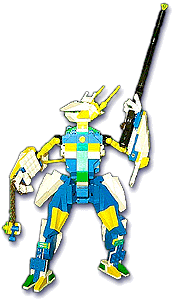 One
of the largest and most successful Galactic Empires of the
later sixteenth millenium G.S. was that of the Rho Botek Civilization.
The exact details of their discoveries are unknown, but it
is generally believed that the Botex stumbled across the ancient
ruins of lost offshoots of the Teknik Giants' civilization
sometime during the Botek Civil War in the early decades of
the 15400's. The Rho faction's early advances in investigating
the ancient technology soon gave them a decisive advantage
over their rival factions Sigma and Tau. By the end
of the century the Rho Botex had fully assimilated the ancient
Teknix' advanced CombatMek technology and begun full-scale
production of weapons platforms the likes of which the galaxy
had never seen - giant battle robots of such immense subtlety,
variety, and power that the Botex were able to quickly overwhelm
all opposition in their area of space.
One
of the largest and most successful Galactic Empires of the
later sixteenth millenium G.S. was that of the Rho Botek Civilization.
The exact details of their discoveries are unknown, but it
is generally believed that the Botex stumbled across the ancient
ruins of lost offshoots of the Teknik Giants' civilization
sometime during the Botek Civil War in the early decades of
the 15400's. The Rho faction's early advances in investigating
the ancient technology soon gave them a decisive advantage
over their rival factions Sigma and Tau. By the end
of the century the Rho Botex had fully assimilated the ancient
Teknix' advanced CombatMek technology and begun full-scale
production of weapons platforms the likes of which the galaxy
had never seen - giant battle robots of such immense subtlety,
variety, and power that the Botex were able to quickly overwhelm
all opposition in their area of space.