 |















|
|
|
|
|
Chapter One Gameplay  Unsophisticated players might think that the Letter of the Rules is more important than the Spirit, but the Letter is a lot less likely to sneak up behind you with an axe if you abuse it.
Owned illustration Uploaded, final

Almighty Benny and Major Natalya settle their BrikWars differences over a high-stakes game of Nano-BrikWars, proving themselves to be deadly metagamers.
Elements shown: LEGO, Nanoblock, die
own photo Uploaded, final
Little is known about Humans, but this much is fact: young or old, rich or poor, all Humans harbor secret toy armies and dreams of conquest. Anyone failing this requirement is either not a real Human or has forgotten how to be one. BrikWars provides a safe and comfortable setting for construction toy armies to mutilate and slaughter one another for the entertainment of their Humans. Unlike less serious wargames, BrikWars is about combat between the toys themselves. Players take turns moving toy troops and toy vehicles through toy terrain to attack one another with toy weapons and die horrifying toy deaths. The conflicts can be large or small, balanced or skewed, orderly or chaotic, as long as they deliver the mindless violence on which minifigs' psychological health and happiness depend. 
own photo Uploaded, final
Bricks Bricks are the fundamental physical material making up the worlds of BrikWars. An individual brick is called a component: the smallest physical piece of an object that can't be disassembled any further, like a brick in a wall, the head of a minifig, or the entire body of a horse. Most objects in BrikWars are built from plastic construction bricks, but non-construction toys and other components are included as well; minifigs can't tell the difference. It's good to have a supply of spare bricks close at hand. Players can whip up a costume change for their Hero, craters and debris from explosions, support stands to hold unexpectedly airborne minifigs aloft between turns, and any other objects that might appear as the result of events spinning completely out of control. Extra blood and fire elements become increasingly useful as a battle drags on. 
own photo Uploaded, final
Minifigs Minifigs and their violent passions are the heart and soul of a BrikWars battle. The minifig is the basic example of a unit: an active combatant within the game with the ability to engage in independent Movement and Action. 
own photo Uploaded, final
Dice Dice are spirits of chaos that power all meaningful events in BrikWars, bound in plastic and geometrically determined to thwart their Humans' plans. The minifigs' ability to take Action and do Damage is determined by the Action dice that animate them and the Damage dice they control. The more dice, the better. Players can pass communal dice back and forth, but play goes much more smoothly if each player has their own set of dice to roll, preferably in their own color. 
own illustration Uploaded, final
Gratuitous Violence Gratuitous violence is both the means and the justification for all minifig behavior. Every minifig activity from peace negotiations to gardening to basic dental hygeine has gratuitous violence as its end result.  Besides being easier to assemble and play on, quick terrain built with boxes and colored felt feels more natural and realistic to a minifig than the over-precious model landscapes of other wargames.
Photo: Bálint Kapos
from the BrikWars Facebook group image quality too low. recreate
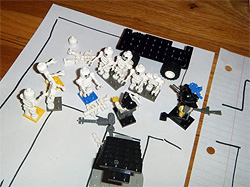 Olothontor and Kidko find themselves in a zombie-infested museum. Very quick games can be thrown together by scribbling out maps onto sheets of paper.
Photo: Kidko
from "Zombie Survival" what even happened to kidko? recreate
Players prepare for BrikWars by assembling armies, fortifications, and scenery as dictated by the imagination and toy collections of the Humans involved. Plastic brick construction is best, allowing forces and landscaping to be modified on the fly to reflect damage, equipment changes, and dramatic posturing, but armies of stuffed animals and action figures can march through book-stack mountains and shoebox buildings using the same rules. A typical BrikWars battle has two to four players with a dozen units each, fighting over a tabletop-sized battlefield (either a literal tabletop, or a tabletop-sized area of the floor), lasting two or three hours or until players decide it's time to stop. Battles can of course be much larger or smaller, from single-combat duels between lone Heroes in tight arenas, to quick-paced skirmishes between several dozen small teams all seeking to steal the same prize keg of Maniac Beer, to epic multi-faction zombie invasion campaigns run online with thousands of minifigs and taking months to complete.
Once the battlefield and armies are assembled, players assign a turn order and starting locations by any combination of scenario requirements, mutual agreement, and dice-rolling, and then combat can begin. If one player designed the battlefield, it’s customary to allow the other players to have first pick of starting locations.
One at a time, each player takes a turn, conducting Movement and Action for each of the active units under their control. When they've completed maneuvers for all of their units, the next player's turn begins. When all surviving players have taken their turns, the cycle begins again with the first player. While it's easiest to pick a turn order and stick with it, players can mix the sequence up as they see fit. Some players like to roll dice to randomize the order of each cycle of turns, or to let the current smallest army decide the turn order each round.
When players are allied, or their forces are too far apart to interact, it can save time to run multiple players' turns simultaneously until they're in position to start killing each other like civilized minifigs.

own illustration Uploaded, final
It's not especially important for any one player or team to "win" a battle. Dying horribly in some ridiculous fashion is always funnier than surviving horribly in some ridiculous fashion, and BrikWars is set up to favor the optimum result of the complete destruction of all participants, bystanders, and scenery. Final victory goes to forces of nature or deadly catastrophes as often as to any of the players. Fire, explosive decompression, and "I told you to put your toys away twenty minutes ago" have winning records that no Human strategist can hope to match. The classic BrikWars conclusion is for the entire battlefield to be destroyed in a cataclysmic fireball. This is considered a victory for all sides.
 General Yadlin briefs Nyphilian cabinet members on the success of PandoraNuker's objectives in Project Orion, despite his having later become the hated war criminal FedoraNuker.
remove or replace
 Regardless of the "official" mission objectives, reducing a pristine battlefield to complete chaos is a clear victory for everyone.
image rights: Warhead, signed 12/24 Uploaded, final

Minifigs are notoriously poor at sharing. There's nothing in the world they won't use as justification for mutual homicide.
own illustration Uploaded, final
The simplest battles have no larger goal. Minifigs holding weapons don't need an excuse to run around whacking each other with them. When the dust settles on the piles of and dismembered limbs, success is measured solely on whether this battle was crazier than the battle before, and by how much. In (marginally) more serious games, minifigs fight for a higher objective — stealing the enemy's secret taco recipe, assassinating a meddling peace delegation, or heaping the largest pile of skulls for the glory of the Stud God. Objectives work best when they're aggressive and specific, driving minifigs away from safety and into direct confrontation. Specific targets to destroy, murder, or steal make for exciting battles. Passive goals like defense or escape should be treated with disgust if they're tolerated at all. "Survival" is never a worthwhile objective. Any minifigs saddled withsuch a repugnant goal should ignore their Humans' orders and kill themselves immediately in protest.
Units in BrikWars are defined by their physical construction and positioning. Players don't need to refer to pages of charts and graphs to see if a minifig's shopping cart has been returned correctly, if the minifig policeman is holding a chainsaw, or if the cable news channel's cameras are pointed the right direction to record fair and balanced video of parking lot justice being served. The plastic figures speak for themselves. Some attributes aren't obvious from the physical models. In-game abilities like a shopper's running speed, a policeman's lumberjacking skill, and a chainsaw's effectiveness versus escaping minivans are represented by numbers and die rolls. BrikWars' moment-to-moment chaos is built up from orderly numerical comparisons.  The blessed RulerBokken exacts disciplined measurement in the hands of White Nun and the Purification Sisters of Saint Attila.
Wiki: White Nun
Own illustration Uploaded, final
In BrikWars, movement and weapon ranges are measured in inches. If players are opposed to inches, they can use any alternate system of measurement that seems reasonable. An inch is about three centimeters, the length of three construction studs, or the height of three construction bricks. It's not important whether the conversion is exact, as long as everyone's using the same system. 
The length of a sixteen-stud brick is exactly five inches, a standard measurement distance for movement and ranged attacks.
own photo Uploaded, final
 An assortment of
The result of this unusually lucky roll is 0 + 6 + 6 + 6 + 6 + 6 + 6 + 10 + 10 + 10 + 10 + 10, or 86, ignoring the possibility of Bonus Dice. Whether or not a roll of 0 on a Elements shown: dice
own photo Uploaded, final
Dice are the animating power that allows inert toys to rise up and take violent action against each other. A minifig without dice is a smiling lump of plastic. A minifig with dice is a smiling lump of plastic who can run, play, drive, operate heavy machinery, plant explosives, and use farm animals as projectile weapons. BrikWars uses die rolls to reflect the unpredictability of minifig efforts. If a minifig fires a pistol at an opponent, sometimes he'll hit, sometimes he'll miss, and sometimes he'll "accidentally" shoot his own commanding officer. If the bullet strikes a target, sometimes it will do enough damage to kill, sometimes it won't, and sometimes it just makes the minifig's superior officer very, very angry. Die rolls determine the outcome of actions whose effects aren't guaranteed.
For the Core Rules, dice come in two flavors: the d6
(
Die rolls are described according to the number of each type of dice involved, plus or minus a modifier number (if any). A roll of
4 No matter how negative a modifier may be, the lowest possible result for any die roll is zero. A roll of 1 Rolling dice in BrikWars is never a sure thing. No matter how easy or difficult the task, as long as at least one die is rolled, there's always a chance to defy the odds through Critical Failure or Critical Success. 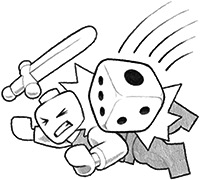 Critical Failure If all the dice in a roll come up "1," then the roll is a Critical Failure, regardless of other pluses and minuses. Whatever task a player or unit was attempting fails completely, no matter how easy it might have been. Many player groups use Critical Failures as opportunities for slapstick. Their Critically Failing minifig might have to choose between breaking his weapon, slipping and falling on his face, or accidentally slaughtering his friends and loved ones. For further ideas, see Something Bad in 5.1: Making Attacks.
own drawing Uploaded, final
Critical Success When rolling any number of dice, for each die that comes up on its highest-numbered face (a six on a A player may elect not to roll a Bonus Die that they earned, for whatever reason. Action Rolls, introduced in 4.2: Action, earn an even crazier version of Critical Success called Over the Top Action.
1.3 Proper Observance of Rules 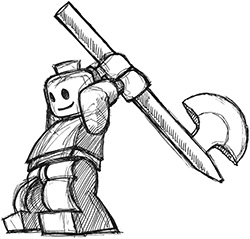 The right answer is the wrong answer if it takes more than thirty seconds to look it up. When checking a rule isn't worth the effort, it's better to axe a stupid question.
own illustration Uploaded, final
Rules are for the small-minded and weak. Let some first-graders loose with a collection of bricks and watch the way they play. All the drama, death, and explosions anyone could want, and they won't have to crack open a rulebook even once. How is it that they're so much smarter than adults? The answer is that adults have been subjected to many more years of forced schooling than the kids have. Wait until the kids turn eighteen; they'll have become just as slack-jawed and dull-eyed as any other Human. BrikWars has a lot of rules. Players who've felt the sting of the compulsory education system will respect these rules, because the rules are written down in a book and some of them are even capitalized. For players whose lives went so badly that they attended college as well, there's a risk that they'll not only shackle themselves to these rules, but will then twist them to their own ends, weaseling out loopholes and exploits to cleverly frustrate the other players and ingeniously prevent fun for the entire group. Players engaging in rules-lawyering and munchkinism have missed the point of BrikWars. If possible, they should schedule some time with actual children and try to remember all the things they've forgotten about having fun. The reason BrikWars has so many rules is that it's a lot more fun to flout a large rules system than a small one. Rules should be treated as a springboard for imagination rather than as a leash for self-enslavement. But not everyone is ready to live without the safety net that a rules system provides, so before going any further, here are the three most important rules in the game.  Inspired by divine fudge, these formerly dreary and law-abiding citizens have turned to a fulfilling life of crime. The power of fudge overrides all laws.
Elements shown: LEGO, fudge own photo Uploaded, final
The Rule of Fudge

Fudge everything your opponents will let you get away with. If left unchecked, rules-obsessed players can track events down to the tiniest detail. Turns take hours, everyone loses interest, and no one wants to play a second time. This is for the best. Those players should give up on construction bricks and donate them to someone with an imagination. Just because players can assign die rolls to every sneeze and trace the trajectory of every blown-off body part doesn't mean they should. The most probable results are very often the least ridiculous, and why bust out calculators just to spend more time having less fun? Except when opponents insist otherwise, the bulk of the action should be resolved by rough estimate, arbitrary fiat, and a generous supply of hand-waving. Given the opportunity, players should always fudge in favor of mayhem. Don't waste time on stuff nobody cares about. Following the rules should be an even lower priority than worrying about who's winning. Getting some laughs during the battle and having a good story to tell afterwards are the primary goals. Remember that while you're fudging everything your opponents aren't objecting to, they're trusting you to set the limits on their fudging in return. They won't know what degree of rule-minding you're most comfortable with if you don't tell them.
WHAT I SAY GOES
Players are smarter than rulebooks. Especially the ones with the highest dice rolls.
There are times when players disagree, when the best course of action isn't clear, or when no one remembers a rule but it's not worth wasting time to look it up. Can zombie bites convert bears into zombie bears? Can archers fire longbows from inside a garden hedge? Magnets, how do they work? If there isn't a quick consensus, then it's time for a What I Say Goes Roll. Every interested player (along with any sufficiently opinionated bystander) states their position. All participants roll dice, re-rolling ties if necessary. The player with the highest roll wins, and What They Say Goes. Everyone's the Boss of Their Own Toys Everyone's The Boss Of Their Own Toys
Don't break people's stuff without their blessing.
BrikWars works best when game effects are reflected in the physical objects. When a minifig gets decapitated, the head is removed and knocked aside. When a tank gets blown apart, the model is smashed to pieces and scattered across the battlefield. When land mines explode underfoot, holes are chainsawed into the table surface to show where the craters are. When the doomsday nuke goes off, players set their house on fire. Surprisingly, not everyone is happy to see their prized constructions, furniture, or home equity destroyed for the sake of BrikWars realism. They may doubt their ability to put their favorite models back together again after the battle, or they might worry about losing valuable elements when all the pieces get mixed up. They may be thinking ahead to the tedious job of explaining completely justifiable arson to an insurance adjuster. No matter how poor the excuse, Everyone's the Boss of Their Own Toys. If a player or other concerned bystander doesn't want their stuff broken, don't break it. There are other ways to track damage to enemy units and structures and players besides busting pieces off of them, even if it's not as much fun. If you don't know whether someone is excited about the idea of you breaking their stuff, ask. Even more important than their physical models, players can be very protective of their characters and storyline. Players should resist the urge to What I Say Goes an opponent's twenty-year epic with a cast of thousands into a black hole for the sake of making their own half-assed army they invented over a lunch break seem two percent cooler. Regardless of what happens on the battlefield, players are the bosses of their own storylines. If they don't feel that other players are treating their Kanon with respect, their plot twists will be vetoed.  When constructing BrikThulhu, it's important to keep a supply of flowers close at hand for the sake of omitting them.
Elements shown: LEGO, Mega Bloks Own photo Uploaded, final
| |||||||||||||||||||||||||||||||||||||
|
|
|


 es
es s
s .
. in controversial Six Ed classes, while rumors of more exotic dice are spread in salacious whispers behind closed doors. Religious and moral leaders forbid the use of four-letter obscenities like "dice" and "roll," making them incredibly popular in insults, comments sections, and basic minifig dialogue.


 Yellow: Action
 Green: Movement and Range
 Red: Damage
 Blue: Armor and defenses