Chapter Ten: Creatures
Not
all Creations are designed for active roles. Objects like trees, warehouses,
and bridges perform their duties perfectly well by just sitting there
and not wandering off at critical moments. If a Creation is intended
for more proactive tasks, such as moving around, carrying loads, or vaporizing
civilians, it needs either a mind of its own, or
an intelligent operator at the controls.
The difference between a Creature and a Vehicle is that Creatures are capable of independent thought and action, whether their brain is
composed of meat, circuitry, or magic. A mech piloted by a minifig is a robotic Vehicle; a mech operating independently to destroy all minifigs is a robotic Creature.
10.1: Minds
Action Dice
Of all the inadvisable weapons and devices ever bolted onto a Creation by negligent Humans, the Mind is the most destructive. A Mind harnesses the power of an Action die to turn a Structure or Vehicle into an independent Creature, granting it one Action per turn without any corresponding sense of moderation or decency to use that Action wisely.
| Action Dice |
| Action Die |
Skill Level |
Example |
Over The Top Chances |
 |
Incompetent |
(see Half Minds, below) |
|
 |
Trained (default) |
standard troopers |
|
 |
Expert |
specialists, officers, veterans |
|
 |
Heroic |
Heroes |
|
 |
Supernatural |
demigods, immortals |
| 1 |
2 |
3 |
4 |
5 |
6 |
7 |
8 |
9 |
10 |
11 |
12 |
|
* - Action d4s can't roll high enough to take an Action Over the Top. The best they can do is earn a Bonus d4 on a Critical Success. |
Like Weapons, Propulsion systems, and Controls, a Creature's Mind must be represented by a specific physical component on the Creature. For minifigs and other organic Creatures, the Mind is usually contained in the head, but a Mind can be located in any appropriate container: a computer A.I. core, a haunted phylactery, an extradimensional energy crystal, or a haphazardly-wired brain in a jar, for example. If the component containing the Mind is destroyed, the Mind is also destroyed, and the Creature becomes an inanimate object again unless it has at least one backup Mind still functioning.
By default, all BrikWars units have an Action  . For independent Creatures, the is all in their own Mind, while Vehicles, gun emplacements, and dependent Creatures rely on the in the mind of a minifig handler or operator. . For independent Creatures, the is all in their own Mind, while Vehicles, gun emplacements, and dependent Creatures rely on the in the mind of a minifig handler or operator.
Abilities
By default, Creatures with Minds have the same general abilities as a regular minifig.
As long as they have the proper appendages, they can use equipment,
open doors, and toss items around as normal. Common sense should be
an adequate guide for whether a Creature has the proper body shape
to work a stick shift or the fine manipulators to type on a keyboard.
When players aren't sure, a What I
Say Goes roll can quickly resolve the issue (for instance, an intelligent cockroach can type on
a keyboard by jumping real hard, but it takes him twice as long as
normal, and he can't use the shift key without the help of the local
cat).
Carrying and Manipulating Objects
| Natural Appendages |
| Appendage |
Motor Skills |
Natural Attacks |
Examples |
Hands  |
can carry, throw,
and operate items
|
no natural attacks; can Grab or Shove |
minifig hands, monkey paws,
robot manipulators |
| Teeth and Claws |
can carry or drag items
Action  in Close Combat in Close Combat |
equivalent to one Melee Weapon up to Creature Size
may automatically Grab on successful hit,
if appropriate |
dog teeth, giant lobster claws,
octopus tentacles |
| Horns and Hooves |
can push items |
equivalent to one Melee Weapon up to Creature Size
may be used as a Charging Weapon, if appropriate
may automatically Shove on successful hit,
if appropriate |
mammoth tusks, moose antlers,
unicorn horns, horse hooves |
|
By default, Creatures have one pair of arms and Hands (or close equivalents) that they can use to carry and manipulate objects.
Creatures without Hands or equivalent appendages may be able to clumsily carry and drag objects, but they can't operate weapons or devices in any useful way. To compensate for this, Hand-less Creatures develop improved natural combat abilities. They gain natural Close Combat attacks equivalent to a Melee Weapon up to their own body Size (8.1: Weapon Size). Dogs can bite, horses can kick, giant scorpions can sting, and possessed food processors can initiate a hostile puree maneuver. For teeth, claw, and tentacle attacks (or if otherwise appropriate), a Creature can make an automatic Grab with any successful hit with its natural attack, and the Creature's Action die is raised to a for Close Combat rolls . For horn, hoof, and club tail attacks (or if otherwise appropriate), a Creature can make an automatic Shove on a successful hit, and horns in particular can be treated as Charging Weapons.
A Creature (or any Creation) with the ability to pick up items can carry an object or group of objects up to its own Size at full speed, or twice its Size at Half Speed. It can push or pull objects around up to twice its own Size, at full speed if the object is on wheels or the equivalent, or at Half Speed otherwise. For objects that are Too Big to pull or carry, creations can Divert All Power or use Teamwork to increase their effective strength, just as if they were trying to power a large weapon (8.1: Weapon Size).
Multitasking
As with minifigs, a Creature with a standard Mind has one Action
and can focus on one target per turn.
If that's not enough for the species a player is imagining, they can keep adding
additional Minds at the usual cost. These extra Minds may all exist in the same physical element as the Creature's original Mind, or they may be put in different places if the Creature doesn't want to put all its eggs in one basket, but they must have a physical location.
A Creature with an extra Mind has an extra Action (and an extra Action die) that it can use to focus on one additional
target during its turn. The extra Action can have a different Action die than the original Mind - a multi-brained Creature might be an expert () for its first Action every turn, but incompetent ( ) any time it goes for a second one. ) any time it goes for a second one.
With extra Actions, a Creature with multiple Ranged
or Close Combat attacks can divide them between multiple
targets in the same turn, or to make multiple types of attacks on the same target. A multi-brained or superintelligent
Creature can even take two or more completely dissimilar
Actions in the same turn (e.g., playing the piano while
laying down sniper fire); however, it may not use the
same weapon, hand, or equipment item for more than one
Action during the turn, and it cannot use more weapons or devices than are allowed under its Power limitations (8.1: Weapon Size).
| Multitasking Example: Professor Monkeyhead |
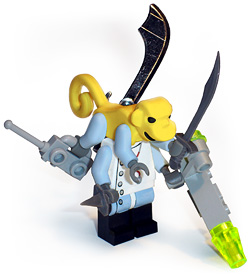
Example: A pioneer in the field of self-bioengineering, the six-armed Professor Monkeyhead is brilliant but insane.
Once a normal minifig student with an Action d6, the future Professor improved his Mind to a powerful Action d10 by using programmed monkey impersonators to avoid attending school.
With all the extra brainpower from escaping education, Professor Monkeyhead was able to develop innovative techniques in the field of replacing his own head with a monkey. In the process, he gave himself four extra arms and a second monkey Mind with an Action d6, allowing him to focus on two Actions simultaneously at different levels of skill. He's still Size 1", so he can't use more than a minifig's Power limit of two weapon inches in a turn, but he plans to use the extra Action for filling out grant applications and claiming authorship on his grad students' research. |
Half Minds
Creatures with Minds are fully independent, able to form their own
strategies and wage effective warfare without supervision. If this
doesn’t fit a player's vision for their Creature, they may elect instead
to give it a Half Mind.
| Half Minds |
| Impairment |
Usefulness |
Notes |
Examples |
| Incompetent |
impaired by Stupidity |
Action |
zombies, civilians |
| Programmed |
while executing program |
can be reprogrammed |
robots, mind-control victims |
| Submissive |
when directed by a master |
accepts new masters when free |
horses, fanboys |
| Subjugated |
while restrained by a master |
never controlled by oppressor when free |
slaves, schoolchildren |
|
Half-Minded Creatures operate no differently than full-Minded Creatures as long as their requirements for Usefulness are met. A Horse is Useful when a rider directs it, a computer is Useful while it has a program to execute, an employee is Useful while under the lash, and a regular civilian can be Useful when he's not being an idiot.
When the requirements for Usefulness aren't met, a Half-Minded Creature becomes a liability. The player controlling the Creature must choose an enemy player and hand control of the Creature to them. The enemy player, on their next turn, may then direct the Creature to take either a Movement or an Action (but not both). At the end of the turn, if the Creature has not been returned to Usefulness, then that player must hand control of the Creature to an enemy of their own. Control passes from enemy to enemy until the Creature has been made Useful again or until it is killed or otherwise removed from battle.
- An Incompetent Creature is similar to other full-Minded
Creatures, but due to a lack of training, motor skills, or intelligence,
it is prevented it from being an effective combatant.
An Incompetent Creature’s Action die is set at a , which means it can never roll high enough to go Over the Top. Instead, an Action can earn Bonus d4s on a Critical Success like non-Action dice.
Incompetent units suffer from Stupidity. If a player controls more than one unit with Stupidity, then at the beginning of their turn, before taking any other action, one enemy of the player's choice may choose any one of the Stupid units and control it as if it were their own for that turn. It's nice if they can come up with a good story for why the unit is engaging in its particular Stupid behavior, but not required; Incompetent behavior doesn't have to make sense.
Examples: Zombies, civilians,
zombified civilians, corporate middle managers,
clone-brand minifigs, ogres, mutants, politicians
- A Programmed Creature is limited in its ability to
make high-level strategic decisions, and instead follows
a simple set of behaviors.
Programmed Creatures are given
a list of behaviors at the beginning of the battle, and
may only behave in accordance with those instructions.
A Programmed behavior must be specific: “Move
to the nearest wounded allies and attempt to heal them”
or “Stay within 5" of the nearest allied troops and fire at enemy
combatants” are fine Programmed behaviors; “Defeat
all enemies” and “Win the battle” are not. Random animals and wildlife are sometimes made Programmed for efficiency’s
sake, with short behaviors like “flee from any nearby
threat” or “if it's nearby and looks edible,
try to eat it.”
While not technically Creatures,
mechanized defense systems are often given Programmed behaviors as well, such as
"fire at anything in range and moving" or "if
intelligent life is detected, release deadly neurotoxin gas."
| Mechanized Traps are often set up with free Triggers rather than expensive Minds - see F.2: Traps. |
A Programmed Creature is Useful as long as it has a Program to execute. Deleting the program or tricking it into a paradox can cause the Creature to go haywire.
Examples: Kill-bots, golems,
summoned elementals, guard dogs, mind-control victims,
bureaucrats, sheeple
- A Submissive Creature may have the ability
to think on its own, but it prefers to obey the commands
of a master. Under an intelligent minifig’s direction,
the Creature may act as intelligently as if it had a full
Mind, but if abandoned, the Creature reverts to whatever
animal-like behavior seems appropriate: milling around
aimlessly, running and hiding, or attacking everything
in sight.
A Submissive Creature loses its Usefulness if its master is killed, wanders off, or stops paying attention to it. If another intelligent minifig can catch a masterless
Creature, regardless of whether he’s on the same
team, the Creature accepts him as its new master.
Examples: Steeds, androids,
grad students, interns, emotional support monsters, targeting
computers, football players, talk radio listeners, fetishists, cultists
- Subjugated Creatures are restrained or harnessed
and forced to cooperate against their will. They
may be completely intelligent, but have Half a
Mind to break free and run amuck. As long as they are
kept in their restraints, they must follow the orders
of their captors, but if they can be released, they will do
whatever they can to prevent being enslaved again. This
usually means attacking their captors or fleeing the battlefield,
but can also be as simple as just attacking everything
in sight, regardless of allegiance.
A Subjugated Creature must be kept in chains or under the whip of an overseer in order to be kept Useful. If it breaks free, control of the Creature is handed from enemy to enemy as usual, but can never be handed back to the original owner. If the original player is the only enemy at the table, control does not transfer.
Once freed, a group of formerly Subjugated units receives one Instant Benny every turn that they can use for directly attacking their former owner's forces.
Examples: galley slaves,
schoolchildren, chain gangs, draft oxen, conscripts,
berserkers, retail employees
Mob Rule
Not all Creatures in a warzone are there to fight on the side of a player-controlled faction or team. Civilians and wild animals wander around obliviously, zombies and monsters attack without discrimination or objectives, neutral combatants act as annoying speed bumps and background extras, and forces abandoned by their players due to fatal aneurysm or diaper-related emergency struggle to find meaning in the absence of Human leadership.
Creatures in a battle who aren't aligned with a specific player are Mobs, and they're controlled by Mob Rule.
Under Mob Rule,
Mobs have their own turn (or set of turns, if there are distinct Mob factions) after all the player turns are complete. A player-controlled army converted to Mob Rule can keep its place in the turn order or be combined with the other Mobs according to players' preference.
During a Mob turn, players (and sufficiently interested Human bystanders) take turns picking Mob units one at a time and controlling their Movement and Action. This continues until all of the Mob units have moved for the turn, or until a majority of the remaining players have declined to control any more of the Mobs for that turn.
When controlling Mob units, the player with the least remaining forces goes first, and players take turns in sequence afterward.
Depending on the preferences of the players, a faction taken over by Mob Rule might continue to behave rationally (or as rationally as they ever did), or there may be no boundaries on what players make them do. A Mob faction can keep its own turn or be combined into a single turn with other Mob forces already in the battle.
10.2 The Medik
| Hospital 555 |
 |
Chemikal analysis shows that Ablogikal Binding Substance was in use as early as Retkon BrikVerse #1,963. It is believed that the interdimensional disruptions caused by mishandled ABS may have had mutagenic effects on a more primitive species. Records of earlier minifigoids are difficult to verify, but seem to sport a variety of disfiguring mutations, from stunted and limbless homonculi to strange noodle-limbed giants. Theories abound as to whether the earlier civilizations were aware of the effects of uncontrolled ABS and continued using it anyway, bringing about their own destruction.
The notorious Hospital 555 first appeared in the timeline of Retkon BrikVerse #1,976. It was staffed by faceless and limbless proto-figs, who captured unsuspecting citizens and performed horrible genetik experiments on them.
The proto-figs' operations culminated in the engineering of the first true minifig. Their ABS gene-splicing madness successfully gave this new fig arms, hands, legs, and even a face.
Consumed with rage and bloodlust after having been submitted to experiments more gruesome than previously thought possible, the first minifig who survived broke free from his restraints, killed the proto-figs who gave him his new body, and he escaped into the world; a deadly killer genetically engineered for destruction. This first minifig was the Deadly Spaceman.
This is also how babies are made.
|
Creatures are as susceptible to Damage as any other Creation - Size Damage, Component Damage, and all the other special Damage types work exactly the same way (7.2: Taking Damage).
When doing Damage to a living Creature, it's important to remember that its head and body are treated as the central Structure, while any limbs, wings, tails, or tentacles are Surface Elements with a Weight class one level lower (7.1: Structure).
Creatures have an extra vulnerability in that their Minds have a physical location, and they can be specifically targeted like any other device. For most Creatures, destroying or severing the head is usually enough to end its adventures in a single stroke. If the location of a Mind isn't obvious from a Creature's anatomy, its owner should point it out to the other players on request.
Another disadvantage of wounded Creatures is that the biological ones (like minifigs) can't be conveniently patched up or reassembled by any passing Mechanik. A Mechanik's abilities only work for mechanical devices, not living flesh.
| There are settings in which this rule becomes fuzzy - biomechanical alien species, Lovecraftian abominatrixes, and mad-geneticist vivisectors may occasionally pop up with attendant Mechaniks for whom biological parts are interchangeable with mechanical ones. This is entirely setting-specific, but should be discussed by players beforehand. |
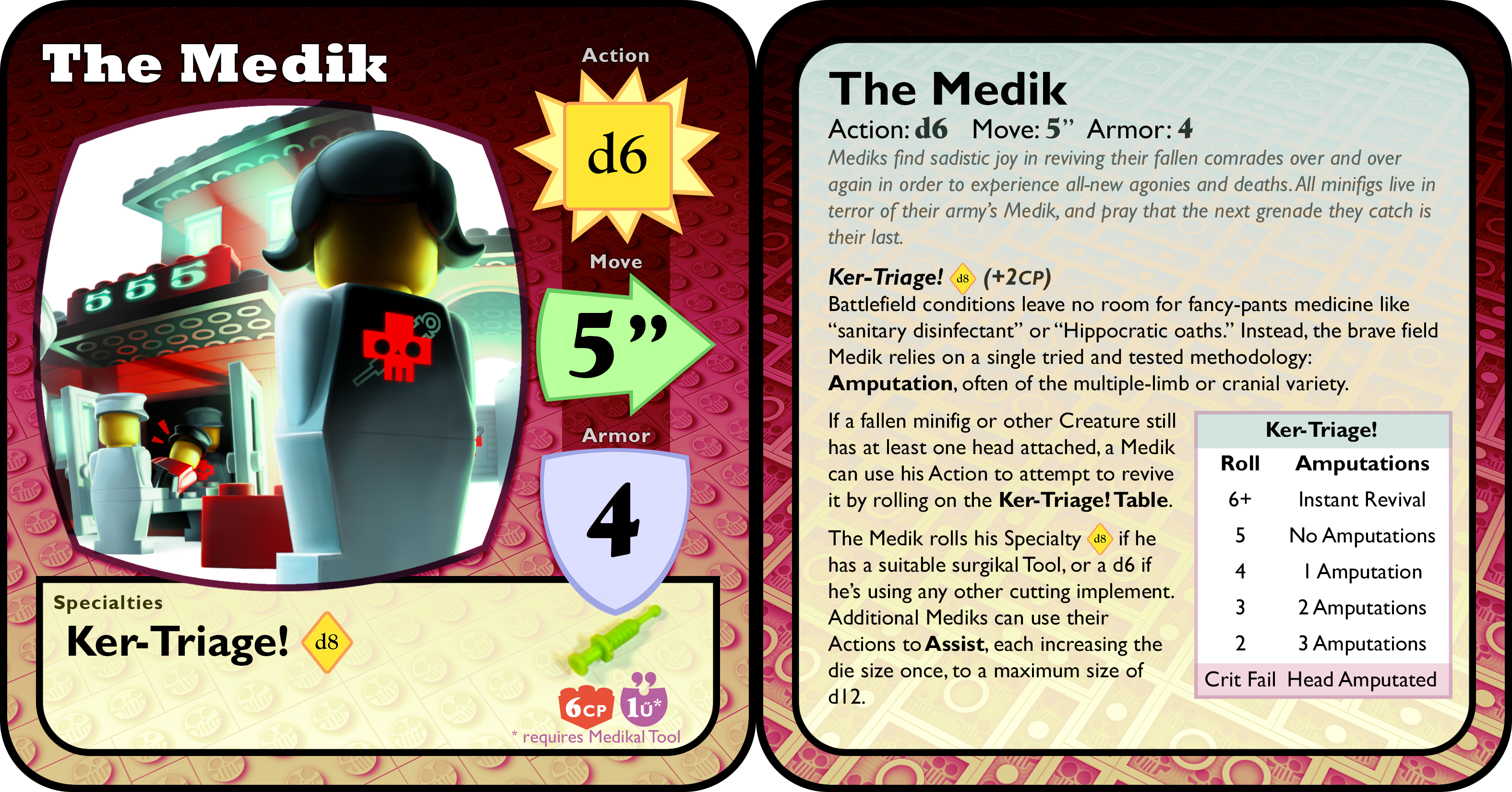
The Medik
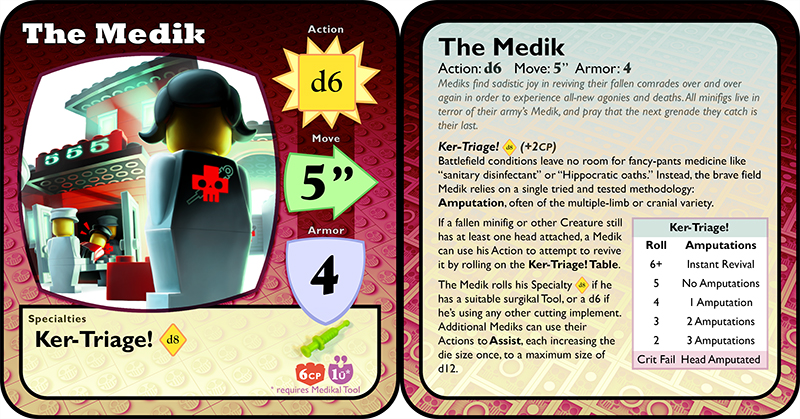
Fortunately, there are minifigs who specialize in meat-based repairs just like Mechaniks specialize in reconfiguring machinery. The Medik is a unit specially trained to perform impromptu surgeries in the field, reviving fallen soldiers over and over again so that each one can experience repeated gruesome deaths in the greatest agonizing variety.
Ker-Triage!
Ker-Triage! Specialty: allows a Medik to perform field amputations to revive fallen minifigs and Creatures
Lacking fancy operating facilities or any time for second opinions, the Medik uses the tried-and-true methods of Ker-Triage!, allowing him to quickly discern how many limbs need to be Amputated in order to bring fallen minifigs and Creatures back up to combat readiness.
| Ker-Triage! |
| Roll |
Amputations |
| 6+ |
No Amputations;
instant revival |
| 5 |
No Amputations |
| 4 |
1 Amputation |
| 3 |
2 Amputations |
| 2 |
3 Amputations |
| Crit Fail |
Head Amputated |
|
 A Medik carrying proper medikal Tools (3.4: Desperate Measures) can attempt to revive a fallen minifig or other Creature of Size 1" or greater as long as it has at least one head still attached. To do so, he declares a Construction Action, similar to a Mechanik's (7.3: Field Construction), and begins operating. A Medik carrying proper medikal Tools (3.4: Desperate Measures) can attempt to revive a fallen minifig or other Creature of Size 1" or greater as long as it has at least one head still attached. To do so, he declares a Construction Action, similar to a Mechanik's (7.3: Field Construction), and begins operating.
At the beginning of his next turn, if the Construction Action wasn't interrupted, the Medik rolls their Specialty on the Ker-Triage! Table. (If multiple Mediks are operating on the same patient, they each roll separately, and only the highest roll is used.)
| A Medik without his Tools can attempt impromptu Ker-Triage! with any bladed weapon instead, but he rolls a d6 rather than a d8. |
If the Medik rolls a five or greater, congratulations! The minifig or Creature is revived with no ill effects. It may immediately stand up and re-equip itself as needed (so that players don't forget it's alive), and it can take Movement and Action and continue fighting as normal starting on its following turn. (On a six or better, the revived Creature can jump up and take its turn immediately.) Creatures larger than Size 1" are revived with an Effective Size of 1", along with the limitations that entails - a maximum of Armor of 1d10, in particular (7.2: Taking Damage).
If the Medik rolls less than five, then the problem is more serious
and he'll have to perform one or more Amputations in order to save the patient. The Amputations succeed automatically; the Medik doesn't need to make any Action or Damage rolls or spend any more Actions to remove the number of limbs indicated by the Ker-Triage! result.
Each limb removed (or otherwise disabled, for Creatures whose limbs can't be removed) counts as one Amputation. Arms and legs are the most common limbs chosen; wings and tentacles will also do. Tails don't count.
If there are not enough regular limbs to satisfy the Amputation requirements, the Medik has no choice but to Amputate the head. This may still save a Creature if it has extra heads in reserve, but a normal one-headed Creature will now be dead beyond any hope of Medikal revival.
If the Medik's Construction Action is interrupted, he still rolls on the Ker-Triage! Table and performs the indicated amputations, but the minifig or Creature is not revived. He can continue attempting Ker-Triage! on subsequent turns.
Effects of Amputation
The complete loss of an arm or leg is a massive trauma that causes all surrounding tissue to swell and adrenaline to course through the body, cutting off blood loss and allowing the Creature to ignore the pain, at least until the end of the battle.
Creatures who lose one or more limbs are still capable of continuing to fight. They're just differently capable.
| Effects of Amputation |
| Limbs |
Effects |
| Legs/Wings |
| One leg/wing lost |
-1"  Move each Move each |
| Legs reduced by half |
Half Speed, on top of other Move penalties |
Wings reduced by half
or all legs lost |
Move reduced to 0";
may use Action
to drag self the length of remaining arms |
| Arms |
| Reduced to one arm |
 may not use two-handed equipment may not use two-handed equipment |
| All arms lost |
may not hold items or use devices |
| Heads |
| One head lost |
-1  Action Action |
| All heads lost |
 Death Death |
|
 The loss of legs, wings, or other limbs the Creature uses to move around is treated as Propulsion Damage (9.1: Standard Propulsion). Each Propulsion limb removed or disabled reduces the Creature's Move by 1" (to a minimum of 1", if it still has at least one Propulsion limb remaining). For regular Propulsion types, if half or more of the Creature's Propulsion limbs are lost, it moves at Half Speed after applying all other penalties. For flight Propulsion, the loss of half of the Propulsion limbs means the Creature is grounded and cannot fly. The loss of legs, wings, or other limbs the Creature uses to move around is treated as Propulsion Damage (9.1: Standard Propulsion). Each Propulsion limb removed or disabled reduces the Creature's Move by 1" (to a minimum of 1", if it still has at least one Propulsion limb remaining). For regular Propulsion types, if half or more of the Creature's Propulsion limbs are lost, it moves at Half Speed after applying all other penalties. For flight Propulsion, the loss of half of the Propulsion limbs means the Creature is grounded and cannot fly.
If all of the Propulsion limbs are lost, the Creature is limited to dragging itself along by the length of any arms it still has attached. (For minifigs, whose arms are each 1/2" long, this means that a minifig with both arms and no legs can drag itself one inch per turn.) This uses up the Creature's Action for the turn; it may not use its arms for anything else. Even if it's still able to drag itself around, a Creature with no Propulsion limbs is treated as one that has no Move ability - it may not Sprint, Bail, or use Angry Inches, and all Close Combat attacks against it are Automatic Hits.
Regardless of the state of its Propulsion limbs, a Creature who loses one or more hands or arms is limited in other obvious ways. A Creature with only one hand can't use a Two-Handed or Long-Ranged Weapon. A Creature with no hands can't use any tools or weapons at all. Less common objects have to be considered on a case-by-case basis; it may take a What I Say Goes Roll to decide whether a given armless minifig can successfully operate a door latch with his teeth or mash a self-destruct button with his face.
Dismemberment and Disabling
In the Core Rules, dead is dead, and the treatment of corpses is a matter of taste. Whether they slump over uneventfully or their bodies are blown into discrete plastic bits depends only on how excited the players are about the quality of the attack.
In a battle that includes Mediks, injuries can make a big difference between easily-revived minifigs and hopeless casualties. A minifig with both legs blown off is two points closer to failure on a Ker-Triage! Roll than his anatomically intact buddy, and it's important to track who's just mostly dead and who's really, really, no-fooling dead.
If players decide to allow Dismemberment, then minifigs and other Size 1" Creatures (or Effective Size 1" Creatures, for larger Creatures on their last inch of life) are no longer unaffected by Damage that exactly matches their Armor. Instead, the attacker (or any Enemy, if there is no attacker) may choose a Disabling consequence based on the type of Damage taken.
| Minifig Dismemberment and Disabling |
| Damage Type |
Consequence |
Effect |
| Cutting, blasting |
Dismemberment |
remove one limb of victim's choice |
| Bashing,
poison |
Stunned |
victim is Incompetent (Action ) for one turn,
with potential Stupidity (10.1: Minds) |
| Impalement, lashing |
Pinned / Entangled |
victim is Grabbed by the weapon |
| Any |
Disrupted |
victim is Knocked Back one inch and Disrupted |
|
If a minifig is killed by Damage equal to double its Armor or greater, then the minifig is Decapitated. Its head is removed, along with any extra heads and whichever other body parts seem appropriate, to show that there is no chance of revival by Mediks on the battlefield.
10.3: Dangerous Beasts
The playthemes of the construction toy world offer any number of pre-molded beasts and monsters, and there's no limit to the custom species players might come up with on their own. Most of these Creatures are easily handled as variations of standard units - a dragon, for instance, is statted as a Flying Horse with a FlameThrower on its face, while a telekinetic alien is just a regular minifig with a couple of SuperNatural Dice.
Creatures are categorized by the Size measurement of their head and main body (or their closest anatomical equivalents), and variations are based on standardized defaults for each Size. The standard Creatures for Size 1" and 2" are the Minifig and the Horse, each described in their own chapters. The standard Size 0" Creature is a Vermin, and the standard Creature of Size 3" or larger is a Great Beast.
Vermin
| Vermin |
| Creature |
 Size Size |
 Action Action |
 Move Move |
 Armor Armor |
Attack |
| Vermin |
0" |
(Incompetent) |
4" Spidering |
0 |
Tiny Bite or Tiny Spit |
| Flying Vermin |
4" Flying |
| Venomous Vermin |
4" Spidering |
Tiny Sting |
|
| Tiny Attacks |
| Attack |
Use |
Range |
Damage |
| Tiny Bite |
1 |
CC |
1 |
| Tiny Spit |
5" |
| Tiny Sting |
CC |
 -2 Poison -2 Poison |
|
 |
Vermin are Creatures that are so small that their Size is rounded straight down to zero. The most common Vermin are the simple one-piece pre-molded animals scattered as props in adventure settings: snakes, bats, spiders, parrots, and babies, for instance, depending on the genre. The small Size of Vermin makes them ineffective as individuals, so they are best deployed in swarms, giving them strength in numbers to harass unarmored foes and support the attacks of larger allies.
All Vermin are Half-Minded (Incompetent). On any team with multiple Vermin, one of them will do something Stupid on every turn (10.1: Minds).
Size Zero
Vermin are so small that they have no Size or mass at all. They can be carried like equipment items, or swung or thrown as Random Objects for Bite Damage. When throwing or Launching large bundles of Vermin, the size of the overall bundle is used, not the sum of all the Vermins' individual zero-inch Sizes.
Zero weight gives crawling Vermin the Spidering ability: they can climb on any vertical or inverted surface at no penalty (although they must end their turn in a stable position for practicality's sake), and they are immune to Falling Damage (7.6: Creation Combat).
A Vermin with proper appendages can carry a one-handed minifig equipment item or weapon at no penalty, or two such items (or one two-handed item) at Half Speed. It can't throw, operate, or use them in combat, or operate mounted weapons or other devices. Vermin have zero Momentum and offer zero Physical Opposition, and cannot attempt Shoves, even on other Vermin.
Vermin have a Structure Level of zero and zero Armor. Any attack that hits a Vermin skips the Damage Roll and kills it automatically. Groups of Vermin are especially vulnerable to Explosions and Arc Fire.
Units and objects of Size 1" or greater can crush any number of Disrupted Vermin underfoot with Trample Damage (9.5: Collisions). If the Vermin aren't Disrupted, a unit can choose one of them to try to stomp on, but must treat this as an Attack with Use:0. The Vermin can attempt to Bail out of the way if it wishes, or hope that the stomper Critically Fails the Attack Roll.
Tiny Attacks
Vermin don't have the natural attacks of larger animals. They must rely on a Tiny Bite, Tiny Spit, or Tiny Sting.
A Vermin's attack is painful but not particularly dangerous - it's only effective against unarmored Creatures of Structure Level 1 or less, and even then it only does 1 point of Damage (or 1d4-2 Poison Damage for Venomous Vermin). A Creature with a higher Structure Level or wearing armor can ignore Vermin completely, even if they're crawling around all over it.
 |
| If a Venomous Vermin's Tiny Sting does zero points of damage or less, it fails to break the skin and the Poison effect is canceled. |
Vermin attacking in cooperation with non-Vermin are subject to the usual Close Combat limit of three attackers for every inch in the target's Size, or else they risk being struck by their own allies' attacks. Vermin attacking by themselves can ignore this limit, forming a swarm that can pile as many attacks onto an unarmored Creature as there are Vermin able to reach it.
The Vermin's single point of Damage isn't enough to threaten most enemies, although their Cumulative Damage can bring down a full-sized minifig if they all make successful Bites at the same time. Vermin are more useful for outnumbering opponents in Close Combat to inflict Action penalties, and for absorbing attacks to protect higher-value allies.
Animals
| Example Animals |
| Creature |
Size |
Action |
Move |
Armor |
 Attack Attack |
| Size 1": Minifigs and Their Peers |
| Minifig |
1" |
 |
5" |
4 |
Hands: |
| Pig |
none |
| Dog / Wolf |
Bite |
| Monkey |
5" Spidering |
Hands: |
| Mountain Goat |
Ram |
| Octopus |
5" Swimming |
Claw |
| Stingray |
Sting |
| Size 2": Horses and Other Steeds |
| Cow |
2" |
|
5" |
4 |
Ram |
| Bear |
Bite, Claw |
| Panther |
10" |
| Velociraptor |
Bite |
| Horse |
Kick |
| Ostrich |
| Camel |
Kick, Tiny Spit |
| Unicorn |
Kick, Ram |
| Hippogriff |
10" Flying |
Bite, Claw |
| Pteranodon |
Bite |
| Crocodile |
5" Ground /
Swimming |
 |
| Shark |
5" Swimming |
| Dolphin |
10" Swimming |
4 |
Ram |
| Sawfish |
Claw (faceblade) |
| Size 3"+: Great Beasts |
| Rhinoceros |
3" |
|
10" |
|
Ram |
| Hippo |
5" Ground /
Swimming |
Big Bite |
| Great White Shark |
10" Swimming |
| Elephant |
4" |
10" |
Ram |
| Mammoth |
Big Ram |
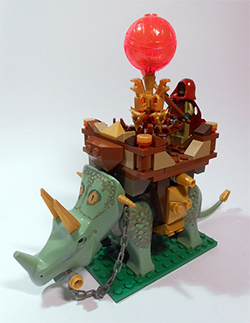
| Triceratops |
varies |
10"
(Half Speed) |
(Armor Plated head) |
Ram |
| Stegosaurus |
(Armor Plated) |
Big Club
(tail) |
| T-Rex |
10" |
|
Big Bite |
|
| Natural Attacks |
| Attack |
Use |
Range |
Damage |
Notes |
| Attacks |
| Bite / Claw |
2 |
CC |
Action Die
|
may Grab on hit
Action in Close Combat |
| Kick / Club |
may Shove on hit |
| Ram |
may Shove on hit
may use as Charging Weapon |
| Sting |
Poison |
|
| Big Attacks |
| Big Bite / Big Claw |
3 |
CC |
2× Action Die
|
may Grab on hit
Action in Close Combat |
| Big Kick / Big Club |
may Shove on hit |
| Big Ram |
may Shove on hit
may use as Charging Weapon |
|
Whether pre-molded or player-built, brick animals' stats and abilities are kept simple for the sake of convenience. Animals of the same Size are roughly equivalent to each other (with some room for Fudge - a monkey is strictly superior to a pig in battle, for instance, although a pig is superior in a breakfast). Animals of Size 2" or larger can be ridden as steeds, although the sea Creatures can be tricky if they lack dorsal studs for mounting.
Basic animals draw from a small set of Natural Attacks. Most are limited to attacks equivalent to a minifig's Hand Weapon with an extra effect or two; Size 1" animals can have one such attack, while Size 2" animals sometimes have two. Great Beasts can have larger Big Attacks, if their attack appendages are large enough to justify it; these are equivalent to Size 2" Melee Weapons.
10.4: Monsters
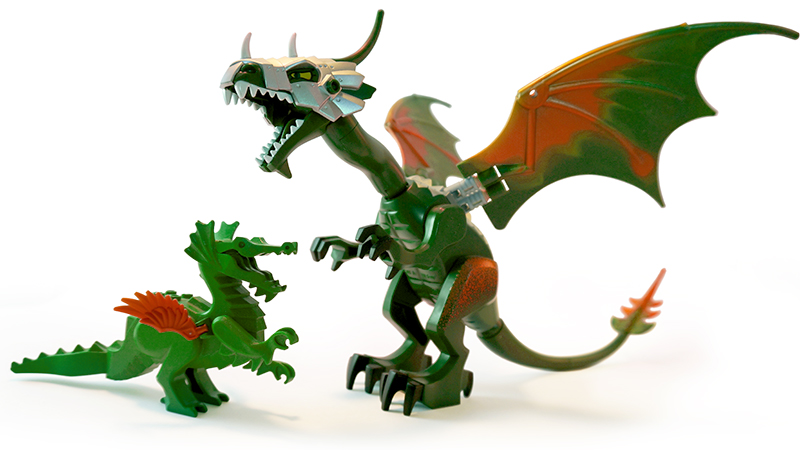 |
| A single Monster type can have wide variations depending on their origin. Dragons, in particular, have wildly different Sizes and abilities from individual to individual. |
| Example Monsters |
| Creature |
Size |
Action |
Move |
Armor |
Attack |
| Corrupted Minifigs |
| Dimmy |
1" |
(Incompetent) |
5" |
4 |
Dimmy Bite
Hands: |
| Jaw-Jaw |
 Regenerating Regenerating |
Suck
Hands: |
| BlokBot |
|
1 Modular |
Ram
Reconstruct |
| Furfig |
4 |
Natural Attack
Hands: |
| Bigfigs |
| Bigfig |
2" |
|
5" |
4 |
Hands: |
| Giant |
varies |
|
10" |
| Troll |
(Incompetent) |
5" |
2 |
| BURPman |
3" |
| Monstrosities |
| Three-Headed Dog |
3" |
(Multitasking) |
5" |
4 |
Bite, Bite, Bite |
| BrikThulhu |
varies |
 |
N/A |
Ensanity |
| Dragon |
unknown |
|
Unlike their animal counterparts, true Monsters appear in limitless variety and adhere to no standards. Each Monster can have features and abilities unique among Creatures and sometimes even among other Monsters of the same type.
Corrupted Minifigs

| Under the corrupted ablogical effects of Kounterfeit Leg-Ore, minifigs suffering under a KLOan Brand become warped and distorted, as if they were incompetent forgeries made victim to shoddy manufacturing practices. |
|
Corrupted minifigs are similar to regular minifigs with a single horrifying change. Some have animal heads, some are made entirely out of bricks, and at the extreme end, some have noses. While not especially dangerous individually, corrupted minifigs often travel in swarms, overwhelming defenders by force of numbers.
Most corrupted minifigs have hands and can use minifig weapons and tools as well as any regular minifig. Some also have a additional Bite or other Natural Attack. A corrupted minifig with a Natural Attack can't use it on a turn in which they also use hand weapons or equipment.
The Dimmy
| Dimmies |
Minifig Dimmies, uniformed in the T-shirts and baseball caps of the human FratBoys they seek to emulate, destroy quality construction wherever they find it. They turn their sections of the BrikVerse into endless wastes of shoddy assembly and piles of random elements. This Mystikal Juniorism is viewed by some as an ultimate escape from the materialism, desire, standards, and expectations of Brik society, especially by minifigs who have become depressed by their own Critical Failure during a crucial opportunity for righteous destruction.
|
| The Dimmy |
Action |
Size |
Move |
Armor |

|
1" |
5" |
4 |
| * Incompetent |
Notes:
Attack: Dimmy Bite |
|
 |
|
|
| Dimmy Bite |
| Attack |
Use |
Range |
Damage |
| Dimmy Bite |
1 |
CC |
Dimmy Poison* |
*A minifig killed by Dimmy Poison reanimates
as a Dimmy on the following turn
|
|
A Dimmy's most horrifying features are a bulbous facial mutation (called a "nose") and a Poisonous Bite that can turn minifig victims into more Dimmies. Any minifig killed by Dimmy Poison comes back to life as a Dimmy on the Dimmies' next turn, allied with whichever Dimmy bit him.
The Jaw-Jaw

| A Settanian soldier falls victim to a Jaw-Jaw's paralyzing Dungan Poison. |
|
| Jaw-Jaws |
As an amphibious species of Poopacabra, Jaw-Jaws are coprophages, feeding exclusively on sewage and excrement.
Rarely encountered in the wild, their hunger draws them into metropolitan sewers where they build great nests of detritus and debris, breeding massive Jaw-Jaw infestations if not exterminated quickly. They can be drawn out by the scent of a live shitgoat, which they find irresistible.
|
| The Jaw-Jaw |
Action |
Size |
Move |
Armor |
|
1" |
5" |
 |
* Incompetent
** Regenerating |
|
 |
|
|
| Suck |
| Attack |
Use |
Range |
Damage |
| Suck |
1 |
CC |
special* |
*A Jaw-Jaw who bites an incapacitated
or Disrupted minifig
can regenerate one lost limb. |
|
The ecology of Jaw-Jaws and their Dungan religion are developed entirely around feeding on the poop of minifigs.
Jaw-Jaws possess the unnatural ability to regenerate from fatal injuries and dismemberment. After a Jaw-Jaw is killed in combat, its corpse attempts to revive itself on its following turn, making a
roll on the Medik's Ker-Triage! Table using a . If it succeeds, any amputated limb or limbs fall off, and the Jaw-Jaw returns to combat.
When drawn out of their sewer nests, Jaw-Jaws coat their weapons with paralytic Poison for the purpose of incapacitating victims before attaching suckers to feed.
If a Jaw-Jaw comes across a living non-Jaw-Jaw minifig who's paralyzed or Disrupted, it can make a Suck attack on the minifig to extract the vital bodily wastes and regenerate one of its own lost limbs.
Any minifig leeched in this manner is depleted of poop and cannot be used for this purpose again.
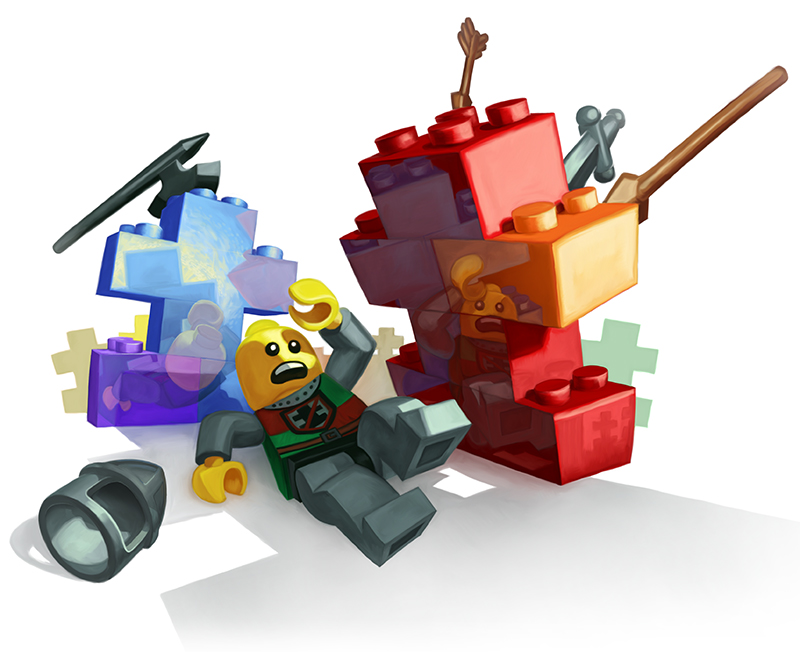
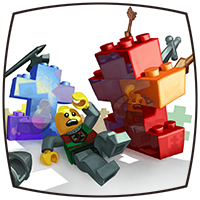
The BlokBot
| Blokbots |
Blokbots are a force of destruction born out of the amorphic nature of ABS itself. Led by strange kult figures and erupting in a dizzying variety of forms and capabilities, Blokbots spread across planets and star systems, seeking to
tear all opposition into bite-sized chunks for conversion into additional waves of Blokbots.
Resembling a minifig shape in only the clumsiest sense, a Blokbot has the uncanny ability to reanimate its own disassembled chunks into strange configurations when blown apart, along with other chunks of ABS picked up along the way. A Blokbot infestation must be contained and eliminated quickly if there's to be any hope of stopping it at all.
|
| The BlokBot |
Action |
Size |
Move |
Armor |
|
1" |
5" |
1* |
| * Modular |
Notes:
Attack: Ram
Action: Reconstruct |
|
 |
|
|
A BlokBot is the most primoridial of Monsters: a cyclopean pile of bloks. The most common variety is built of six bricks assembled into the vague form of a minifig and relying on slam attacks to overwhelm its foes. But in regions where the BlokBots' power is strongest, often in the presence of large double-sized blocks, there are no limits to the size, form, and abilities of the strange BlokBots that appear.
BlokBots are Modular, crumbling and reconstructing themselves as they take damage. Every point of damage inflicted on a BlokBot knocks one of its bloks off, causing the usual penalties for lost limbs. Detached bloks become normal bricks again, allowing crumbled BlokBots to be used immediately as a cheap source of building materials.
A BlokBot with at least one "arm" can use its Action to Reconstruct itself or another BlokBot, replacing a lost blok with any unattached single brick or corpse of the same size or larger than the lost blok. Regardless of the size or form of the new Reconstructed blok, whether a boat hull, dead horse, or standard brick, it behaves like the original blok in all regards, and can be knocked off again by another point of damage.
The Furfig
| FurFigs |
The bucolic Furbuland civilization was a favorite target of early minifigs and their rapidly-developing xenophobia. Long kept at bay by religious fursecution and crusades of the Knights of Yellow Castle 375, the embattled FurFig population dwindled to apparent extinction in B.R. 1,989.
Their violent resurgence in B.R. 2,013
caught minifig civilization by surprise, as the FurFigs' existence was all but forgotten, preserved only in animated children's propaganda cartoons and cautionary bedtime stories about the horrors of Peace and Friendship. The new FurFig descendants, bred for war and hungry for vengeance on their probably-delicious minifig oppressors, inherited none of the Peace-loving spirit that made their forebears such easy targets.
|
| The FurFig |
Action |
Size |
Move |
Armor |
|
1" |
5" |
4 |
Notes:
Attack: Natural Attack |
|
|
|
FurFigs are minifigpomorphized animals with the bodies of minifigs and the heads (and sometimes other parts) of beasts.
FurFigs take on some of the abilities of their animal relatives where appropriate, including a single Natural Attack and an occasional alternate movement type. These are usually obvious - a RhinoFig has a Ram attack, a BirdFig has Flying movement and a Bite attack, and a StingrayFig has Swimming movement and a Sting attack, for instance. For some FurFigs, the nature of their Natural Attack may be up to the game fiction and player negotiation; an eldritch SquidFig's face tentacles might be treated as a Claw attack with a Grab, or a Sting attack with paralytic Poison to render victims helpless for convenient brain consumption, depending on what kind of SquidFig the players have in mind.
BigFigs
work in progress
Monstrosities
work in progress
|
|