MOC Combat
MOC (mŏk)
(n.)
Term used by plastic brick enthusiasts to describe constructions other than the ones designed by toy manufacturers and pictured on box covers. MOC is an acronym for "My Own Creation," which more often than not is a bald-faced lie, as fans shamelessly refer to any fan-made construction as a MOC whether it's Their Own Creation or not. |
The BrikWars Core Rules give Human players the basic ability to slap a bunch of weapons into the hands of minifigs fresh out of the box and push them immediately into brutish deminifigizing violence.
As noble a pursuit as that certainly is, the Core mechanics can be applied just as easily to a force of toy cars or fighting teddy bears as to minifigs. Construction bricks are unconstrained by the prepackaged plotlines and locked-in designs of lesser toys, and demand a more flexible style of wargame to match.
The MOC Combat rules allow BrikWars to draw out the limitless potential contained within construction bricks, and to crush the fruits of that potential without mercy. In place of specific units with pre-assigned stat blocks and storylines, the MOC Combat system supports the creation and cruel extermination of whatever weird and original units, structures, events, and gameplay players can spill out onto the tabletop or bash together during the course of play.
| Don't worry about having to scuttle your existing armies. All the units and weapons in the Core Rules were built with the MOC Combat system, so custom creations play well with generic units. |
Making MOCkeries
Watching minifigs hack and smash each other into plastic bits
is loads of fun, but few tabletop strategists will be satisfied with minifigs-only
combat in the long run - not while visions of tanks, castles,
and nuclear assault dinosaurs dance in their heads.
Rather than building
a model to match a particular set of stats, more exciting Creations result when players build the MOCs first and then match the stats to the finished models. If a Creation comes out a little more or less
expensive than the budget calls for, it's no cause for alarm; nothing is more militarily authentic than a cost overrun. Players can add or remove
a couple of minifigs from the army to make up the difference later. An arbitrary public execution for budget purposes will show the minifigs that their Humans mean business.
Design Overview
Once players have a model in hand, the first step for any Creation
is to define its Structure (Chapter 7: Structures). All Creations begin with the same two Structural
stats: Size and Armor, based on the size of the model and how tough the players decide it is.
For simple buildings and fortifications, that's all that's required. However, Creations are a lot more satisfying if they're loaded up with Weapons and Gunners (Chapter 8: Weaponry), Propulsion systems and Pilots (Chapter 9: Vehicles), or even their own Minds and abilities (Chapter 10: Creatures). Each of these are described in their respective chapters.
| Ablogical Binding Substance |
Ablogical Binding Substance, or ABS, is the prime construction material for the engineers of Galactik Civilization. Its mysterious properties allow fuelless vehicles, impossible structures, and reconstructible creatures. ABS is an inexhaustible source of energy, thought, and motion - in short, all the inexplicable Plasticity that makes a BrikWar work.
The reality-warping effects of ABS allow Mediks to bring dead soldiers back to life, Mechaniks to create vehicles from debris in seconds, common housepets to mutate into unstoppable monsters, fully-staffed castles to materialize next to orbital military bunkers, pirate ships to sail in outer space, and invading armies from parallel universes to arrive at the wrong battlefields a thousand years off schedule.
While the strange influence of ABS can never be fully defined or understood, minifig Mystiks believe that its effects radiate in tune with an underlying Farce that binds all briks together. Under the influence of this Farce, impossible and ridiculous Koincidences snap themselves to reality with a clutch power determined by how entertaining and destructive they are rather than by rules of logic or probability.
While this serves to make the universe more Ossum, there can be negative effects where cynicism and frustration take root. Minifigs who succumb to the Snark side of the Farce are dangerous opponents of fun, but for the heroic forces who are willing to face them down and destroy them, they represent valuable opportunities for glory and recreational murder.
|
Fancy Dice
In order to keep the game easy and accessible for more casual massacres, the Core Rules limit themselves almost entirely to regular six-sided cube-shaped dice (d6es), with an occasional d10 thrown in for the spicier bits. For players invested in a personalized MOC experience, a wider variety of dice are required.
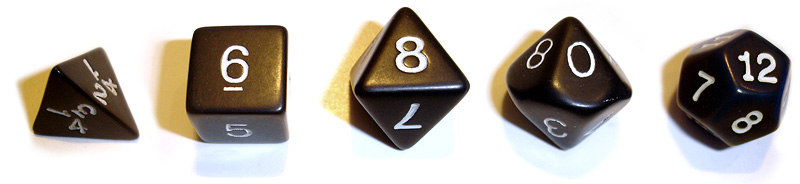
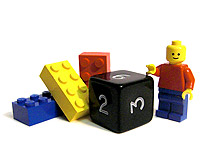
A d4, d6, d8, d10, and d12.
Fancy dice in all kinds of polyhedral configurations are available online or at gaming hobby stores. Any real tabletop gamer is already familiar with these and has several pounds of them immediately at hand.
Elements shown:
dice |
Like the d6es and d10s of the Core Rules, the dice in this wider range are named according to their number of faces, referred to as their die size. A four-sided die is a d4, an eight-sided die is a d8, a twelve-sided die is a d12, and a twenty-sided die is forbidden. Certain effects can increase or decrease a die's size between these five dice, to a minimum size of d4 and a maximum size of d12.
The new dice score Critical Failures and Successes the same way as in the Core Rules (1.2:
Numbers).
Any roll in which all the dice come up with a result of "1" is considered a Critical Failure, and any die that comes up on its highest-numbered face (an 8 on a d8, a 12 on a d12) generates a Bonus d6 for the roll (with the exception of the d4, which only ever generates Bonus d4s).
In an Action Roll, an Action die that comes up 6 or higher, not counting modifiers, takes the Action Over The Top (4.2: Action). This is very common for Action d12s and relatively unlikely for Action d4s.
While all dice are handled in a roughly similar way, they each have an individual flavor dictated by tradition and superstition.
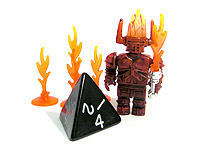
The Incompetent D4
Shape: Tetrahedron Used for: Mindlessness
What's the one requirement of a die? Players roll it and a number comes up.
As far as minimum performance standards go, this isn't a tough one to meet, but a d4 can't manage even that much. Numbers are scattered helter-skelter all over every face, and not a single one of them is "up." Players need a secret decoder ring just to figure out the result of the roll.
D4s aren't even that great when used as caltrops, since construction bricks have sharper corners and players tend to have a lot more of them.
The d4 is the most unsatisfying of all dice, and is used to represent incompetence and uselessness of all kinds. It is especially reserved for mindless destructive processes, like fire, disease, and consumer capitalism.
The d4 is unique in that it doesn't earn Bonus d6es. On a roll of 4, all it gets is another Bonus d4.
The Basic D6
Shape: Cube Used for: Most Everything

Standard units and standard objects use the square and reliable standard d6. A d6 indicates a unit or object has the basic features or abilities to accomplish its duties, but is not otherwise exceptional.
Because the majority of units and weapons are based around the d6, players may end up needing big piles of them if a battle is very large. Fortunately most gaming hobby shops sell uniform dice blocks of a few dozen small d6es for fairly cheap. Dice blocks in contrasting colors make the game experience a lot smoother, since every player will have plenty of their own dice and they won't have to keep passing a limited supply around the table.
The Specialist D8
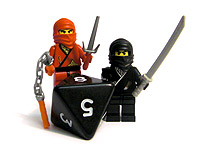
Shape: Octahedron Used for: Special Training and Blast Weapons
The d8 is used for advanced skills or special training. These are indicated on a unit's Stat Card, either in the stat boxes or in the unit's Specialty descriptions.
The d8 is also used for Blast damage that spreads over an arc, such as a dragon's breath weapon or a ShotGun blast.
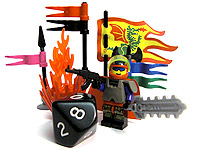
The Heroic D10
Shape: Pentagonal Trapezohedron Used for: Structures, Explosions, and Heroes
If something really awesome is happening, odds are good that d10s are involved. The d10 is used for siege-level weapons, vehicles, creatures, and fortifications, as well as for Heroes. They're also the die used for Explosion Damage, where the number of d10s determines the radius of an Explosion.
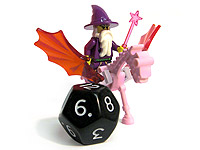
The SuperNatural D12
Shape: Dodecahedron Average Value: 6.5 (6.85 with Bonus Dice) Used for: Magikal, divine, and extradimensional effects
The d12 is rarely seen in BrikWars, and is reserved for unique SuperNatural entities and effects. Wizards, demigods, and superheroes may have access to d12s if they're powerful enough, but for regular mortal units (and even Heroes) this die is normally out of reach.
The d12 is also used for magical, chaotic, and energy-based types of Damage that bypass a target's Deflection. Damage from the effects of lightning bolts, ghost launchers, friendship, and BrikThulhuian soul disruptors is measured in d12s that cannot be Parried or reduced by Heavy Armor.
The NonPossible D20
Shape: Nonexistent Icosohedron Average Value: Null Used for: Ensanity
The d20 is reserved for BrikThulhu alone. Even the tiniest brush with the effect of a d20 is rumored to strike a minifig cripplingly sane.
The Benny
Ossum within a BrikVerse compounds over time, and players act to cultivate and intensify that Ossum without regard for moderation or responsible conservation practices. Their favor elevates the glory of Ossum above the ignomy of Nahsome, thanks to the power of the Benny.
MOC Combat calls on Humans' creativity to not only make decisions about what they want in their Creations, but also what they want in their battles. By giving bonuses to their enemies in the form of Bennies, players have the opportunity to steer the group towards their preferred kinds of fun, and the mutual fun of everyone at the table supercedes all other goals. (Players who worry about winning or losing more than about everyone's fun are playing the wrong game.)
If players like impressive models, they'll give Bennies for impressive models. If they like hilarious hijinks, they'll give Bennies for hilarious hijinks. This keeps everyone at the table aware of what makes the game most fun for everyone else, and the more freely they hand out Bennies, the more freely they're likely to receive them in return.
Awarding Bennies
For Humans, the majority of BrikWars is about smashing opponents' minifigs into small piles of plastic debris. In the midst of that humiliation, when an enemy does something Ossum that deserves recognition, the Benny exists to let a Human grant that enemy a brief ray of hope before heartlessly crushing them brutally underheel once again.
Any time a player's enemy does something cool that makes the game better, the player can award them a Benny. Examples include:
- setting up an Ossum battlefield
- building Ossum models
- doing anything that causes everyone at the table to say "that was Ossum" and exchange high-fives
- doing anything Ossum that causes players at the table to laugh one or more of their butts off, especially when it results in self-inflicted casualties
- demonstrating extreme sportsmanship, character, enthusiasm, genius, bloodlust, hospitality, stupidity, brand loyalty, or any other attribute the player personally finds Ossum and would like to see more often
- acts involving beers and / or doughnuts and the Ossum distribution of said beers and / or doughnuts
To create a Benny, a player grabs any pair of construction bricks, attaches them together, calls it a Benny, and gives it to their chosen enemy, possibly giving it a name to commemorate its origins (e.g., "The Almighty Benny of Heroic Self-Immolation.")
At any moment from that point forward, the enemy can break the two bits apart to add a one-time Bonus d6 to any standard roll or stat (but not to a What I Say Goes roll).
Instant Bennies
There's a less enduring type of Benny which grants the same general-purpose Bonus d6, but can't be saved for later. An Instant Benny represents a momentary opportunity for the army that possesses it. If it isn't spent, it disappears at the end of its owner's turn and the opportunity is lost.
| Instant Bennies can't be saved from turn to turn, so there's no point in trying to earn one if you're not in a position to spend it immediately. |
Unlike regular Bennies, Instant Bennies are awarded automatically when certain conditions are met, and their use is subject to restrictions.
The five standard Instant Bennies are First Blood, Inevitable Betrayal, Deadly Ground, Last Man Standing, and King of the Hill. Players can add or make changes to this list to support their scenario or preferred playing style.
- The Instant Benny of First Blood is awarded to the first player to kill a minifig belonging to an enemy. Killing allies doesn't count.
- Instant Bennies of Inevitable Betrayal reward players who betray their allies.
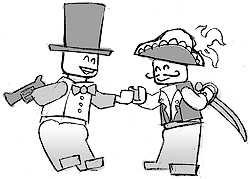
At the beginning of each of their turns, a player with allies must decide whether or not it's time to betray them. If the player remains faithful, then they add a brick to their Betrayal pile, and play continues as normal.
If the player decides to betray their alliance, then each brick in their Betrayal pile turns into an Instant Benny to spend against their former allies. The more bricks they have, the more tempting Inevitable Betrayal becomes, so players should always keep one eye on their supposed friends.
A player who's betrayed an alliance is no longer part of it, and can't be Betrayed by it in return.
- The Instant Benny of Deadly Ground is awarded to a player on each turn that they have units in enemy territory. Only units that are in enemy territory can use the Instant Benny of Deadly Ground, and only against the enemies whose territory they're in.
In a scenario battle, enemy territory is defined in concrete terms - in a siege, for instance, the territory inside the defensive wall belongs to the defenders, while territory outside belongs to the besiegers. In more loosely-defined battles, a unit is in Enemy territory if it's closer to that Enemy's starting position than to its own.
| Territorial boundaries can be marked by placing monuments or landmarks at the halfway points between players. Players can move the boundary closer or further away if one army is much larger than another, according to preference. An army that's twice as large at the beginning of a battle can be considered to control twice as much territory. |
- Instant Bennies of King of the Hill are awarded to armies who achieve a scenario battle's special objectives.
The most common objectives are to seize and hold particular critical locations or pieces of equipment, typically involving flags and the capture thereof. Once per turn, each held objective grants a King of the Hill Benny that can be used by the player with uncontested control over it.
| Objectives are normally built into a scenario, but there's nothing to stop players from making up new ones at random halfway into the battle. |
- The Instant Benny of Last Man Standing is awarded to any player who has only one minifig left alive at the beginning of a turn. The minifig can continue to earn a new Last Man Standing Benny at the beginning of each subsequent turn until he either dies or receives reinforcements.
|
|