|

|
|
|
|
|
Chapter Five Combat 
own illustration Uploaded, final
Engaging in combat is a minifig's highest goal and greatest joy, for he knows that violence is what pleases the Humans best. If prevented from mayhem for too long, minifigs become despondent and irrational, eventually succumbing to dreaded pacifism. Victims of this affliction may find limited use as menial laborers, but they're best put out of their misery quickly as target dummies for the other minifigs' entertainment. Regardless of the flavor of violence employed, whenever a minifig makes an attack he follows the same three steps. First, he measures his weapon's Range (for Ranged weapons) or reach (for Close Combat weapons) to see if his attack can reach the target. If so, he next makes an Action Roll to see if his attack successfully hits. If it does, the minifig makes a Damage Roll to see if the weapon's Damage defeats the target's Armor. Each of these steps can be affected by a variety of modifiers as the minifigs maneuver for best advantage.  Rappelling in on VTOL transports, military snipers take a commanding view of their zombie-infested town from the top of the church tower.
rights not secured
In order to attack a target, a minifig must be able to strike it with a weapon. If the minifig is using a Close Combat weapon (a weapon with a Range of CC), he must be able to touch the target with the weapon's striking surface. (Some weapons may have additional restrictions, according to common sense - a Jousting knight can't stick his lance out sideways to damage a target way off his right shoulder, for instance, and a poleaxe can't be meaningfully swung if it's stuck halfway through an arrow slit.) If the minifig is using a Ranged weapon (a weapon with a Range measured in inches), there must be a clear line of sight between the weapon and the target. The weapon's Range is measured from the business end of the weapon to the target. Targets outside of this Range can still be attacked, but with penalties (described further below). 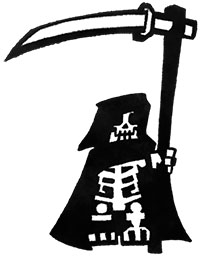
own drawing Uploaded, final
Two rolls determine an attack's success, resulting in either a glorious kill or an ignominious whiff.
Once he's picked a target, the minifig must be skillful or lucky enough to hit it. The minifig spends his Action and uses his Action Die to make an Action Roll against the Use rating of his weapon. If the result of the Action Roll (including modifiers) is equal to or greater than the Use rating, the attack strikes the target. If not, it misses completely, resulting in the minifig's humiliation. He may say "I meant to do that," but everyone knows he's lying. 
If the attack hits, it then has to do enough damage to destroy the target. The player rolls the dice in the weapon's Damage rating. If the amount of damage from this Damage Roll (including modifiers) is greater than the target's Armor, the target is destroyed (or parts of it are destroyed, in the case of larger targets (7.2: Taking Damage)). Congratulations! If the damage is less than the target's Armor, the attack has glanced away harmlessly, traditionally accompanied by one or more players making a "ka-ping!" sound effect. If the damage is exactly the same as the target's Armor, then the target isn't necessarily killed, but it doesn't escape unscathed. Instead, Something Bad happens.
When a minifig is struck by damage that exactly matches his Armor, his player chooses Something Bad to happen to him. They normally choose from three basic results: the minifig is either Disarmed!, Struck to the Ground!, or Mortally Wounded!, but the minifig's player can invent an Unexpected Twist! variation if it's entertaining enough to earn the other players' approval.
Destroying a target is rarely a foregone conclusion, and ambitious leaders will want to give their troops every possible advantage. While the best defense is a gratuitously overpowering offense, it's fun to frustrate enemies by maneuvering to eliminate their advantages at the same time. There are a number of conditions that players can manipulate for modifiers to improve or handicap an attack's chances of success. Positive bonuses can add to an attacker's Action Roll, to the Range of his weapon, or to the damage dealt on a successful hit. Negative penalties can subtract from an attacker's Action Roll or damage total. Action modifiers can sometimes raise or lower an Action Roll by a large amount, but remember that Critical Successes and Failures mean that the results of a roll are never guaranteed. Critical rolls are based only on the numbers rolled on individual dice, not on the final totals after modifiers are applied (1.2: Numbers). 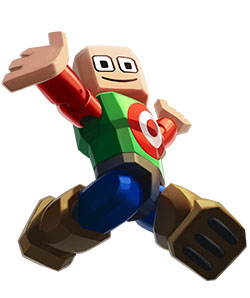 Standard attacks are based on nature's perfect target: the minifig.
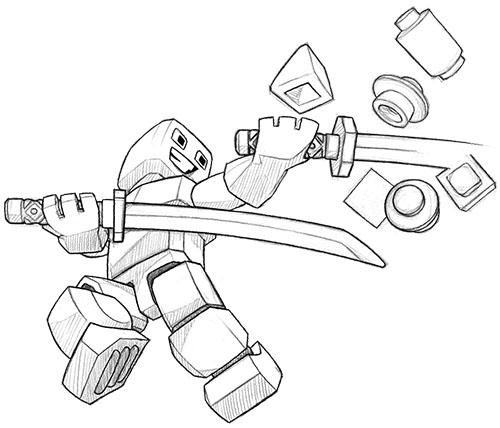
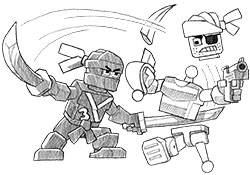 When checking for visibility modifiers, or if you're a ninja practicing swordplay, remember that a minifig is divided into three main parts.
own illustrations Uploaded, final
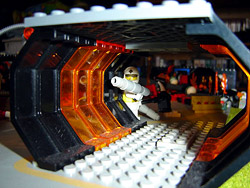 After failing in his attempt to blow up some VOL troops standing inadvisably close to explosive gas cannisters, the Immortal M.Q.S. takes cover at the end of this corridor.
image rights: Uploaded, final
Most attacks target a minifig or similarly-sized object. Larger targets are easier to hit, and smaller targets are more difficult. For targets that are very large, like the ground, the broad sides of barns, and Humans, attackers receive +1 to their Action Roll for every 2" of the target's Size. This Action Bonus only applies to sections of the target the attack is able to hit - if a space frigate is twenty-four inches in length, but only four of those inches are visible and in range, then the bonus is only +2. Measuring the Size of objects is described in greater detail in 7.1: Structure, but it works like you'd expect - players measure the main body of an object along its greatest dimension, in inches, and that's good enough for most purposes. A standard minifig's Size is one inch.
When special precision is required, an attacker can focus on smaller targets. For a target equivalent to a 2x4-stud brick, the attacker fires as normal. If the target size is closer to 2x2 studs, he takes a -1 Action Penalty to his Action Roll. If the target is the size of a single 1x1 stud, he takes a -2 Action Penalty. For minifig targets, this process is streamlined. Rather than trying to estimate how many studs' worth of any given minifig is visible, minifigs are divided into three main sections: the head (including helmet, hat, or hair), the torso (including arms, backpacks, and armor, but not carried equipment), and the legs. If the attacker can see any part of one of these sections, however small, then the section is considered visible. If all three sections are visible, the minifig targeted as normal. If the attacker can see two out of the three sections, he takes a -1 Action Penalty. If only one minifig section is visible, the Action Penalty is -2. 
Action Modifiers for target size and visibility also modify the Damage from Explosions and other area-based effects. Only the sections of the target within the area of effect are considered. Even if a minifig is fully visible from an Explosion's point of detonation, if his head and body are outside the two inch radius then the Explosion affects his pants only, doing -2 Damage.  Natalya's Assyrian forces rely on disciplined Combined Fire to take down heavy targets.
image rights: Uploaded, final
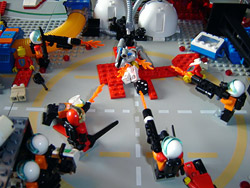 Although the Assyrians are out of formation, it's worth risking friendly crossfire from Missed Shots in order to focus damage on one of the Immortals' deadly Maniacs.
image rights (informal): Warhead 1/18/18
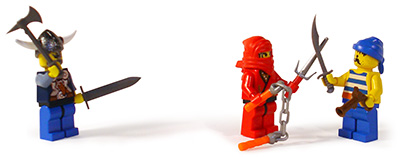
If a minifig lacks the power to take down a target by himself, he can coordinate attacks with friends and allies to deliver a combined attack. The damage from all participants is added together and applied in a single large sum, which is handy for punching through otherwise-impregnable Armor levels or for maximizing the humiliation of weaker targets. If units want to join together in a combined attack with the units of another player, they may delay individually to make their attacks on that player's turn instead of their own. They return to acting on their own player's turn again afterwards. Combined Ranged attacks (5.3: Ranged Combat) simply combine the attacks' damage and any secondary effects. Any units capable of making a Ranged attack on the target may join in; they don't need to communicate with the other attackers. 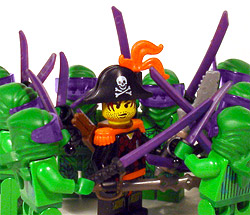 Even Space Ninjas lack the skill to coordinate this many swords at once. The Space Pirate is momentarily safe as his overeager foes become entangled in one anothers' blades.
own photo Uploaded, final
Combined Close Combat maneuvers (5.2: Close Combat) combine their damage and secondary effects, and also make it more difficult for victims to fight back effectively. Not only will the targets' Parries be quickly used up against multiple attackers, they also take a -1 penalty to all Action Rolls if they (and their allies, if any) have fewer fighters in a single Close Combat engagement than their opponents. The Action Roll penalty for being outnumbered applies even if the opponents are on different teams. If there are several mutually opposing forces in the same Close Combat group, they may find themselves in a situation where each of them is in the minority against the rest of them.
No more than three Close Combat opponents can gang up on a single minifig at any one time, or they'll end up jostling and lopping each others' arms off by mistake. Larger targets are subject to no such hard limitations, although other limits may be dictated according to common sense. In a combined Charge attack (5.4: Charge!), the attackers combine their Damage and, if they're all striking from the same direction, they can combine their KnockBack Roll as well. The target must be big enough for all the attackers to Charge into at the same time; otherwise, they're prone to disrupt their own Charge by all crashing into each other. When combining attacks of different types, keep in mind that Close Combat fighters are likely to be directly in the line of fire of any Ranged attackers' Missed Shots (5.3: Ranged Combat) or Charging attackers' Charges if any of them blow their Action Rolls. 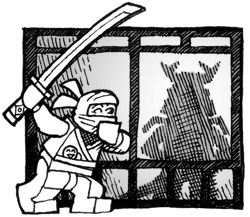 Although this assassin can't actually see his target, the shadow on the rice-paper wall gives him a pretty good idea of where to strike.
own drawing Uploaded, final
The remaining Action Modifiers don't fit into the standard categories. Ranged attackers with a height advantage gain a little extra edge, in the form of one inch of extra weapon Range (up to +5") for every vertical inch of altitude between them and the targets below. (Low attackers shooting at elevated targets are not subject to any corresponding disadvantage.) Attackers frustrated by targets that are slightly out of range can fire their weapons anyway, but their attacks' accuracy and effectiveness drop off quickly with distance. For every inch past a Ranged attack's Range, the attack suffers a -1 penalty to its Action and Damage Rolls.
The Damage penalty for attacking out of range is ignored for Explosive weapons, which do the same Explosive Damage regardless (3.2: Ranged Weapons), making this a handy option for thrown grenades. Units firing at a target they can't see are firing blind, and receive a -5 Action Penalty in addition to any other Action modifiers at play. The target may be hidden or invisible, the attacker may have been blinded or blindfolded, or he may be extra cocky and firing backwards over his shoulder with his eyes closed. While he is unable to see the target, the attacker must still somehow have a very close idea of where the target is (within one inch) to attempt the attack. The target may have chosen a small and obvious hiding place (he's hiding inside a pup tent) or he may have made enough noise to give away his location (his cell phone went off).
 own drawing Uploaded, final
A unit with a Close Combat weapon can use it to try to whack any object within reach. Inanimate targets (trees, buildings, helicopters) are not notably responsive to such aggression. They take whatever damage is applied and, assuming they survive, stoically continue on with whatever they were doing. More reactive targets (minifigs, animals, robots) are less likely to take that kind of thing lying down. Whenever one melee unit attacks another with hand-to-hand weapons, the two of them leave the regular turn cycle of movement and Action and enter into the more refined state known as Close Combat. Close Combat is normally initiated by one minifig running up to hit another with whatever he's holding in his hands. It can also occur when he carelessly wanders within range of an enemy's melee weapon, and that enemy makes a preemptive response attack. Close Combat is often one-on-one, but can also involve larger groups ganging up on lone victims or attacking each another in grand melees. While in Close Combat, minifigs are locked in an intense struggle, attacking on their own turns and countering attacks on their enemies' turns, using as many weapons as they have available in hand, until one side is defeated or makes a shameful retreat. On each player's turn, every minifig in Close Combat can use each of his hands once, with or without held objects. For normal minifigs with two hands, this limits them to a maximum of two maneuvers per turn. A minifig who is engaged in Close Combat cannot make response Actions to events outside of Close Combat. 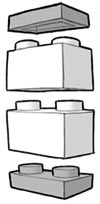 An Angry Inch is easy to construct - two bricks and two plates stacked together make an accurate inch.
Uploaded, final
 This warrior lunges forward one Angry Inch to Strike an enemy just out of reach.
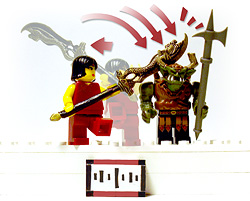 When the enemy gets too close, she jumps back one Angry Inch to give herself room to swing her blade.
Elements shown: LEGO, Little Armory, Mega Bloks, custom mold Minifigs in Close Combat don't take movement in the normal fashion. Instead, prior to each Close Combat active maneuver or Counterstrike, they can lunge up to one inch to better position themselves. This fancy footwork is known as the Angry Inch, and it's not counted against the minifig's regular Move inches. Minifigs can take advantage of this free inch as many times as they make Close Combat maneuvers against an opponent. A minifig cannot deliberately use an Angry Inch to move to a location from which he would be unable to complete his maneuver. On his own turn, a minifig who's Disrupted from a previous turn can use an Angry Inch to recover and immediately initiate a Close Combat maneuver.
A minifig doesn't need an unspent
 Action to Parry or Counterstrike, but his Action is considered spent afterward. Action to Parry or Counterstrike, but his Action is considered spent afterward.On a minifig's own turn, he is the active combatant who drives the course of Close Combat. He can use an Action to Engage his opponents with a Strike, a Grab, or a Shove. If he's feeling cowardly, has a more important Action to focus on elsewhere, or just forgets to Engage any of his opponents, he can Disengage, either withdrawing from Close Combat to take Action elsewhere, or simply ignoring the opponents trying to murder him and hoping for the best. A normal minifig is only able to focus on one type of maneuver in a turn. If he wants to Shove a target and then Strike it, he has to do it on separate turns, no matter how many unused weapons he has available.
Once the active minifig initiates a Close Combat maneuver, his target can try to Parry it to reduce or nullify its effects. Minifigs can use any object to Parry a Shove or Grab, but only a Shield can Parry damage.
Minifigs don't need to have an unspent Action to attempt a Parry, as long as they haven't already used the hand or object they're Parrying with during the current player's turn. Regardless of whether the target had an unspent Action or not, their Action is spent after Parrying. As a last resort, if a target minifig has nothing to Parry with, he can try Bailing out of the way as a response Action (4.3: Enemy Response). This can save him from the effects of one Close Combat maneuver, but leaves him Disrupted and defenseless against any subsequent ones. Unlike Parries and Counterstrikes, a minifig must have an unspent Action to attempt a Bail.
A Parrying minifig makes an Action Roll against the Use rating of the weapon or object he is Parrying with. When Parrying, Ranged weapons are treated as Minifig Tools (Use:3) rather than using their Ranged attack stats. Bare Hands have Use:0, meaning that a Bare-Handed Parry rarely fails, except on a Critical Failure or when there are significant Action penalties. If a minifig is Parrying against an opponent making an Attack or Shove using a Two-Handed Weapon, he Parries with +1 to his Action Roll due to the weapon's large size.
If a Parry fails, then the opponent's maneuver is not deflected. Worse, any time the Parrying Action Roll is a Critical Failure, the Parrying weapon or object (if any) is knocked out of the minifig's hands as if the minifig had taken the Disarmed! result when Something Bad happened (5.1: Making Attacks).
Rather than get caught up in the chaos of hand-to-hand combat, minifigs may try using Ranged attacks to strike cleanly from a distance, either using dedicated Ranged weapons or by throwing Close Combat weapons or other objects. Ranged attacks are straightforward affairs. After taking appropriate modifiers into account for visibility and range, the attacking minifig rolls his Action Roll against his weapon's Use rating and applies its Damage Roll on a successful hit. A minifig can only make Ranged attacks against a single target in a turn, even if he has multiple Ranged weapons. He may not make Ranged attacks while engaged in Close Combat. (Minifigs who successfully Disengage from Close Combat without spending their Action are free to make Ranged attacks.) 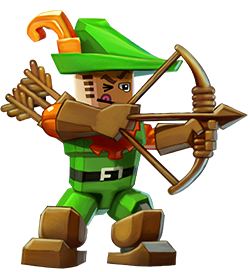
 
When a Ranged attack misses, the shot is usually considered to have flown off into the sky or harmlessly impacted the ground next to the target. Any player may insist on tracking a Missed Shot more accurately, if they have a good reason to make the effort. Players might think that the target is big enough that even a bad shot would have had to hit another part of it, or that an Explosive landed close enough to the target to catch it in the blast radius, or they might be looking greedily towards other potential targets in the field of fire. When players decide to track a missed Ranged Attack, they check to see the amount the Action Roll missed by. (For instance, if the attacker needed a 5 but rolled a 3, then the Action Roll missed by 2.) The Missed Shot lands somewhere within this many inches of the target. If the target of the attack belongs to an opposing player, then that player gets to decide where the shot lands, within that many inches. Otherwise, the attacking player chooses any of their current enemies to make the decision. The enemy can pick any spot within the Missed Shot range for the shot to strike, no matter how Koincidentally ridiculous or unlikely, provided that it's somewhere the weapon could theoretically have hit in the first place. The weapon's damage is then dished out, including penalties for going out of range if necessary. The only restriction to the enemy's choice of accidental target is that they can't choose a target that's owned by any player other than themselves, the player making the attack, or either of their allies. Other players' units are off-limits unless hitting them can't possibly be avoided.
 own drawing Uploaded, final
The third way for minifigs to make attacks is to run flat-out and smash into their target, either with a thrusting weapon or with their own bodies. A Charge can be used to add power to an attack with a Charging Weapon, but occasionally minifigs find themselves just slamming into things, whether on purpose or by accident. Knightly jousting, football tackles, and car crashes are all examples of Charge attacks. Charge attacks can be combined with a Sprint into a single Action (4.1: Movement), allowing minifigs to both cover ground and destroy stuff in the same turn. 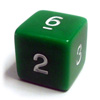 Element shown: Your MOM

For a Charge to be of any use, a minifig must build Momentum. He does so by running, Sprinting, flying, or falling out of the sky straight at his target from at least four inches away. As in real life, anything shorter than four inches grants no advantages and can be safely ignored.
Momentum grants a special type of Benny called a MOM. Like Bennies from taking an Action Over the Top (4.2: Action), a MOM can be used to add +1 A minifig gets his MOM when he's run for four inches in a straight line, and it lasts for as long as he continues traveling in that line. The moment he turns to the right or left from his straight-line path (jumping over obstacles or running down slopes is allowed), does anything that would prevent running at full speed (opening a door, running up stairs, putting on roller skates), or ends a turn without using up all of his Move inches, his MOM abandons him and he has to start over. Fortunately, he can get a new MOM as soon as he runs another four inches. Because of his small size, a minifig has limited Momentum and can never have more than one MOM at a time. A MOM can be spent to add a Bonus Die to any roll or stat that would logically (by the players' definition of logic) benefit from the Momentum of a speeding minifig. A minifig might roll his MOM to add +1 A minifig can also use his MOM to add +1 A MOM's effect only works in the direction of the Charge. It can't be spent at an angle off to one side or to the rear. As soon as the minifig rolls his MOM, the MOM is spent, and he must run another four inches to get a new one. Unless he's stopped by whatever he ran into, he must continue running in a straight line to the limit of his Move inches for the turn, even if this forces him to run over a cliff or into a wall of spears. This can be especially inconvenient when Bonus Dice on a critical Sprint roll add more inches of Move than he was prepared for. 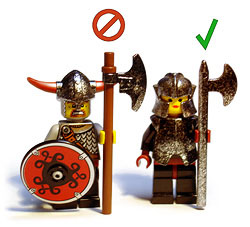 Poor Olaf's axe isn't pointy enough to Charge with like Betty's. But players might let him Charge with his horns if they're feeling generous.
Elements shown: LEGO own photo Uploaded, final
Ramming enemies head-on is a time-honored Charging technique, but a statistically significant number of minifigs prefer to lead with a weapon rather than their own bodies. Not all Close Combat weapons are appropriate for a Charging attack. A Charging weapon must be a Two-Handed Weapon or a Heavy Weapon swung or thrust with both hands (3.1: Close Combat Weapons). For minifigs Charging on foot, the weapon must be designed for spear-like thrusts (lances, battering rams, rifle-mounted bayonets). For minifigs flying or falling out of the sky, any type of Heavy or Two-Handed Weapon can be used in a mighty two-handed downward strike. Players may come up with more exotic examples on a special-case basis. A Charging berserker might use a horned helmet or a spiked shield, for instance, if all players agree to allow it.  own drawing Uploaded, final
A Charge attack is treated as a special kind of Close Combat maneuver. Due to the rush of the Charge, the attacker and defender are each limited to a single attack and Parry. They may not use Angry Inches. If an attacking minifig hits his target with a Charging Weapon Strike, he can spend his MOM to add +1 If his Charging attack misses, the attacker keeps his MOM and must either Collide with the target (if the target is directly in his path) or continue running in a straight line to the limit of his Move inches. Charging attacks may only be Parried with a Shield (5.2: Close Combat). When Parrying isn't possible, Bailing is often the best response to a Charging attack. 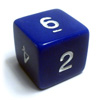 Element shown: Your POP
When a minifig with Momentum crashes into another minifig, a Collision occurs. A Collision is part of normal movement and doesn't cost an Action. Even the most heavily-armored minifig is too soft and squishy to cause any direct damage in a crash, but a Charging minifig has the chance to send targets flying if his Momentum is enough to overcome their Physical Opposition. In the right situations, this can be more entertaining than mere damage would have been, knocking minifigs out of formation, off the sides of bridges or parapets, and into unfavorable tactical positions like minefields or active volcanoes. A minifig in a Collision spends his MOM to cause +1 A target minifig struck by a Collision automatically resists it with one die of Physical Opposition (one POP), rolling 1 If there are inches of KnockBack left remaining, then the target minifig is Knocked Back that many inches and Disrupted (4.1: Movement). The Charging minifig must continue running forward to the limit of its Move inches for the turn. If two minifigs cause a Collision by Charging directly at each other, they both inflict KnockBack on each other at the same time. If a Knocked Back minifig is prevented from flying the full distance by slamming into a larger obstacle, he receives one point of Smash damage for every inch of KnockBack prevented, cumulative with any other Damage received from the Charge. | ||||||||||||||||||||||||||||||||||||||||||||||||||||||||||||||||||||||||||||||||||||||||||||||||||||||||||||||||||||||||||||
|
|
|


 -2 reduces the damage to 1.
 Action die. An eight! Because it's a six or greater, he gets an Over the Top Benny to improve his shot.
 +1,
+1,