|



|
|
|
|
|
Chapter Four
The Player Turn
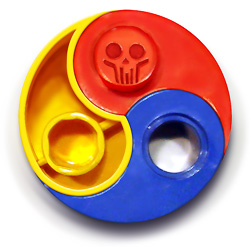 The BrikThulhian Troika can be thought to represent the cycle of Movement, Action, and Response. But on the other hand it can really be thought to represent just about anything.
During a player’s turn, each of his or her units may engage in whatever Movement is allowed by its Move statistic, and may take one major Action (preferably an attack). Meanwhile, other players' units can use unspent Actions in Response to the active player's offensive behavior. 4.1 Movement  During Movement, a minifig's Move rating of 5" allows him to move five inches in any direction - he can run across five inches of level ground, climb five inches’ worth of stairs or ladders, or leap over five inches of chasm.
His Movement is limited in a couple of ways. He can’t pass through solid obstacles or leap higher than 1” (three bricks) in a single jump. Difficult types of Movement might slow the minifig to Half Speed. Movement that requires the use of one or both arms (swimming, crawling, climbing ladders, or swinging on ropes, for example) will prevent the minifig from using those arms to make attacks or perform other manual Actions. If a minifig moves within Close Combat striking distance of an opposing minifig who still has an Action to spend, the opponent automatically attacks him, unless the opposing player says otherwise. If the minifig decides to Parry the attack, they are both entered into Close Combat (5.2: Close Combat) and the minifig’s Movement is over for the turn. If he declines to Parry and survives, he can ignore the attack and continue moving normally. Impaired Movement A minifig is not always able to run around at full speed. Difficult conditions or activities can slow him to Half Speed or Stop his Movement entirely for that turn. If he's taken violently off his feet, whether by a Shove, an Explosion, or from desperately Bailing out of the way of impending destruction, it will cause him to become Disrupted and defenseless until his next turn.
Activities marked with a
 cost the minifig's Action for the turn.
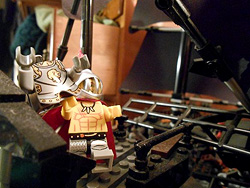 With his ship taking heavy damage, Oscar the Strong decides to remove his armor rather than risk drowning if it sinks.
Minor Activities Although a minifig can only take one major Action per turn, there are lesser activities that are too minor to count against this limit. Activities that require no particular attention, aiming, or dice rolls are either free or treated as an impairment to Movement rather than spending the minifig's Action. Simple acts, like picking up or dropping objects, holding conversations, or sneezing don't slow a minifig down at all. More strenuous activities may reduce a minifig's Movement to Half Speed, Stop them completely, or leave them Disrupted. Half Speed Actions or conditions that actively burden a minifig, such as wearing Heavy Armor, carrying or dragging a heavy object (the size of a minifig or 2x4 brick), or engaging in difficult movement requiring the use of both arms (swimming, crawling, climbing ropes, etc.) will reduce a minifig's Movement to Half Speed. While moving at Half Speed, all Movement costs twice the usual number of Move inches - that is to say, moving two inches of distance across the battlefield costs four inches of the minifig's Move ability instead of two. If he can jump, he can only jump half as far and half as high. If he can fly, he can only fly half as fast. If a minifig is already reduced to Half Speed, additional Half Speed conditions have no effect - he's still at Half Speed. The important exception is while swimming: minifigs who try to swim while wearing Body Armor or carrying heavy objects are Stopped and will drown if they don't dispose of their burdens before the end of their following turn. Stopped If a minifig is Stopped, his Movement is over for the turn, regardless of whether he had five inches of Move left or zero. He regains his full Movement on the following turn, unless something is still Stopping him. Even when reduced to Half Speed or Stopped, a minifig may still perform regular Actions and minor activities if it makes sense to do so. He may be immobilized with his face caught in a bear trap, but that doesn't prevent him from opening an emergency panel and mashing a self-destruct button if it's within arm's reach. 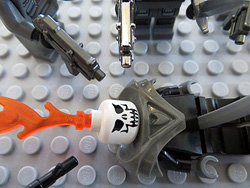 Disrupted, skewered, and surrounded by hostile gunmen, a Warhead Shard is still a dangerous adversary.
Disrupted Events that knock a minifig violently off his feet, whether voluntarily or otherwise, cause him to become Disrupted. This most often happens when a minifig is knocked over by the effects of a Shove, Explosion, or Collision, or when he's forced to Bail out of the way of oncoming damage. A Disrupted minifig is helpless, and may not attempt any further Movement or Action until his following turn, not even to Counter a Close Combat attack. Until then, he is considered an inanimate object, granting +1 to hit with Ranged Attacks, and granting Automatic Hits for attackers standing close enough to touch him directly with their weapons. Heroes can attempt Heroic Feats even while they're Disrupted, sometimes allowing them to move or act when they normally shouldn't be able to.
On their following turn, minifigs recover from Disruption, getting up and moving at Half Speed for their full turn but otherwise acting as normal. 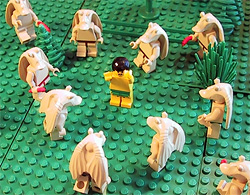 Unarmed, naked, and surrounded by sausage-wielding Dungans, this minifig's best option is to Sprint like hell and never look back.
Sprinting When speed is critical, a minifig (or any mobile unit) can spend his Action to Sprint, rolling his Action die and giving himself that many extra inches of Move.The minifig's entire Movement for the turn (including the Sprint) must be in a straight line forward. His path may go up or down and over any obstacles that he can leap over without having to stop and climb, but it may not turn to the right or left by even a tiny amount.Sprinting minifigs may not engage in any activity that would break their run, like opening doors or typing in security codes. Minifigs moving at Half Speed can put in the extra effort to Sprint, but the extra Sprint inches are also at Half Speed. Sprinting can be combined with a Charge attack (5.4: Charge!) as part of the same Action, spending only the single Action Die. Minifigs Sprinting in a group can roll a single Action die for the entire group's Sprint distance, for the sake of convenience. The die roll for Sprinting can benefit from Bonus Dice like any other roll (1.2: Numbers) - the extra dice keep adding more inches to the Sprint, allowing truly ridiculous straight-line speed. By tradition, if a series of Critical Successes in a Sprint roll suddenly ends with a roll of one, it's a special kind of Critical Failure: the unit is unable to stop itself, and must run the full distance allowed by the extra Bonus Dice, even if he runs into a wall or off the table.
4.2 Action  Any act that requires a minifig’s focused attention or concentrated physical effort is an Action. Due to the limitations of time and plastic brainpower, a normal minifig is limited to one Action per turn. He can use this single Action before, after, or in the middle of his Movement, but he only gets one, so he should spend it wisely (which is to say, as unwisely as possible). His spent Action returns at the beginning of his next turn.
In ideal circumstances, a minifig will almost always use his Action to make an attack (5.1: Making Attacks). But even the most belligerent minifigs will concede that less violent Actions are sometimes called for in order to set up better attacks later. Use Ratings Minifigs are clumsy and easily distracted, and Actions are rarely automatic successes. Each Action is given a Use rating describing its relative difficulty. Except for the most trivial types of Action, a minifig attempting an Action must make an Action Roll, rolling his Action die to see if his attempt succeeds. If his Action Roll is equal to or higher than the Action's Use rating, then the Action is a success. If it's lower, the Action fails, and the minifig suffers whatever consequences logically result. 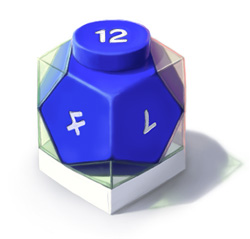 Dice-worshipping Dodekube cultists believe that logic is an illusion and that all of reality is nothing more than the cosmic dice rolls of disinterested Human gods. Their belief arises from the fact that even the most sober minifigs have sometimes been able to "see the dice."
Weapons and other equipment items have standard Use numbers in their descriptions (Chapter 3: Minifig Weapons). Minifigs attacking with or utilizing these items roll their Action die against those Use numbers. Otherwise, there are all kinds of unusual tasks that minifigs might attempt, from the trivial to the impossible. Most will have a default Use rating of 3; players may agree on a higher or lower difficulty as seems appropriate. For truly exceptional Actions, the Use rating can be so high that minifigs have to pin their hopes on adding one or more Bonus Dice to the roll to have any chance of matching it. Over the Top Action No matter how minor or Herculean an Action may be, a minifig of unusual skill or luck can find ways to execute it with extra flair.An Action Roll doesn't score Critical Successes the same way as other die rolls (1.2: Numbers). Instead, any time a minifig rolls a six or higher on his Action die (before adding or subtracting any modifiers) to perform an Action, he can take the Action Over the Top. Over the Top is only earned by the Action die itself. Other dice added to an Action Roll as Bonus Dice score regular Critical Successes instead, as do Action dice rolled as Damage for Close Combat weapons.
While a six is the highest number a normal minifig can naturally roll on his
 Action die, other unit types may have larger or smaller dice. Heroes, introduced in Chapter Six: Minifig Heroes, have a Action die, other unit types may have larger or smaller dice. Heroes, introduced in Chapter Six: Minifig Heroes, have a  Action die, and can go Over the Top on a natural roll of six, seven, eight, nine, or ten. Action die, and can go Over the Top on a natural roll of six, seven, eight, nine, or ten.Incompetent units with an Action Die of  , introduced in Chapter Ten: Creatures, can never roll high enough to go Over the Top. As consolation, they are allowed to earn Critical Successes on their Action Rolls, gaining a Bonus d4 on a natural roll of 4. , introduced in Chapter Ten: Creatures, can never roll high enough to go Over the Top. As consolation, they are allowed to earn Critical Successes on their Action Rolls, gaining a Bonus d4 on a natural roll of 4.
When a minifig goes Over the Top with an Action, he receives a special Bonus Die, called a Benny, to amplify that Action. An Over the Top Benny can be spent to add +1d6 to the Action Roll or to any of the Action's existing stats (+1d6 inches to the distance of a Sprint, for instance, but not +1d6 inches to the Range of a Close Combat attack, which has no existing Range stat). If the Over the Top Benny is used to add Damage to an attack, it adds one more of the attack's existing Damage dice. A 1d6+1 Rifle gets an Over the Top bonus of +1d6, while a 1d10 Exp Grenade gets an Over the Top bonus of +1d10 Exp, making the Explosion twice as large (8.4: Heavy Explosives).
Regardless of Action or Damage type, rolling a Critical Success on an Over the Top Benny die adds a +1d6 as normal.
In some cases, rather than adding a die to a stat, the Over the Top Benny can be spent to avoid a negative consequence of an Action, such as allowing a Bailing minifig to land acrobatically and avoid being Disrupted (4.3: Enemy Response). An Over the Top Benny can als be used to make an attack more precise: a minifig might spend it to change "I was shooting at the dragon" to "I was shooting at the dragon's left eye," if his original Action Roll was high enough to hit the eye despite the penalties for small target size.
Long Actions Some Actions are so involved or time-consuming that they take up a minifig’s entire turn, even if they aren’t difficult enough to require an Action Roll. These are called Full-Round Actions. Examples include piloting a vehicle, operating a computer, putting on a suit of plate mail, rowing a rowboat, or reading a wargaming rulebook. Once engaged in a Full-Round Action, a minifig is Stopped and can't engage in any other type of Action or Movement of his own for the rest of the turn, although he may still be moved around by vehicles or other units (for instance, if he's using a Full-Round Action to ride a Horse). A Full-Round Action that extends over multiple turns is an Extended Action. The most common Extended Action for minifigs, often extending over a very large number of turns, is "Being Dead." 4.3 Enemy Response  If a minifig doesn't spend his Action on his own turn, he can save it to use in response to other units' activity. A minifig can use a Response Action to fire at scouts as they pop out from behind cover, to whack soldiers that stray into range of his melee weapon, or to pull the self-destruct lever at the exact moment when the final invitees have boarded the cruise liner for his birthday party. Of course, his enemies are just as free to use saved Actions during his turn as well, so he should tread carefully.
To take a Response Action, a minifig must have an unspent Action from his previous turn. He can move up to one free inch (known as an Angry Inch (5.2: Close Combat)), if necessary, in order to press, grab, or otherwise operate a critical object (to pull a lever or slam a door, for instance), or to position himself in range of a target for a Close Combat or Ranged Attack. An Angry Inch doesn't cost any Move inches. Cone of Vision A Responding minifig must be aware of the specific action or movement he's reacting to, and in a timely enough fashion to make a proper Response. In most cases, this means he has to be able to see it. If he sees an enemy soldier raise a rifle and take aim, he may have time to dive for cover. If all he knows is that he heard a gunshot, it's too late. A minifig's Cone of Vision points in whichever direction his head is facing, and forty-five degrees to either side, making a complete cone of ninety degrees. If an object or event is within that field of view, the minifig can see it; if not, he can't. Whenever it's hard to tell whether or not an object falls within that cone, a quick What I Say Goes roll resolves the issue. Who Acts First Even if a minifig can see disaster about to strike, he won't always be fast enough to respond in time. In some cases, a minifig will have plenty of time to make a Response Action. If an enemy's running up with a knife while the minifig's swinging a polearm, or if the enemy's running up with a polearm while the minifig's aiming a pistol, or if the enemy's running up with a pistol while the minifig's hiding in an underground bunker with a hand on the magma release lever, the minifig is going to have plenty of time to act before the enemy gets close enough to do anything about it. If a minifig is able to take an Action or Response Action while his target is still at least an inch away from taking its own Action or Response Action, then the minifig's Action happens first. Otherwise, both Actions occur simultaneously if possible, and with the higher Action Roll going first otherwise.
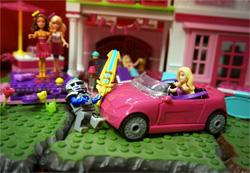
Long before he became the Emperor of Akkadia, the feats of Piltogg were already legendary. Strengthened by the secret arts of Running Five Miles, Piltogg was able to Bail out of a deadly NegaBlok collision in an event known as That Time He Got Hit by a Car but Rolled Out of It.
While the recommended Response to any enemy behavior is to attack with every available weapon, there are times when a minifig's best bet is to make a desperate leap for safety. He may be dodging an oncoming truck, jumping out of an exploding helicopter, or diving behind cover when an enemy gun turret opens fire. Minifigs are not able to Sprint as a Response Action. Instead, assuming their movement type would logically allow it, they have the option to Bail. A Bailing minifig rolls his Action die and can dive to any spot within that many inches of his current position, ending up lying prone on the ground and Disrupted. A minifig who's reduced to Half Speed also Bails at Half Speed, diving only one real inch for every two Bail inches. If a minifig is at Half Speed because he's carrying a heavy burden, he can drop it before he Bails and leap the full distance.
| |||||||||||||||||||||||||||||||||||||||||||||||||||||||||||||||||||||||||||||||||||||||||||||||||||||||||||||||||||||||||||||||||||||||||||||||||||||||||||||||||||||||||||
|
|
|


 dead)
dead)