 |













|
|
|
|
|
Chapter D
The Dice
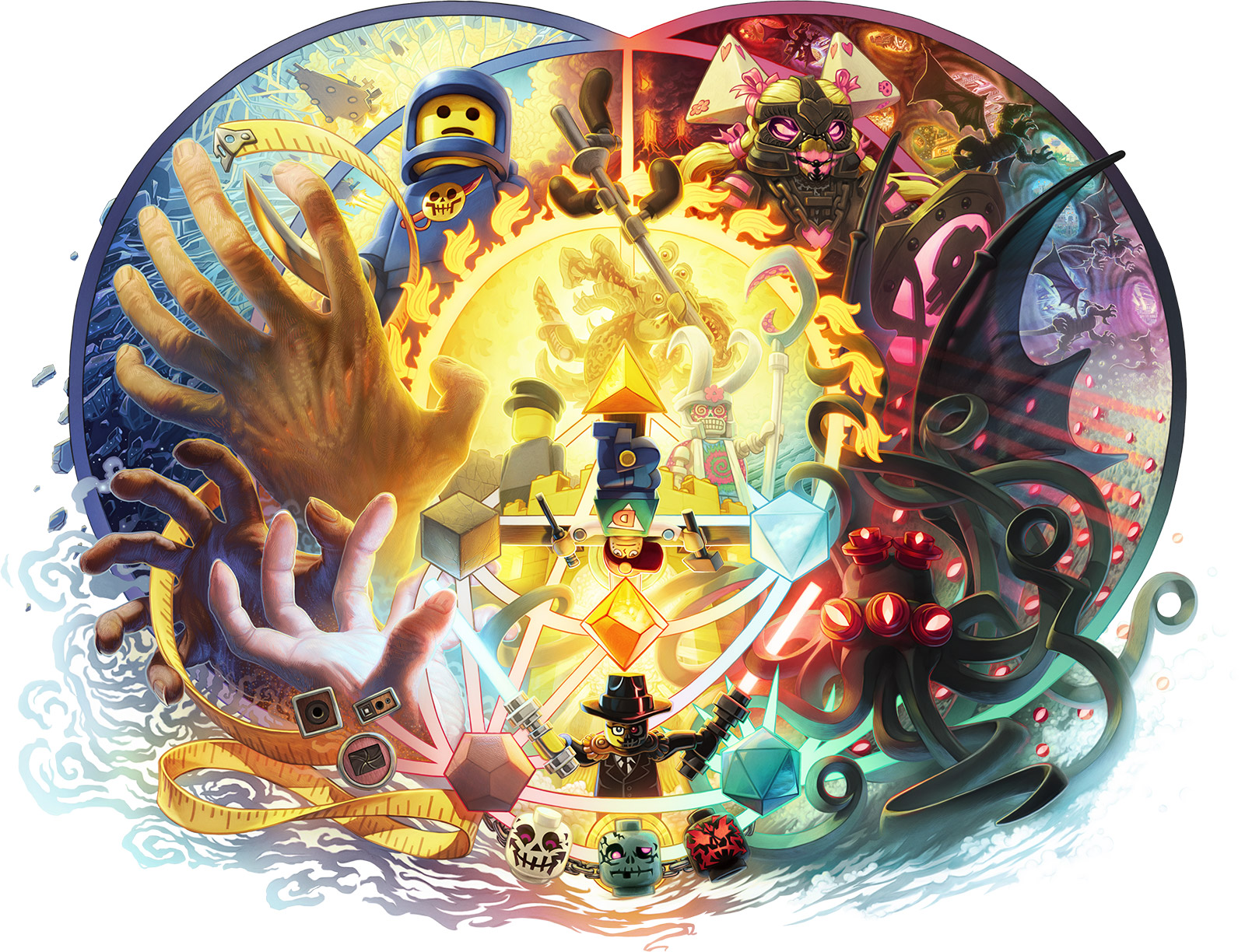
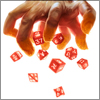
All action within the BrikVerse originates in the Farce, and the Farce expresses Itself through the six archetypal Dice. These Dice shower down throughout the lives of minifigs, determining their every success and failure in an uncaring downpour, imperceptible without magikal or pharmeceutikal aid. Few minifigs are granted the vision to see the Dice, and those who do are often driven permanently and horrifyingly sane.
To respectable minifigs, Dice are a myth, superstition, or blasphemy. Minifigs of all ages get their mouths washed with soap if they're caught saying the the four-letter D-word in the wrong company. But to Dieists whose snake eyes have been opened, the Dice are real - the living instruments of the Farce itself, willful and treacherous and definitely not on anyone's side. D.1 Dice and Diemons The creation of the infinite BrikVerses are the purview of Humans, but the will of those realities is decided by the Dieties of higher and lower Diemensions who express their influence through the unfathomable Dice. The only element of BrikWars outside of Humans' direct control, the geometry of a rolling Die is a reflection of its internal Diemons, tiny elemental spirits who act as polyhedral agents of chaos to disrupt the best-laid plans of Humans and minifigs. When minifigs manage to harness the powers of one or more Dice, they can be used to create SuperNatural Effects according to the elemental properties of the Dice's inner Diemons', but Diemons have a will of their own. Depending on his nature, a minifig may be able to summon or release the Diemons from his Dice. Less commonly, Diemons can escape on their own, crossing the barriers between Diemensions and leading unpredictable Dice rebellions. When a Diemon appears in the real world, it appears as an elemental Vermin with Size 0" and Armor:0, normally taking the form of a MunchFig or other small one-piece creature. During its turn, a Diemon can either engage in Movement with its own Die roll worth of inches, or take a single Action using its own Die as an Action die. A Diemon who earns a Bonus Die from its Move roll can spend the extra die on an Action, and vice versa.
In addition to these attributes, each variety of Diemon has one extra bonus ability or advantage according to its elemental nature.  In the crashing plasma storms of the Half-Ass Vortex, everything is in constant motion and unrest, and the line between Fudge and Poop can be difficult to distinguish. The d4 is the likeliest of all the dice to betray its owner, and also the likeliest to multiply and spread out of control. SuperNatural  s used for Damage always cause some form of continuing Burning effect, making them appropriate for fantasy mainstays like fireballs and acid sprays, or for post-apocalyptic nightmare fuel like zombie infection, fundamentalist religious evangelism, and internet drama. s used for Damage always cause some form of continuing Burning effect, making them appropriate for fantasy mainstays like fireballs and acid sprays, or for post-apocalyptic nightmare fuel like zombie infection, fundamentalist religious evangelism, and internet drama. 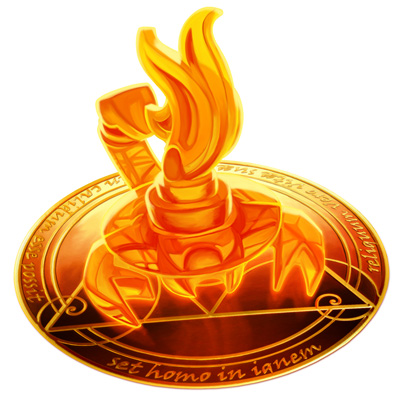
A d4's Diemon is a 4pion, and it mindlessly consumes everything in its path. 4pions typically take the form of shelled scorpions and other venomous Vermin. A 4pion burns with its own elemental corrosion, damaging objects it touches. A 4pion is immune to the effects of its own element (an Acid 4pion can't be harmed by acid attacks, for example), but on a poor roll it can burn itself out of existence without warning. At the beginning of its turn, a 4pion makes a Burning Roll as if it were on Fire (Chapter F: Field Hazards), rolling 1d4. If the Burning Roll is a 1, then the 4pion burns out and disappears, and its d4 returns to its owner. Otherwise, the Burning works as normal: the Burning spreads to one object the 4pion is in contact with, as long as the object has a Weight class less than the number rolled on the Burning Roll (7.1: Structure). The Solid 6creant  The Rainbow Block Grid is an endless block of multicolored architecture spanning to infinity in every direction.
As the blockiest die, the d6 is most closely attuned to the physical structure of a brick-built universe. The SuperNatural  is the Die of blocks, and it's dull and steady as dirt. is the Die of blocks, and it's dull and steady as dirt.
The d6's Diemon is the 6creant, who enjoys a physical size and structure that other Diemons lack. 6creants may appear as skeletons, golems, or terrifying minifig-shaped collections of bricks known as BlokBots. The Ingenious 8vian  The PlayTrix Codex is a realm of plasticity and brutal puns, where time and space are octofurcated into 8th-Diemensional pretzels by unforgivable wordplay.
The SuperNatural  is the Die of wind, and particularly of sprays and breath weapons. Any time a SuperNatural d8 is used to add inches of Range, the player has the option to add +1 Firing Arc to the final Effect if it's appropriate to do so. is the Die of wind, and particularly of sprays and breath weapons. Any time a SuperNatural d8 is used to add inches of Range, the player has the option to add +1 Firing Arc to the final Effect if it's appropriate to do so.
The d8's 8vian is a Diemon of thought and breath. Taking the forms of birds, bats, and spiders, 8vians vary in nature more than the Diemons of other dice. All 8vians have a spider crawling ability that lets them traverse surfaces at any angle. When an 8vian is created, it may choose a single  -based Specialty from any standard minifig specialist (for instance, it might choose the Medik's Ker-Triage! Specialty and act as an 8vian Medik from that moment forward (10.2: The Medik)). If the Specialty requires Tools, the 8vians will have to find their own. If the 8vian chooses no Specialty, it gains Flight ability instead. -based Specialty from any standard minifig specialist (for instance, it might choose the Medik's Ker-Triage! Specialty and act as an 8vian Medik from that moment forward (10.2: The Medik)). If the Specialty requires Tools, the 8vians will have to find their own. If the 8vian chooses no Specialty, it gains Flight ability instead.The Exceptional 10amyte  In the interlocked Daemonic realms of The Circles of Hellius, warfare and conflict play out in infinite variety and forms, acting as the driving engine of all decent music in the BrikVerse.
The SuperNatural  is the Die of Explosions and metal. Regardless of how it's used, d10s add an Explosion-like radius to the target area of any Effect, and they can be used to raise or lower a target's Structure Level. is the Die of Explosions and metal. Regardless of how it's used, d10s add an Explosion-like radius to the target area of any Effect, and they can be used to raise or lower a target's Structure Level. What happens if a minifig uses a d8 and a d10 in the same Effect? Can he create an Arc of Explosions? SuperNatural Effects are based on a unit's SuperNatural Cliché, not on which dice it happens to be using. If a wizard is casting Spray of Fireballs, then you already know what those d8s and d10s mean. If the wizard is rolling d8s and d10s and trying to make up an Effect after the fact, then the player is doing it wrong.
The Diemon of a d10 is the 10amyte, who prefers to take the form of small explosives, a golden idol, or, occasionally, an electric guitar. A 10amyte's special ability is simple: at any moment, for any reason, it can blow itself up in a 1d10 Explosion. This self-destruction is instantaneous and doesn't require an Action. The 10amyte's d10 is then returned to its owner. The Elusive 12vard  The Magistik Czat is a Gnostic realm of SigFigs and other avatars, whose transitory forms are shaped entirely by momentary breaks in Human apathy.
The SuperNatural  is the unpredictable Die of magik and energy. Representing pure SuperNatural energy disconnected from any "natural" element, it's available only to the most divine or esoteric beings. A d12 used for Range can allow Effects to pass through obstacles for those Range inches; a d12 used for Damage ignores Deflection for those points of Damage. is the unpredictable Die of magik and energy. Representing pure SuperNatural energy disconnected from any "natural" element, it's available only to the most divine or esoteric beings. A d12 used for Range can allow Effects to pass through obstacles for those Range inches; a d12 used for Damage ignores Deflection for those points of Damage.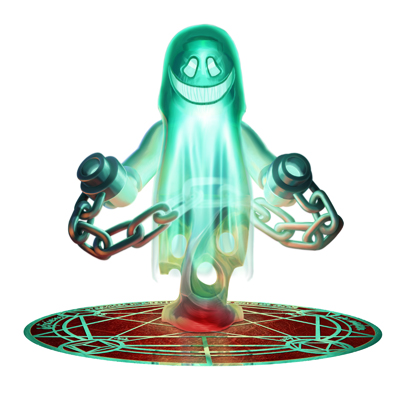
The 12vard is the rarely-seen Diemon of a d12, usually appearing (if it's visible at all) as a ghost or a mysterious ball of light. A 12vard can phase itself (along with any objects it's carrying) through solid objects during Movement, making it immune to any non-d12 Damage and allowing it to easily bypass physical obstacles. It's phasing range is limited, however; the Diemon must un-phase at the end of each turn. If the 12vard is still inside of an obstacle at the end of its Movement, it's immediately annihilated and its d12 is returned to its owner.  Rl'yego is a warped realm of hyperbolic geometries and illegal building techniques. Its colors outside of space and time are rumored to have been the source of the Gray Shift.
Water and chaos are associated with the SuperNatural d20, but minifig Mystiks have yet to encounter one of these mind-shattering Dice without suffering immediate and permanent Ensanity. Along with an irrational number of other non-Euklidean dice like the Dodekube of Non-Consensual Enlightenment, the d20 is available only to BrikThulhu. D.2 SuperNatural Powers 
The most magikally powerful military force in the BrikVerse, the fighting battle mages and soldiers of RedRover's Imperial Magikstrate incorporate magikal effects into all levels of their fight to restore the lost Uasciri Empire.
BrikWiki entry: The Imperial Magikstrate
Illustration generously sponsored by RedRover In every age, there are minifigs gifted with abilities that defy natural explanation, allowing them to grab the laws of Physiks and twist them into pretzels. Some are blessed with arcane knowledge, psychik ability, divine favor, or affinity with the Farce. Others attribute their powers to martial-arts mastery, genetik mutation, or an unforeseen reaction to the rays of a yellow sun. Many have no explanation other than complete Koincidence and dumb luck. It would be impossible to list every super power, spell, psychik ability, and avenue of divine intervention that might occur to the imaginations of players. Instead, SuperNatural Powers in BrikWars are based on a system of SuperNatural Clichés and powered by SuperNatural Dice. The SuperNatural Cliché In the same way that some minifigs become Heroes through the development of an Action-Hero Cliché; other minifigs become SuperNatural by pursuing a SuperNatural Cliché. (A few develop both types and become SuperNaturalHeroes, but this is largely redundant and is not considered the most efficient use of their efforts.) DC Comics and Marvel Comics tirelessly defend their joint trademark on the word "SUPERHERO™." Players who have Heroes that are also Super should avoid making the mistake of ever using the two descriptors in conjunction, because corporate rights are more important than Humans being allowed to use words.
SuperNaturally-powered minifigs draw their stereotypes from the same video games and cartoons as Heroic ones, but their powers are inspired by the supporting cast as often as by the main protagonists and villains.
When choosing a SuperNatural Cliché, it's best to have a specific character in mind - three units with the "Vampire" Cliché might have completely different powers if one is based on Bram Stoker's Dracula, one is pulled from an RPG sourcebook, and the third is just extra-sparkly.
Where Heroes develop ridiculous accents as an involuntary side-effect of Heroism, SuperNatural units develop funny voices on purpose, in response to years of persecution from jaded skeptiks and jealous MereMortals. The more SuperNatural power a unit collects, the greater the SuperNatural chip on his shoulder grows, and the more likely he is to limit himself to speaking only in booming echoes, testosterone growls, or mysterious whispers. Before long, he's put together a ludicrous outfit and accessories to match, not realizing that these affectations only result in being taken even less seriously. 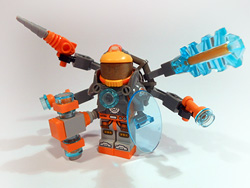 Little is known about the Foreman, one of the founding members of the Planetcrackers, but plenty is known about the Foreman's gear. The experimental armor is equipped with jumpboots, a standard portable drill, an energized rock saw, a pair of gravity manipulators, a solidslight shield, and the fabled beam-hammer Stonesmite.
SuperNatural Talismans A SuperNatural unit's ridiculous accessories do more than just make him an easy target for mockery - they're the physical Talismans that bind the SuperNatural Dice to his will. As with Minds, Weapons, and other instruments of mayhem, each of a SuperNatural unit's SuperNatural Dice must be based in a specific physical element so that enemies have the chance to target them for destruction or theft. An element that carries a SuperNatural Die is called a Talisman, and a separate Talisman is required for each SuperNatural Die. The powers of these Talismans are controlled by whatever unit possesses them, inevitably making them the targets of avarice and violence.
Any object can be used as a Talisman and imbued with SuperNatural power. SuperNatural abilities can be placed directly into a minifig's body parts - skulls, beards, and mustaches are popular Talismans - but machines, animals, fancy outfits, and random inanimate objects can be Talismans as well, through enchantment, possession, alien teknology, or by a minifig's failure to realize the power was within himself all along. The more SuperNatural Dice under a unit's control, the more Talismans it has to carry. It's hard for SuperNatural objects to be subtle, especially when glowing crystals tend to be their main ingredient. SuperNatural units, devices, and Vehicles become increasingly more ostentatious and ridiculous as they become more powerful. D.3 SuperNatural Effects The SuperNatural power of a unit or object is determined by the SuperNatural Dice under its control. A unit spends its Dice, singly or in combinations, to produce SuperNatural Effects appropriate to its own Cliché, or to the Clichés of the Talismans the Dice are bound to. The SuperNatural Effects can be used to create or modify the Actions, Movement, or attributes of units, Vehicles, and equipment, or to affect the results of die rolls as they happen. Each SuperNatural Die may be spent once per turn to modify one Aspect of a SuperNatural Effect, described further below. Like Action dice, a spent SuperNatural Die returns at the beginning of its controlling unit's turn and becomes available to spend again, unless the unit decides to keep it active in a Lasting Effect or as a summoned Diemon. Effect Delivery 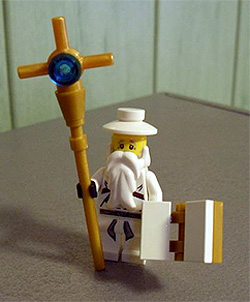 In the Konfederacja and the Republik of Magyar, priests of the Church of the Great Creator accompany troops to provide spiritual guidance and morale. Armed with Holy Staves, these cleriks are known for bringing about wonders that even the most educated are unable to explain.
By default, minifigs can channel their SuperNatural powers by touching a target with their Bare Hands. For willing targets or inanimate objects, this is automatic and requires no Action. To touch a hostile target, the SuperNatural unit must successfully Shove or Grab them Close Combat. For targets that aren't close enough to touch (or who are too difficult to Shove or Grab), he has to add SuperNatural Range inches to move the Effect from himself to the target. In either case, aiming SuperNatural Effects at a hostile or distant target spends the SuperNatural unit's Action for the turn.
Wands and Staves are special categories of minifig weapons that have no Damage rating of their own, but can be used to extend the reach of a minifig's SuperNatural Effects by a successful touch, melee attack, or ranged attack. A Wand is a Small-sized weapon that can be used in one hand, while a Staff is Medium-sized and is Two-Handed. Wands and Staves can be used in both Ranged and Close Combat, and are often made Talismans in their own right. Lasting Effects Under normal circumstances, spent SuperNatural Dice are returned to their owner at the beginning of the owner's next turn. In some cases, however, units may wish to leave one or more of the Dice on their targets as a Lasting Effect. The Die is kept next to the affected target and its Effect continues for as long as it remains - an extra Armor d6 for a soldier, an animating Action d4 for an undead skeleton, and a Curse d10 on an enemy Hero can all extend indefinitely, no matter how far away the target wanders, until the SuperNatural minifig who owns the Dice is incapacitated or decides to cancel their Effects on his own. Lasting Effects are limited by the SuperNatural Dice left behind. For example, a minifig may spend an Arc Range d8 plus an Action d6 to Bless multiple units in an Arc during his turn, but since he only has the single d6 to leave behind, only one of the targets can keep the Blessing as a Lasting Effect on the turns following. A SuperNatural unit can cancel any of its Lasting Effects at any time, including during an opponent's turn, but the unit only gets its SuperNatural Dice back at the beginning of its own next turn. The unit is allowed to sustain a previous turn's Lasting Effect right up to the beginning of its turn and then cancel the Effect to get the Dice back immediately. Rolling SuperNatural Dice SuperNatural units don't need to decide ahead of time how many SuperNatural Dice they're going to spend, if any. SuperNatural Dice are spent and rolled one by one as needed. However, SuperNatural Dice can only affect events as they occur - they can't change what's already taken place and been resolved. It's important to know exactly when and where an Effect is targeted. If a BattleMage has his hand on the shoulder of an allied bowman firing an arrow, the BattleMage can spend a SuperNatural Action Die to boost the bowman's Action Roll directly. Because he's touching the bowman and not the weapon, he would have to buy Range and spend an Action to have an Effect that reached the bow itself - turning the arrows into Explosive or Fire Arrows, for instance. If the bowman's attack hits, but the Damage Roll isn't high enough, then it's too late to boost the attributes of the bow - the arrow has already struck the target. The BattleMage must now buy Range all the way out to where the arrow is striking if he wants to add additional Damage Dice. SuperNatural Bonus Dice Like regular dice, a SuperNatural Die can earn a Bonus Die whenever it lands on its highest-numbered face. But the SuperNatural Bonus Dice behave differently, due to the chaotic nature of the Farce that powers them. SuperNatural Bonus Dice are always the same size as the SuperNatural Die that spawned them. A roll of 8 on a SuperNatural d8 earns a SuperNatural Bonus d8, for instance. And these SuperNatural Bonus Dice can earn SuperNatural Bonus Dice of their own. Unlike regular Bonus Dice, players who earn SuperNatural Bonus Dice don't get to decide how or whether to spend them. A SuperNatural Bonus Die automatically adds to the same Aspect as the SuperNatural Die that spawned it. These supercharged Aspects are normally beneficial, but occasionally disastrous - a couple extra inches of Explosion Radius, for instance, can lead to all kinds of unintended consequences if the player wasn't planning for them. Fumble Dice Whenever a SuperNatural Die rolls a "1," it doesn't add anything to its Aspect. Instead, it turns into a traitorous Fumble Die, and is handed over to an opponent of the player's choice to use in sabotaging the Effect. The enemy may use the Fumble Die for any Aspect, adding or subtracting in whatever way seems best designed to thwart the Effect the enemy's favor - for instance, sending the Effect in the wrong direction, or causing it to strengthen a target rather than harm it. The only limitation is that the opposing player must come up with a story to explain why the Effect Fumbled in that particular way. A Fumble Die that rolls its highest-numbered face can spawn SuperNatural Bonus Fumble Dice for the enemy player. A Fumble Die that rolls a "1" is double-Fumbled right back to the original SuperNatural unit's control. Regardless of how it's used, the Fumble Die returns to its owner at the beginning of the next turn as usual, feeling no remorse for its transgression. Physikal Manifestation 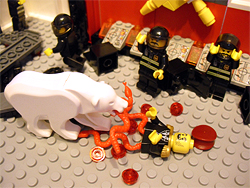 These conscripts are unable to explain to Admiral Gradenko why they decided to summon a polar bear onto the Soviet flagship. Luckily, the bear is able to bring the discussion to a close with several convincing points.
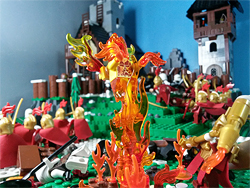 Kaptain Jy'udi, Heroine of Esduin, takes advantage of an abandoned Frostborne campfire to commune with the spirits of fire and summon a fire matriarch.
Many SuperNatural Effects occur as invisible stat boosts or penalties, having no visual or physical existence that minifigs can detect. More tangible Effects might involve the creation of a SuperNatural Object, like a ball of fire, energy beams, wings, claws, a solid wall, or loaves and fishes. More ambitious Effects might conjure up a SuperNatural Creature, like a steel golem, a lightning rat, a swarm of duck-sized horses, or a manic pixie dream gorilla. SuperNatural Objects and SuperNatural Creatures only last as long as the SuperNatural unit maintains the Effect that created them. When the Effect ends, the objects and creatures disappear, and their SuperNatural Dice return to the controlling unit at the beginning of its next turn. SuperNatural Objects
A SuperNatural Effect can take whatever form is appropriate to its nature. By default, a SuperNatural Effect can freely produce a generic object of Size 0", with no weight or substance, and zeroes for all stats. A SuperNaturally-created object might start as a knife that does no damage, a rope that can't support any weight, or a helmet that protects against nothing. By themselves, these are fine for creating dramatic illusions or spooky sounds, but if they're going to be used for tangible effects then their stats will need to be boosted with SuperNatural Dice. For each SuperNatural Die used in an Effect, the Use rating of the created object increases by one, along with the object's maximum Size inches, Weapon Size inches, or Explosive Size. Summoned Items Rather than creating SuperNatural Objects from scratch, a unit can spend SuperNatural Die rolls to "buy" regular minifig equipment into existence (Chapter Three: Minifig Weapons). This can be useful for equipment items whose abilities aren't easily replicated by SuperNatural Dice. Summoning the object must fit into the unit's SuperNatural Cliché, and the unit must spend at least as many SuperNatural Dice as the object's Size (or Weapon Size or Explosive Size, if applicable). The player chooses the item or unit to purchase, and then spends SuperNatural Dice to roll against its SN cost. If the roll is equal or higher, the SuperNatural unit receives the object as planned. If the roll is lower, the dice are wasted. If one of the Dice rolls a 1, then it's Fumbled and may be used to sabotage the purchased object. If all of the Dice roll a 1, then the entire purchase is a Fumble and the unit may discover that it's summoned something it didn't want to. Once created, SuperNaturally purchased items can be augmented by additional SuperNatural Dice like any other object. SuperNatural Creatures
SuperNatural Effects can also take the form of summoned Creatures. SuperNatural Creatures start with the stats of the Diemon associated with the first SuperNatural Die spent (D.1: Dice and Diemons). The unit can continue augmenting the Creature with additional SuperNatural Dice, making it as large or as ridiculous as its remaining Dice allow. D.4 SuperNatural Aspects
Each SuperNatural Die may be spent on one of five SuperNatural Aspects. The effects of these Aspects are combined to create a SuperNatural Effect that fits into the unit's SuperNatural Cliché. Range Increase/Decrease Range:
+/- inches of Range to SuperNatural Effect or ranged weapon stats  A d8 used for Range can add an optional bonus +1 Firing Arc to SuperNatural Effect or ranged weapon stats
 A d10 used for any Aspect adds +2" Effect Radius to a SuperNatural Effect
 A d12 used for Range inches ignores obstacles for those inches
 For any Effect, the first order of business is making sure the Effect can reach the target.
Depending on the nature of the SuperNatural Cliché, a SuperNatural unit may center an Effect on itself, it may be able to transmit Effects through physical contact (by touching an ally or inanimate object directly, or by making a successful Grab or Shove on an enemy target), or it may be able to channel Effects through a weapon or tool (by touching an ally or object with the weapon, or making a successful Close Combat or Ranged attack on an enemy target). If the SuperNatural unit isn't able to touch, hit, or be a target directly, then it has to spend a SuperNatural Die as a SuperNatural Range Die to reach it. Each Range Die is rolled to add inches of Range (spending a Range d6 adds +1d6" of Range, for example), either measured directly from the unit's hands or Talisman or added to a weapon's existing Range. Hitting a target with a Ranged Effect automatically costs an Action, but doesn't require an Action roll unless it's part of an attack with its own Use rating. When rolling Range Dice, the Dice are rolled one at a time and placed on the table in the position where the Effect has been moved to along the path of its Range. This is done in case a Fumble Die is rolled before the Effect reaches its target, and the players need to know where in Effect's path the Fumble occurred. Knowing where a SuperNatural Die takes effect is also important when using s for Range inches. Inches from a SuperNatural d12 can be used to pass through obstacles, but can't end within an obstacle, even if another d12 is added for more inches immediately afterwards.Area Effects Besides covering the distance to a target, Range can also come into play when trying to hit multiple targets or to cover an area. By default, a standard Effect affects up to a single minifig-sized (Size 1") target or area, or a minifig-sized section of a larger target. A SuperNatural Effect can be made to cover a larger area by spending SuperNatural d8s to cover a wider Arc, or d10s to cover a larger Radius. When s are used as Range or Damage Dice, each one gives the option to add +1 Firing Arc to the Effect or to the stats of an affected weapon or device, if applicable and desired.When s are used for any Aspect, each one increases the final Effect's radius by two inches, similar to the an Explosion, whether applicable and desired or not. A SuperNatural unit centering an Effect radius on itself can choose whether to include itself in the Effect. Otherwise, everything in the radius is affected equally, friend and foe alike.Movement Increase/Decrease Move:
+/- inches of non-Flight Move to target object, Creature, or Vehicle Increase/Decrease Flight Move:
+ ½ inches or - inches of Flight Move to target object, Creature, or Vehicle Direct Movement:
apply inches of controlled motion to target small object (<1") or larger object covered by area of Effect Thrust:
apply inches of Thrust to object
A d8 used to add Flight Move adds full inches instead of ½ inches
A d12 used for Movement can ignore obstacles
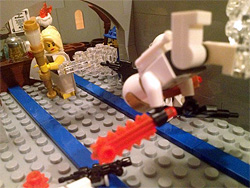 In defense of the Magician Alliance's school, the Bavarian Professor Hölzer uses elemental wind to sweep a Trattorian Recovery Force commander off his feet.
Increasing or decreasing a mobile target's Move rating is the simplest use of a Movement Die. The Die roll is added to or subtracted from the inches in its Move rating each turn. Move ratings can't be reduced below zero inches. A unit whose Move is reduced to 0" is Stopped but not inanimate. It can still perform regular Actions as long as they don't require moving around. When adding Flight, a Movement can add inches of Flight as easily as any other type of Movement, but all other SuperNatural Dice are only half as effective. Each non-d8 spent to add Flight Movement adds half inches rather than full inches. Decreases to Flight Movement are fully effective regardless of the type of Dice in use; each Movement Die can be used to subtract full inches of Flight Movement.Like Range d12s, a Movement can be used to ignore obstacles, but only for the length of Movement granted by the d12. This Movement can't end with an object inside an obstacle, even if it's followed by another Movement d12. Animated Objects Changes to Move ratings can also be used to give movement to inanimate objects. This is best limited to objects with a clear movement style already in place - stone statues and end tables can start walking around, shopping carts and boulders can start rolling, but the results of animate a suspension bridge or a shipping crate will mostly be the confusion of everyone involved. If units insist on animating an object without an obvious style of Propulsion, the object moves at Half Speed. An animated object isn't be able to use its new Move inches unless it has a set of Controls (allowing it to be used as a Vehicle) or it's given a Mind (turning it into an animated Creature). Moving Objects Directly SuperNatural Units can also use Movement Dice to move a loose object directly, if its Size is 1" or smaller, for as many inches as are rolled on the Movement Dice. This can be used for Effects ranging from hurling rocks, pulling levers, lifting kilts, or tossing enemies over a cliff. Directly moving a larger object or group of objects is also possible, but more difficult. The Effect has to cover the larger target area completely, using radius inches from d10s or arc ranges from d8s. If a SuperNatural Unit doesn't have enough dice to move a large object directly, it can use Movement Dice to create inches of Thrust to push things around instead (9.3: Thrust Vectors). Thrust Effects are not size dependent and can be effective against even very large targets. Movement Dice can't be used to separate objects from their moorings. A door can be opened and closed, but not removed from its hinges; an enemy soldier can only be tossed around until he manages to grab hold of something and stabilize himself. A unit that's able to actively resist being moved does so with its usual Physical Opposition dice (9.5: Collisions), subtracting its POP roll from the number of inches moved. Damage Increase/Decrease Damage:
+/- Damage to SuperNatural Effect or weapon stats  Fire Damage (or equivalent)
 Blast Damage, +1 Firing Arc
 Explosion Damage
 ignores Deflection
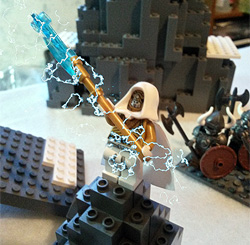 A mysterious Quantumstalker powers up his staff for a devastating attack, before blowing his Heroic Feat roll and landing face-first in the snow. Even the doots of mr skeltal's trumpet are unable to help him.
Armor Increase/Decrease Armor:
+/- Armor to target object Increase/Decrease Deflection:
add or subtract one level of Deflection against all Damage dice of equal or smaller size  A d10 used to modify Armor affects Weight accordingly (to max 5, min ½)
 Rather than dealing or nullifying Damage directly, it can be more advantageous to SuperNaturally weaken or strengthen a target's Armor instead.
A Supernatural Die can be spent as a SuperNatural Armor Die to affect a target's Armor or Deflection. Armor Dice are kept with the affected target for as long as the Effect persists. If Armor Dice are used to modify an Armor stat directly, they're rolled again any time the Armor stat is called for. Subtracted Armor Dice can never lower a target's Armor below zero, and can never damage or destroy a target outright. Weight Adding or subtracting an Armor affects the target's Weight class accordingly. The Weight changes to match the new number of d10s in the target's Armor rating, to a maximum Weight 5 or a minimum Weight ½ (7.1: Structure), even if it raises an object's Weight past the limits determined by its Effective Size. The new SuperNatural Weight is used in the place of the regular Weight for any effects that require it, affecting such things as the object's Momentum, resistance to Fire, and ease of Repairs.Deflection When an Armor Die is used to affect a target's Deflection, it only adds or removes Deflection for Damage dice of the SuperNatural Die's size or smaller. A d8 added to Deflection would provide one level of Deflection against d4s, d6es, and d8s of Damage, but not against d10s. A d6 used to weaken a target's Deflection would remove one level of Deflection against d4s and d6es of Damage, but not d8s or d10s. (Deflection is never effective against d12s.) Action Action Modifier:
+/- Bonus or Penalty to a single Action or Specialty Roll Blessing or Curse:
+/- a potential re-roll to target's Action or Specialty Die of the same die size or smaller Increased Action:
add an extra Action die or Specialty to a unit or inanimate object Decreased Action:
suppress a unit's Action or Specialty of the same die size or smaller  A SuperNatural Die spent as a SuperNatural Action Die can be used to enhance or impair a unit's Actions and Specialties in a number of ways, from changing the success of an individual roll to creating SuperNaturally animated units from lifeless objects.
Action Modifiers The simplest use of a SuperNatural Action Die is as a direct modifier to be added to or subtracted from a single Action or Specialty Roll. Subtracted SuperNatural Action Dice don't affect whether or not a particular Action Roll results in a Critical Failure, even if they reduce the result of the Action Roll to zero or less. A Critical Failure only occurs when a unit's own Action die rolls a natural result of "1," regardless of added or subtracted SuperNatural Dice or other modifiers.
While SuperNatural Action Dice can be spent to modify individual rolls, they can't be used to modify a target's own Action and Specialty dice directly. These must always be a single die with no modifiers (d4 or d8 are legal Action dice; 2d6-1 or d8+d4 are not). Instead, SuperNatural Action Dice can be applied as a Blessing or a Curse on a target's Action or Specialty die of its own die size or smaller. (A SuperNatural d8 can be added as a Blessing on an Action die of d4, d6, or d8, for example, but a d4 can't be used to Curse an Action d6.) Blessings and Curses have the potential to replace the results of the target's affected die each time it's rolled. Whenever the affected unit makes an Action or Specialty Roll with a Blessed or Cursed die, it rolls the dice for both its own Action Rating and the SuperNatural Action Die (or Dice). If the die is Blessed, the unit uses the highest roll as the result; if Cursed, the unit uses the lowest result instead. When a target unit is larger than the Effect area of a Blessing or Curse, a SuperNatural unit will have to settle for affecting a smaller portion of the target - perhaps a single arm, a weapon, or the Creature's head. Only the Actions that involve that part of the target will feel the Effect of the Blessing or Curse. Blessing and Curses suppress each other. A die that's both Blessed and Cursed ignores one Blessing for every Curse, and one Curse for every Blessing.
Minds and Specialties 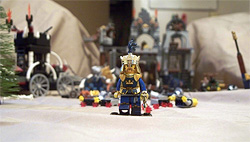 Deceived by Pacifass's horrifying illusion of Peace overtaking the battlefield, this knightly King is tricked into slaying all of his own men in a panicked frenzy.
A SuperNatural Action Die can be given as an Action die to animate an inanimate object, or to give an extra Action to an existing unit, as if the Die were a new SuperNatural Mind. The target keeps its existing stats (such as Armor and Move) and physical abilities (like its attack capacity based on loadout and Power level); a Death Tank with three Minds can still only fire its main cannon once per turn, but the two extra Minds mean it can also launch its missiles at a secondary target and fill out questionnaires on Death Tank dating sites at the same time. If a unit uses a SuperNatural Action Die to animate an enemy Vehicle while one or more enemies are still piloting it, it's treated the same as a Vehicle with opposing Operators at the controls (9.4: Piloting). The SuperNatural Mind and the enemy Operator can each use their Action on whichever systems they have access to in order to Interfere or prevent each other from Operating them at all. Rather than adding a Mind, a SuperNatural Action Die can also be used to add a new Specialty. For Specialties marked with a die, the SuperNatural Die is treated as the new Specialty die; this may result in Specialists who are either phenomenally skilled or abysmally incompetent, depending on the die in use. For Specialties without a Specialty die, the SuperNatural Die must be as large or larger than the affected unit's Action die. A SuperNatural Action Die can also be used to attempt to suppress an Action or Specialty die in a unit or animated object. To determine if the attempt is successful, the players roll both dice. If the SuperNatural die rolls higher than the target Action or Specialty die, then the target die is suppressed until the beginning of the SuperNatural unit's next turn. Otherwise, the SuperNatural Die is spent but has no effect. An animated object with all of its Action dice suppressed turns into a regular inanimate object again, while a regular Creature falls into a comatose stupor. In either case, the SuperNatural unit that suppressed the Action dice can then spend another SuperNatural Action Die to Mind Control the target, giving the target a new SuperNatural Mind with that Action die under the SuperNatural unit's control. The Mind Control is broken if anything interrupts the suppression of the victim's own Action die, or any time the controlled Mind Critically Fails a Action Roll. | |||||||||||||||||||||||||||||||||||||||||||||||||||||||||||||||||||||||||||||||||||||||||||||||||||||||||||||||||||||||||||||||||||||||||||||||||||||||||||||||||||||||||||||||||||||||||||||||||||||||||||||||||||||||||||||||||||||||||||||||||||
|
|
|


 Action /
 Move
Move
 "
"


 "
"

 or
or


 /
/
 /
/

 es deliver standard Damage.