
|



|
|
|
|
|
Chapter Eight
Weaponry
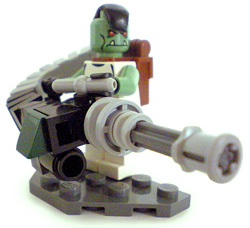 Tyronian Uber-Heavies are known for carrying weapons that regular minifigs can't even lift, much less fire.
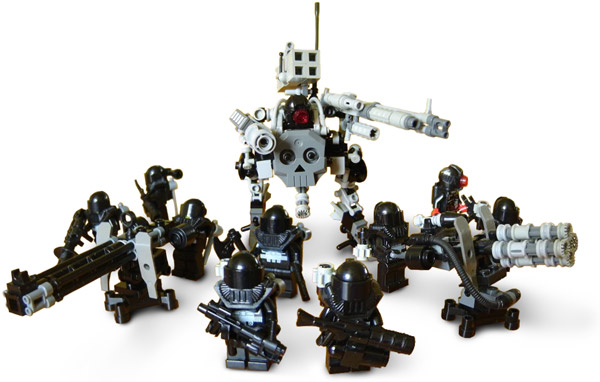
TEST Even without weapons platforms to mount them on, the Immortals' Terrorkhan units arrive with a complement of siege-level weapons to set up offensive field emplacements.
BrikPacifists may waste time with talk of the beauty of a Gothic cathedral or the protective strength of castle walls, but true BrikWarriors are immune to these distractions. The reason to build really large creations is because they need places to put the really big guns. 8.1 Weapon Size
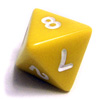
 As with Structures and everything else of real importance, Weapons are classified according to their Size in inches (7.1: Structure). At a Weapon Size (WSize) of one inch or less, a weapon is equivalent to what you might find in the hands of a minifig. As the Size increases, so do a weapon's stats – every statistic is listed relative to the number of inches of Weapon Size (or, for an Explosive, the number of construction elements in its Explosive Size).
Explosive Size  Explosives are measured on a smaller grain than other types of weapons. Explosive Size (XSize) is measured by the number of bricks (or roughly brick-sized elements) used to construct an individual Explosive, rather than by inches. This exception is made so that Explosives can be small enough to throw as hand grenades, or to load into Launchers or Cannons of matching Size. Explosives are measured on a smaller grain than other types of weapons. Explosive Size (XSize) is measured by the number of bricks (or roughly brick-sized elements) used to construct an individual Explosive, rather than by inches. This exception is made so that Explosives can be small enough to throw as hand grenades, or to load into Launchers or Cannons of matching Size.If an Explosive is launched from the Creation directly (for instance as a dropped bomb or a fired rocket), the points of Explosive Size count against the Creation's Power limit as if they were inches of Weapon Size. If the Explosive is launched from a Launcher or Cannon, only the Weapon Size of the Launcher or Cannon is counted against the Creation's Power limit. KnockBack All targets affected by an Explosion receive an inch of KnockBack for every die of Explosion Damage they receive. Non-Explosive weapons can also cause KnockBack if they strike targets smaller than themselves. A target is Knocked Back one inch for every inch of difference between the Weapon Size and the target's Effective Size, with the usual potential for being Disrupted as a result. Bastard Weapons 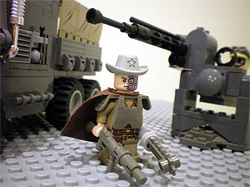 It's a coin toss whether he'll hit you with the ShotGun or the chainblade first. General William Two-Face Tecumseh Sherman likes things up close and personal - face to face to face.
For minifigs, Weapon Size 1" is treated as a Short (S) weapon, while Weapon Size 2" is treated as a Long (L) weapon. Medium (M) weapons fall somewhere in-between. These hand-and-a-half Bastard Weapons give minifigs some needed tactical variety in the Core Rules, and the new weapon types introduced in this chapter also have minifig Bastard versions.
 All Bastard Guns are two-handed for minifigs.
Hand-Held Weapons When weapons are carried in a Creation's hands (or equivalent grabbers), rather than mounted directly to the Creation itself, they are subject to the same kinds of one- and two-hand limitations as minifig weapons (Chapter 3: Minifig Weapons). As with minifigs' weapons, the Weapon Size is compared to the Size of the Creation holding it. A weapon up to the Creation's Size is Short (S) for that Creation. A weapon up to one-and-a-half times its Size is a Bastard Weapon (M), and up to twice the Creation's Size is Long (L).  The sun-worshipping Chosen of Solek dominate the jungle thanks in part to their giant lizardman. For a beastman of his massive Size, his giant axes are treated as a pair of Hand Weapons.
Power Limits
 The weapons and devices a Creation can operate during a turn are limited by Weapon Size. A basic Creation has Power inches equal to twice its current Effective Size. The Creation can be loaded with as many extra weapons as its player is willing to pay for, but on any single turn it can only activate and use as many Weapon Size inches' worth of weapons and devices as its Power inches. The weapons and devices a Creation can operate during a turn are limited by Weapon Size. A basic Creation has Power inches equal to twice its current Effective Size. The Creation can be loaded with as many extra weapons as its player is willing to pay for, but on any single turn it can only activate and use as many Weapon Size inches' worth of weapons and devices as its Power inches.Size zero Creations have zero Power. It's not enough to use standard Weapons, but they sometimes have special attacks.
Each Size Enhancement to Power adds the Creation's Effective Size again, raising its Power inches from the default two times to three times and then the maximum of four times its Effective Size. A Power Impairment reduces a Creation to Half Power. The Creation's Power Inches can't exceed its Effective Size, and it can't Divert All Power to get more. A Creation must be at least Size 1" to take a Power Impairment. By default, Flight Enhancements are paired with a Power Impairment. Flying Creations have Power inches limited to their own Effective Size (although in some cases they may return to the regular Power level of twice their Effective Size while on the ground). For minifig Specialties, a Power Impairment often takes the form of a Tool requirement. Forcing a minifig to use a Tool uses up one of his two Hands, effectively reducing him to Half Power.
Gathering Power 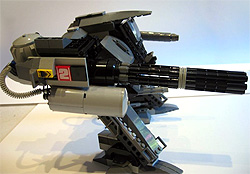 The MAOX's experimental siege mech "Nimrod" suffered from unresolvable balance issues, thanks to its epic Size 7" über-minigun.
A single weapon can be Too Big for its Creation to activate at all, either because the Creation's Effective Size has been reduced by Size Damage (7.2: Taking Damage) or because the player who originally built the weapon was too busy being awesome to care about Power limits. The first option for firing a weapon that's Too Big is to Divert All Power. As a Full Round Action (4.2: Action), a Creation can "save up" its Power over multiple turns. The Creation can't move, activate any Weapons or devices, or take any other Action on a turn on which it's Diverting All Power (other than as part of its powering-up sequence - it would be completely appropriate for a Freud-Class Siege Tank to plant hydraulic support stabilizers and elevate the extending cannon into artillery mode, for example). On the following turn, the Creation may immediately add the extra Power it saved from the previous turn (or turns) to its regular Power supply in order to meet the Power requirement of a single weapon or device activation. Afterwards, the Creation returns to its regular Power limit. 
The .50 caliber machine gun on top of this M1 Jackson is mounted on an independent Small Turret and requires no Power from the tank as long as it's being operated manually.
The second means of employing a Too Big weapon is to bring a team of friends to help out. This is most often seen when a group of minifigs use Teamwork to manually operate a weapon too large for any of them individually, like swinging a battering ram, throwing a boulder, or winding the crank on a catapult. Nobody actually keeps track of minifigs winding up catapults. But if they did, it would take one minifig per two inches of Weapon Size.
Creations using Teamwork add their Effective Sizes together for the purpose of satisfying a weapon's Power requirement. If an Action Roll or throwing Range is required, the unit with the smallest Action die makes the roll, and the lowest-Ranged unit determines the Range. Depending on the type of power source required, Vehicles or magic-powered constructs can sometimes also use Teamwork to help power a weapon - but unless they're specially designed for it, this may require a What I Say Goes roll and some jury-rigging from a clever Mechanik with a set of jumper cables.
For weapons that are so Too Big that neither technique is enough by itself, units can Divert All Power and use Teamwork at the same time. In either case, the participating Creations should be able to provide the appropriate type of power - a medieval knight can't use muscle strength to help power a lightning cannon, any more than hooking that knight up to a car battery would help him swing a bigger sword (although the latter example is really worth testing, just to be sure). 8.2 Basic Weapons Close Combat Weapons Melee Weapon:
Use:
 +1
Range:CC +1
Range:CC
Damage:
× Action die Action dieMelee Shield:
Use:
(see 5.2: Close Combat)×2
Range:CC
Effect:
× Deflection on Parry, Deflection on Parry,
2"
 KnockBack on Shove KnockBack on Shove Representing the height of weeaboo technology, the Oni is the heaviest armored suit in the Nipponian arsenal. The suit packs dual flamers, the MechSlayer cannon, and a heatbeam eye, but its greatest weapon is the giant OT-powered Warsword.
 Though the Jotunn have fallen, a new hope rises. The Last Son of Krypto demonstrates that Heroic Weapons can be scaled up to larger sizes too.
The functions of Close Combat Weapons are easy to scale upwards with Size. Giant swords and the like are just like the minifig versions with larger numbers attached. A Creation with a Close Combat weapon uses it to whack at targets the same way a minifig does. However, Creations are not always able to participate as fully in the back-and-forth attacks of formal Close Combat. There are specific conditions under which a Creation's Close Combat abilities are limited.
The Use ratings of Melee Weapons go up slowly as their Weapon Size increases. Melee Shields become unwieldy much more quickly, but the benefits can be great. A successful Parry with a Melee Shield adds layers of Deflection equal to the Shield's Weapon Size, potentially negating multiple dice of Damage all at once and rendering many attacks meaningless. When Parrying a large weapon, the Parrying minifig or unit can benefit from the standard Action bonus for a large Target Size, receiving +1 to the Action Roll for every 2" in the Weapon Size of the weapon being Parried (5.1: Making Attacks). As with minifig weapons, a Creations' hand-held weapons can be knocked away on a critically failed Parry. The Parrying weapon or object is knocked out of the defender's hands and directly away from the attacker for a number of inches equal to the attacker's Action Roll. Ranged Weapons 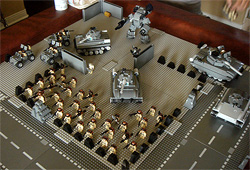 RoC77's 45th Union knows how to deploy their firepower where it'll do the most good. Jeep-mounted gunners are positioned to outmaneuver and strike at lightly-armored Vol forces, while the tanks take the opposite flank to face the heavier vehicles and emplacements of the Assyrian Star Empire.
To make a Ranged attack, a Creation must be able to point its weapon at its target. Both the firing angle and the weapon Range are measured from the end of the weapon barrel. Players can mount a Creation's weapons onto any type of turret, hinge, or arm to cover a wider firing arc. This has no extra cost, but remember that hinges, joints, and other moving attachment points are weak points Armored at one d10 lower than the rest of the Creation (7.1: Structure). Armor Plating Armor Plating:
Effect:
Deflection over covered area
Notes: No alternate forms of Movement;
(see 3.3: Bodily Protection)
Half Speed; doesn't use
 Power PowerSections of Armor Plating can be used to protect some or all of a Creation, granting a level of Deflection to whatever area it covers. This protection comes at a cost to the Creation's mobility - the added weight of even the smallest patch of Armor Plating makes many types of movement impossible, and the Creation is permanently at Half Speed for as long as the Armor Plating is attached. Other than moving backwards, a Creation with Armor Plating cannot engage in alternate movement types that would normally reduce its Propulsion type to Half Speed (9.1: Standard Propulsion). Attackers firing at an Armor Plated Creation should specify which part of the Creation they're attacking. Unless they specifically target an un-Armored section, their attack will Koincidentally hit any section of Armor Plating that is visible and within range, no matter how small or unlikely. Armor Plating is not counted against a Creation's Power limit. 8.3 Automatic Weapons Automatic weapons are a special kind of Ranged Weapon that can be fired in a Firing Arc, spraying a whole area with projectiles, or in a Burst, spraying a whole area's worth of projectiles at a single target. Larger Firing Arcs and Bursts have the potential to do much more damage, but quickly become much less accurate due to cumulative Action penalties known as an Auto Penalty. Firing Arcs  Players may try to fudge an angle by not holding their palm flat and parallel to the table surface. If this happens, smash their hand with a hammer or large rock until it's flattened to the proper orientation.
Elements shown: digits Rather than mess around with clunky protractors and drafting tools, BrikWars measures angles the old-fashioned way: using Humans' fingers. To measure angles of Firing Arc, a player holds their hand out with palm flat to the table and fingers outstretched, with knuckles placed roughly over the attacking end of the weapon being fired. As long as the fingers are evenly spaced, players can measure Arc between whichever set of fingers they find most convenient. Each space between fingers is one point of Arc. There will be some variation between the fingers of different Humans. As with everything else in BrikWars, the players who are most flexible will have the advantage. Arc Fire When weapon fire sweeps over an area because of either continuous fire (in the case of MachineGuns and FlameThrowers) or blast spread (in the case of BlastGuns), it's handled as an Arc Fire attack. Every target within the attacker's Firing Arc receives a single attack from the weapon, and missed shots are ignored. Larger targets suffer an extra attack for each point of the Firing Arc they span completely. Because an Arc attack comes from filling an area with a field of projectiles, modifiers for cover and Target Size not only affect the Action Roll for the attack, but also apply to the Damage inflicted to each target. Large and small targets within the cone of fire catch larger or smaller portions of the Damage flying through the air. (For the purpose of determining the bonus for a large target, only consider the portion of the target within the Firing Arc.) MachineGuns and FlameThrowers firing in an Arc receive an Attack Penalty known as an Auto Penalty. As the Damage is spread over a larger Firing Arc, there is less chance that any individual shot will hit its target. For each point of Firing Arc in the attack, the attacker receives a cumulative -1 Action penalty. BlastGuns have a fixed Firing Arc of 1 and take no Auto Penalty from their Firing Arc. Unlike other Ranged attacks, missed shots in Arc Fire are not tracked (5.3: Ranged Combat). Action Rolls for Arc Fire aren't tracking individual shots, but rather whether or not any out of the whole group of shots happened to be fired in that specific direction, and so a missed shot in an Arc Fire attack means there was no projectile there in the first place. BlastGuns BlastGun:
Use:
+1
Range:(×2)+2"
Damage: × -distance -distanceNotes: 1 Firing Arc, no Auto Penalty 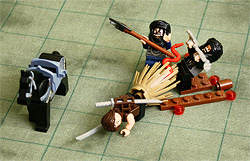 This swordsman uses hummus and irritable bowel syndrome to create an impromptu Blast attack.
BlastGuns are the simplest of the automatic weapons, and are only automatic in the sense that they fire a large number of shots in a single blast. Buckshot, grapeshot, and flechette rounds are the most common examples, but Blast-type effects can also be seen in weapons like sonic cannons, chaff launchers, and exploding alien seed pods. A BlastGun fires with a fixed Firing Arc of 1, and though its blast is powerful at short range, the shots disperse and do less Damage to targets further away. For every full inch between the target and the end of the BlastGun barrel, the Damage to that target is reduced by one, to the point that more distant victims might not take any Damage at all.
MachineGuns and Reloading MachineGun:
Use:
+2
Range:(×3)+2"
Damage: × Notes: may require Reload
 A squad of Noxarian Infantry uses machine gun turrets to calm an agitated civilian.
MachineGuns are the most versatile of automatic weapons, allowing for Arc Fire, single-shot Ranged attacks, or multi-shot Bursts, depending on the needs of the situation. When a MachineGun is used for Arc Fire, the player chooses the size of the Arc he or she is going to attempt (setting the overall Auto Penalty), and, starting from one end and moving to the other, rolls a separate Action Roll for each target in order. A MachineGun can also be used in Burst Fire, firing multiple shots at a single target. The player chooses the number of shots he or she is going to attempt, and this determines the overall Auto Penalty: a cumulative -1 for each intended shot in the Burst. Unfortunately, while Automatic Fire is good for increasing a MachineGun's damage output, it also has a tendency to burn through its ammunition (or to jam, overheat, or lock up in some other way, if ammo isn't an issue). The more Automatic Fire a MachineGun uses, the higher the chances of hitting one of these mechanical limits. For every shot fired in an Arc or Burst Fire attack with a MachineGun, if the number on the Action Roll (before applying bonuses or penalties) is less than the Auto Penalty for that shot, the MachineGun fires that last round and then becomes Inoperative. The weapon can can still be moved around as normal and used as makeshift club, but it can no longer be fired until it's Reloaded. An Inoperative weapon can be indicated by pointing the barrel skyward when possible, or attaching a small brick as a temporary reminder.
Fortunately, Reloading is easy - regardless of the Weapon Size, any minifig operating the weapon (whether directly or from a pilot or gunner's seat) can Reload it with a single Action, making it ready to use again on the following turn. MachineGuns never suffer from a lack of spare ammunition; additional Reloads are always mysteriously available, and minifigs know better than to ask questions about where they come from. A MachineGun can't be Reloaded and fired on the same turn, even by multiple minifigs using their Actions together.
FlameThrowers FlameThrower:
Use:
+1
Range:(×2)+2"
Damage:
× Fire Fire There's no way Firetail the Dragon is letting these Skylink Commandos come between him and the last soft pretzel on planet Azure.
 Warhead tests out his Heavy Flamer in preparation for ground action.
FlameThrowers and other fire-based attacks measure their Damage Ratings in d4s rather than d6es, to represent the special nature of Fire Damage. The dependence on d4s makes them relatively weak for direct Damage output, but this shortcoming is made up for by their advantages in the field of setting objects on Fire.
FlameThrowers are not the most precise or elegant weapons, and must always use a Firing Arc of at least 1. Like other area attacks, Target Size modifiers affect a FlameThrower attack's Damage as well as the accuracy of the Action Roll. Catching On Fire Whenever a target takes Damage from FlameThrowers or other Fire-based attacks, there's a chance that it will be set on Fire. On larger Creations, Fires can become independent creations in their own right, turning into Field Hazards that blaze out of control (F.1: Hazard Dice). On minifigs, Fires are much simpler: any minifig who takes at least one point of Fire Damage is on Fire. (A Critical Failure on a Fire Damage roll, or Damage that's reduced to zero by Damage penalties, has no effect.) For minifigs, being on Fire is unusually distracting. For as long as a minifig continues to burn, he takes a -1d4 penalty to Action Rolls and Armor, and is limited to using one of his two Hands at most. Creatures who are made of Fire, like djinnis and lava monsters, do not suffer penalties from being on Fire.
A minifig can put out his flames by being doused in water or spending an Action to stop, drop and roll around on the ground and Disrupt himself. Otherwise, if he's still burning at the end of his turn and has unused inches of Move remaining, it's mandatory that he uses up every last inch by running and thrashing around hysterically, making that funny sound burning people make when they're trying to hyperventilate and scream at the same time. If a minifig is still on Fire at the beginning of his turn, he makes a Burning Roll on 1d4. On a 1, the Fire goes out, and the minifig may go on with his life. On any other roll, the Fire continues burning. The minifig takes one point of Grinding Damage (7.2: Taking Damage), rendering one limb useless of the minifig's choice as if it were Amputated (10.2: The Medik), and the Fire spreads to up to one flammable object with a Weight class of 1 or below that the minifig is in direct contact with, potentially including other minifigs. The ground is treated as non-flammable by default, unless players want to spend a whole lot of time tracking out-of-control ground fires.
8.4 Heavy Explosives 
Explosions are the most exciting events in a minifig's life, and the options for delivering them are bountiful. Explosive Weapons can be dropped like bombs, thrown like grenades, fired as Ammo from Cannons, launched as Payloads from Launchers, fired off as Rockets, or strapped onto the fronts of speeding Vehicles, Creatures, or minifigs for crashing into each other. Unlike other weapons, an Explosive or Rocket is measured by its number of construction elements rather than inches of Weapon Size. This number is its Explosive Size (XSize), and is particularly important for determining its number of Explosion Damage dice.
When an Explosive or Rocket is dropped, thrown, or fired directly by a Creation, the amount of Power it takes to properly activate the weapon is equal to the Explosive Size. When an Explosives and Rockets are fired from Cannons or launched from Launchers, the Power requirement of the Cannon or Launcher is used instead. Trajectories Where most Ranged Weapons fire some variation of imaginary "pew pew" sounds, flying Explosives are physical objects and are treated as such. Launchers and Cannons can fire projectiles in parabolic arcs rather than straight lines, and some Rockets can curve their flight path to track targets. Explosive weapons can be fired over the tops of obstacles to strike targets behind them, and will often strike targets from above or at an angle rather than along the attacker's line of sight. To fire over the tops of obstacles, the attacker can aim at any spot directly above the target. On a successful Action Roll, the Payload hits that spot and then travels straight downward (downward inches of Movement or Range are always free). On an unsuccessful Action Roll, a Missed Shot with an Explosive has to come down somewhere, unlike regular Missed Shots which can fly off harmlessly into the sky and be ignored (5.3: Ranged Combat). This is particularly important for Launchers, whose high Use ratings make them notoriously inaccurate. Attacks fired over obstacles are subject to a possible -5 Attack Penalty if the attacker is firing at targets he can't see (5.1: Making Attacks), but this can be circumvented by using a Scout's Tracking ability (F.3: The Scout).
Explosives and other physical objects used as projectiles have a maximum speed of 12" per turn. When a projectile is launched further than this distance (e.g., a long-distance Rocket, or a bomb from a large Launcher or Cannon), it can take a turn or more to arrive at its destination, giving potential targets a chance to scatter. Whenever a phyical projectile is fired at a target more than twelve inches away, the attacking player doesn't immediately make the Action Roll. Instead, they place a marker at the intended target location (an "X" built from red bricks is traditional), and launches the projectile into the air, moving it 12" towards the target, and 12" again at the beginning of each of their turns. It's only when the projectile reaches its destination point that the player makes the Action Roll to find out whether it hit the target, or how badly it missed. While early Rockets fire in straight lines, modern and higher-tech Rockets have the ability to track their targets if they change position while the Rocket is in flight. Once during each turn of movement, a Rocket with tracking ability can turn up to 45 degrees in order to follow a moving target. Depending on the type of tracking system used by Rockets in a particular battle, players are encouraged to come up with inventive countermeasures to confuse them. Chaff, flares, holograms, and seductive decoy Rockets in sexy makeup can all be used to distract an incoming enemy Rocket.
Premature Detonation  During an operation to settle the Patrician's shrubbery debts, Farth Nader picks a bad time to critfail his grenade attack.
 Retrieving his dead boss's grenade launcher and landing a shot behind an enemy Orange trooper, explosive KnockBack allows this Blue soldier to launch one of the casualties right back at himself.
For all the hilarity that Explosive weapons bring when dropped into enemy ranks, they're even funnier when a minifig falls victim to his own ordnance's Premature Detonation. Improvised and low-tech Explosive weapons are Unstable. A single point of damage is enough to set off gunpowder kegs, dynamite sticks, fireworks, angry soccer moms, and those red fuel barrels wisely left lying around everywhere by the inhabitants of first-person shooters. Any time an Unstable Explosive weapon takes damage, it immediately goes off, doing its full Explosion Damage wherever it happens to be. Higher-tech Explosive weapons are more difficult to set off accidentally. Grenades, plastic explosives, nuclear warheads, and internal combustion engines depend on specific priming mechanisms to trigger their Explosions. Fortunately, minifig safety precautions are half-hearted at best, and Semi-Stable Explosives can be Detonated just as Prematurely with a little more damage. Any time a Semi-Stable Explosive weapon takes more points of damage than its Explosive Size (XSize), it's activated, and will go off at the end of the current player's turn. Minifigs are free to use Response Actions to try to quickly dispose of the weapon or to encourage a nearby friend or well-wisher to jump on it and save them. Semi-Stable Explosives are treated as Unstable once they're activated - armed missiles in flight, proximity mines, and falling bombs can be hit and Detonated Prematurely by shooters or extremely brave melee combatants with fast enough reflexes. Critical Failures If a unit attepts to use an Explosive but fails the Action Roll, the defending player treats it as a Missed Shot as usual, choosing any Koincidentally unlucky location within the appropriate distance for the shot to land. If either the Action Roll or the Damage Roll is a Critical Failure, the defender has the additional option of declaring the Explosive a Dud. A Dud Explosive doesn't explode on impact, but remains armed and extremely Unstable, even if it was a Semi-Stable type of Explosive before being fired or thrown. Minifigs can use an Action to move the Dud carefully at Half Speed; otherwise, any damage or attempt to move the Dud will set it off. Heavy Explosions Explosive:
Damage:
 × × Exp Exp
Notes: Use and Range determined by Launcher
Rocket:
Use:
×2
Range:×6"
Damage:
× ExpWhen a minifig's grenade goes off, it creates a blast of Explosion Damage (Exp) that affects all objects within two inches. With larger Explosions, this radius is multiplied, doing the heaviest Damage at the center and diminishing over distance. When an Explosion occurs, the player rolls the number of d10s in the weapon's Damage rating, and leaves the dice on the table. All objects (or Components, for larger targets) within a two-inch radius of the blast center take this much damage, and any loose objects in this radius (including objects which only became loose after being destroyed by the Explosion) are Knocked Back one inch for every d10 in the Damage roll (including Over the Top d10s). For a single-d10 Explosion, this is all that's required. For Explosions with multiple d10s, after handling Damage for all the objects within the first two inches, the player removes the highest d10 in the roll (including any Bonus Dice it may have earned), and counts the new total result on the dice that remain. All objects within the next two inches of radius take this new result in Damage, and loose objects are Knocked Back a number of inches according to the number of dice remaining. The player continues removing one d10 for every two inches and distributing damage and KnockBack accordingly, until no dice remain in the Explosion Damage. Players may wish to save handling all KnockBack effects for the end, in order to avoid accidentally damaging or Knocking Back the same object twice.
Damage and KnockBack from more than one Explosion can stack, but the sizes of their radii do not. A hundred 2d10 Explosions in the same spot cause 200d10 worth of Damage in the first two inches, 100d10 in the next two, and none after that. They don't combine into a single massive explosion with a four hundred inch radius.
Explosive Variants 
James+burgundy's Pilots pose for a group photo with their Explosive ordnance: homing missiles, cluster bombs, and helicopter-mount weapons-grade concert speakers.
A standard Explosive does its own XSize worth of Explosive Damage d10s. Depending on a minifig's tactical needs and desire for novelty, he might mix things up a little bit, swapping out the d10s for any combination of Alternate Damage Dice or Field Hazard effects. The Explosive's XSize and other stats remain the same.
Explosives with Alternate Damage Dice work like standard Explosives in most regards. When the Explosion goes off, the attacking player rolls all the dice and applies their full Damage and effects to everything within the first two inches. They remove the highest rolling dice as the Explosion radius increases, along with their associated Bonus Dice and secondary effects. In the case of a tie between different die types, the attacking player chooses which to remove first.
If an Explosive weapon has both Damage dice and a Field Hazard, they're two separate effects. The Explosion Radius and the Field Size aren't added together. Cannons Cannon:
Use:
+3
Range:×4"
Damage:determined by Ammo
Notes: Requires Reload;
can fire Explosive Ammo up to max
of A Cannon is a slow but powerful direct-fire Gun that fires Explosive rounds rather than generic damage dice. Pirate ship cannons, modern combat tank cannons, and starship neutron torpedo tubes are all examples of Cannons. A Cannon must be Reloaded after each shot, meaning that it can only fire every other turn. Ammunition 


Valiant's tanks are packed with a versatile assortment of Ammo. The Champion II has a crew of three minifigs, with Reloading handled by a mechanized auto-loader.
Each time a Cannon fires, its chamber is emptied and it must be Reloaded before being fired again. As with MachineGuns, Reloading costs an Action, whether the Cannon is reloaded by hand or by automatic controls. A Cannon can't be fired and Reloaded on the same turn. Unlike MachineGuns, Cannons require physical Ammo in order to Reload. Ammo is bought as a standard Explosive that's designed to fit into a Cannon, up to a maximum Explosive Size (XSize) equal to the Weapon Size of the Cannon. Ammo must be represented in physical brick and stored next to the Cannon's reloading area, wherever that may be. Minifigs are too busy to keep track of Ammo numbers. Ammo is never used up - as long as there's at least one round of Ammo available for each Cannon, it can be Reloaded over and over again. Like any other Explosive left lying around, however, the physical rounds of Ammo can be stolen, destroyed, or applied to other purposes by wandering minifigs, leaving the Cannon with nothing to Reload with. If a Cannon has more than one type of Ammo available, players must declare which of the types they're using each time they Reload. Payload Launchers Launcher:
Use:
×2
Range:×6"
Damage:(determined by Payload)
Notes: Max Payload Size of
×½;
max Explosive Payload of 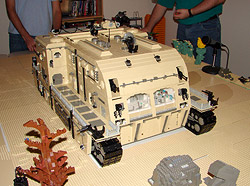 Dave Eaton's Post-Apocalyptic Research Vehicle is the target in a running battle across the nuclear wasteland.
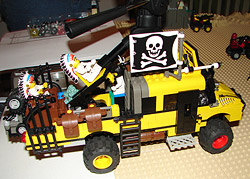 Jonathan Dallas's converted assault schoolbus is loaded with dynamite-strapped kamikaze warriors and a catapult with which to launch them.
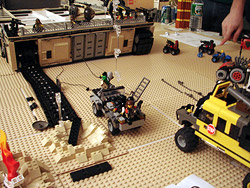 The massive propulsion treads prove to be a weak spot - the detonation of one well-placed kamikaze snaps the tread and leaves it to trail out behind the PARV until the vehicle grinds to a halt.
Photos: Wayne McCaul from NELUG's "The Post-Apocalyptic Research Vehicle" The Launcher category covers any device designed to launch a Payload across a distance, from minifig-scale bazookas, mortars, and slingshots, to siege-scale catapults, mass drivers, and octopus-throwing giant squids. Launchers are ideally used to deliver Explosive Payloads, but boulders, plague-ridden corpses, and fully-loaded port-a-potties also have their special charm. Unlike normal Ranged Weapons, for which ammunition is rarely an issue, a Launcher's Payload must always be represented in-game by one or more physical objects. All Launchers must have a designated area for loading their Payload (e.g., the basket of a catapult, the breech of a cannon, or the trolley of a railgun), and Payloads must be placed into or onto this location prior to Launch. Players may choose to construct their Launcher with an ammunition battery for auto-loading (such as a missile rack or ammunition drum), but most Launchers end up being loaded by minifigs carrying objects by hand. Less traditional Payloads are possible and fully encouraged; an appropriate Launcher might also be used to scramble spacefighters, deliver paratroopers, or fire political opponents into the sun. As long as it's properly loaded, a Launcher can fire once per turn.  This rugged BleakTron tank boasts twin missile racks.
Launched Melee Weapons do Damage as if they had hit the target in a Close Combat attack. Launched Explosives use their Explosion Damage ratings on impact. Other Payloads do Crash Damage with their full Momentum (9.5: Collisions), doing a d6 of Damage for each d10 in their Armor rating.
Thrown Minifig Weapons Minifig Throwing Arm:
Weapon Size: 1/2"
Range:3"
Notes: Use and Damage determined by object;
Size 0" Payloads only 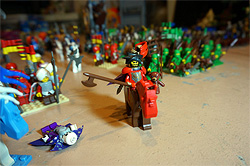 In the siege of VladTron's Fortress, Sir Stalin the Bear rides ahead of the Mocian army to Heroically throw a borrowed battleaxe at the cage holding his ally, Sir Dogdu the Dog.
Rather than freeing the prisoner, Stalin's throw severs the chain the cage is hanging from, dropping both the cage and Sir Dogdu into an active volcano. Often overlooked in favor of the majestic mechanical Launchers of military engineers, a pair of naturally-occurring Launchers can be found hanging off the shoulders of even the lowliest peasants. A minifig's arms are considered free Size ½" Launchers, capable of throwing Size 0" projectiles like grenades, hand weapons, and small animals. Thrown objects have the same Use rating and do as much Damage as if they had been used in a Close Combat attack. Thrown Explosives cause their Explosion Damage on impact (which is technically also the same as when they're used in Close Combat, although there are drawbacks to using them in that capacity). Creatures with larger arms can throw correspondingly larger objects, but these larger thrown objects still have effective Use and Damage ratings as if they were being used in Close Combat, unless the creature's arms were built specifically as Launchers. Minifigs working together can combine their half-inches of strength - four minifigs can act as a Size 2" Launcher, for instance - but the Range of their throw never increases, remaining at 3". The Action Roll for the throw is made by whichever minifig in the group has the smallest Action die. Because a minifig's three-inch throwing range is not a lot of distance, it's good to remember that attacks can be made Out of Range, taking -1 Action and Damage penalties for every inch beyond the attack's normal Range (5.1: Making Attacks). 8.5 Manning Guns 
Every soldier in Robot Monkey's Republic of Independent Nations dreams of being assigned to a helicopter door gunner position. Minifigs love miniguns.
Firing Weapons 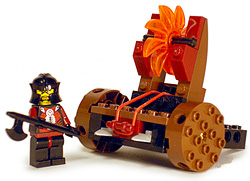 The namesake model of LEGO set 8873, "Fireball Catapult," uses a rubber band to power a pull-back fireball launcher.
Elements shown: LEGO  In normal situations, firing a large weapon is just like firing a small one, except with bigger numbers attached. The attacker chooses a single target or Firing Arc and may fire any number of weapons at it of a single attack type (either Ranged, Arc Fire, or Close Combat), up to his Power limit (8.1: Weapon Size). The attacker uses his Action to make the attack, checks the Range to the target, makes an Action Roll with the usual Action modifiers, compares the result to the Use rating of the weapon, and, if it hits, rolls the Damage and applies the result accordingly (5.1: Making Attacks).
 Controls  The Barracuda Light Assault Carrier is much too large for crewmen to operate the main guns directly. Weapons control is handled from the bridge.
Controlling a minifig-scale weapon is a simple affair. A minifig has perfect control of a sword or pistol as soon as his hand's on the grip. On larger weapons, like intercontinental ballistic missile silos, orbital laser satellite arrays, or Bagger 288s, the controls can be far removed from the business end of the weapon itself. While Controls might be mounted directly on a weapon, they're just as often found in an attached Gunner's seat, in the cockpit of the vehicle on which the weapon is mounted, or in a remote weapons control station within a nearby bunker. Except when there's a specific reason to the contrary, all modern or futuristic military vehicles include Controls for the weapons systems in the cockpit, even if there are separate Gunner's stations.
In some cases, a single weapon may have Controls in several locations, leading to possible conflict if opposing forces gain access to different sets of Controls. While each player's forces can fire a given weapon only once per turn, any unit with access to one set of Controls can use an Action to Interfere with a unit attempting to operate the weapon from a different set of Controls, rolling his own Action and using the result as an Action penalty to the attacking unit's attack. In the rare case that minifigs from allied teams find themselves at the same set of Controls, they cannot each operate the Weapon on their own turns – that would unfairly double the weapon's abilities. Whether weapons, devices, or Propulsion systems (9.4: Piloting), a minifig can only Operate a system if none of his allies used the same system on their previous turn. This special limitation only applies to allies; when enemies commandeer a set of Controls, they can make full and immediate use of them. This is justified by the fact that it's much funnier to let hijackers have instant benefits than to give the original owners any time to react. A Mechanik (7.3: Field Construction) can jury-rig new Controls for a weapon, even if the weapon is still controlled by one or more opponents at another set of Controls elsewhere. The new Controls must be attached to the inner workings of either the weapon or the machinery it's mounted on, not to the outer plating. The Mechanik will have to crack the armor open before he can start messing with the innards. The Gunner 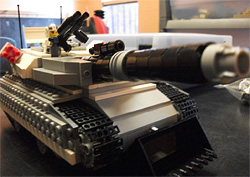  Praetorian Zephyr-class tanks are best supported by a full field artillery team. One or more Scouts act as forward observers, Marking targets for attack, while a team of Gunners remain within the vehicle to provide Gunnery Support to the lead Gunner firing the weapon.
Photos: dilanski from "Praetorian Vehicles (Tank Quad-Bikes and assault Jeep)" and "V4 Zephyr Class Heavy Tank" Elements shown: LEGO Even without training, any minifig off the street who gains access to a mounted weapon's Controls can successfully operate it, although not necessarily very well. The Use requirements of mounted weapons go up very quickly as they increase in Size, making attacks much more difficult than with handheld weapons. Especially for very large weapons, it's best to have a trained Gunner or several at the controls. Gunnery Gunnery Specialty:
 on Action Rolls with mounted weapons;
allows Gunnery Support
The Gunner is a unit that specializes in the operation of mounted weapons. For any Action Roll related to the use of a weapon mounted on a Creation, Gunnery allows the Gunner to roll their Specialty rather than their Action d6.Besides firing large weapons with greater skill than usual, Gunners are also trained to cooperate in teams to fire weapons more accurately and effectively. Any minifig with the Gunnery Specialty can spend his Action to provide Gunnery Support to another minifig operating a large weapon, granting a +1 Action bonus to the attack. This bonus is cumulative, adding additional +1 bonuses for every Supporting Gunner, but the number of minifigs in the firing team (the firing minifig plus the minifigs providing Gunnery Support) is limited to the number of inches in the Weapon Size, and each minifig must be able to access the weapon or a working set of Controls for it. The exact nature of Gunnery Support depends on the weapon and the technology involved. The Gunners may be calculating trajectories, feeding ammunition belts, establishing target locks, or sacrificing captives to the gods of metal and mayhem. As long as the weapon keeps firing at the exact same point, and neither the Weapon or the target move, there's no need to keep recalculating trajectories. The Action bonuses from Gunnery Support can be considered permanent until the Weapon moves or aims somewhere else. If it continues to pound that same target over several turns, the Gunners can learn from the previous turn's results and Home In on the target. For each new attack they can add new Gunnery Support bonuses to the bonuses from the previous turn, accumulating +1s until it becomes almost impossible to miss. The possibility of Critical Failure remains ever-present, however, and any Critical Failure cancels the Homing In bonus and requires the Gunners to start over. | ||||||||||||||||||||||||||||||||||||||||||||||||||||||||||||||||||||||||||||||||||||||||||||||||||||||||||||||||||||||||||||||||||||||||||||||||||||||||||||||||||||||||||||||||||||||||||||||||||||||||||||||||||||||||
|
|
|

 of ½
of ½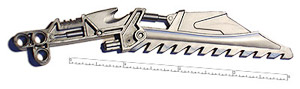

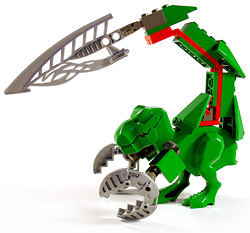





 per
per 

