|











|
|
|
|
|
Chapter Ten
Creatures
Not all Creations are designed for active roles. Objects like trees, warehouses, and bridges perform their duties perfectly well by just sitting there and not wandering off at critical moments. If a Creation is intended for more proactive tasks, such as moving around, carrying loads, or vaporizing civilians, it needs either a mind of its own or an intelligent operator at the controls. The difference between a Creature and a Vehicle is that Creatures are capable of independent thought and action, whether their brain is composed of meat, circuitry, or magic. A mech piloted by a minifig is a robotic Vehicle; a mech operating independently to destroy all minifigs is a robotic Creature. 10.1 Minds
Of all the inadvisable weapons and devices ever bolted onto a Creation by negligent Humans, the Mind is the most destructive. A Mind harnesses the power of an Action die to turn a Structure or Vehicle into an independent Creature, granting it one Action per turn without any corresponding sense of moderation or decency to use that Action wisely. Action Dice
* - Action d4s can't roll high enough to take an Action Over the Top. The best they can do is earn a Bonus d4 on a Critical Success.
Like Weapons, Propulsion systems, and Controls, a Creature's Mind must be represented by a specific physical component on the Creature. For minifigs and other organic Creatures, the Mind is usually contained in the head, but a Mind can be located in any appropriate container: a computer A.I. core, a haunted phylactery, an extradimensional energy crystal, or a haphazardly-wired brain in a jar, for example. If the component containing the Mind is destroyed, the Mind is also destroyed, and the Creature becomes an inanimate object again unless it has at least one backup Mind still functioning. By default, all BrikWars units have an Action  . For independent Creatures, the is all in their own Mind, while Vehicles, weapon emplacements, and dependent Creatures rely on the in the mind of a minifig handler or operator. . For independent Creatures, the is all in their own Mind, while Vehicles, weapon emplacements, and dependent Creatures rely on the in the mind of a minifig handler or operator.Abilities By default, Creatures with Minds have the same general abilities as a regular minifig. As long as they have the proper appendages, they can use equipment, open doors, and toss items around as normal. Common sense should be an adequate guide for whether a Creature has the proper body shape to work a stick shift or the fine manipulators to type on a keyboard. When players aren't sure, a What I Say Goes roll can quickly resolve the issue (for instance, an intelligent cockroach can type on a keyboard by jumping real hard, but it takes him twice as long as normal, and he can't use the shift key without the help of the local cat). Carrying and Manipulating Objects
Creatures without Hands or equivalent appendages may be able to clumsily carry and drag objects, but they can't operate weapons or devices in any useful way. To compensate for this, Hand-less Creatures develop improved natural combat abilities. They gain natural Close Combat attacks equivalent to a Melee Weapon up to their own body Size (8.1: Weapon Size). Dogs can bite, horses can kick, giant scorpions can sting, and possessed food processors can initiate a hostile puree maneuver. For teeth, claw, and tentacle attacks (or if otherwise appropriate), a Creature can make an automatic Grab with any successful hit with its natural attack, and the Creature's Action die is raised to a  for Close Combat rolls . For horn, hoof, and club tail attacks (or if otherwise appropriate), a Creature can make an automatic Shove on a successful hit, and horns in particular can be treated as Charging Weapons. for Close Combat rolls . For horn, hoof, and club tail attacks (or if otherwise appropriate), a Creature can make an automatic Shove on a successful hit, and horns in particular can be treated as Charging Weapons.A Creature (or any Creation) with the ability to pick up items can carry an object or group of objects up to its own Size at full speed, or twice its Size at Half Speed. It can push or pull objects around up to twice its own Size, at full speed if the object is on wheels or the equivalent, or at Half Speed otherwise. For objects that are Too Big to push, pull, or carry, creations can Divert All Power or use Teamwork to increase their effective strength, just as if they were trying to power a large weapon (8.1: Weapon Size). Multitasking Like a minifig, a Creature with a standard Mind has one Action and can focus on one target per turn. If that's not enough for the species a player is imagining, they can add additional standard ( ) Minds as Action Enhancements. These extra Minds must have a physical location. They may all exist in the same physical element as the Creature's original Mind, or they may be put in different places if the Creature doesn't want to put all its eggs in one basket. Each Mind can receive Action Enhancements (+1 die size) or Action Impairments (Half-Minded) separately - a multi-brained Creature might be an expert () for its first Action every turn, but incompetent ( ) any time it goes for a second one. ) any time it goes for a second one.A Creature with an extra Mind has an extra Action (and an extra Action die) that it can use to focus on one additional target during its turn. With extra Actions, a Creature with multiple Ranged or Close Combat attacks can divide them between multiple targets in the same turn, or to make multiple types of attacks on the same target. A multi-brained or superintelligent Creature can even take two or more completely dissimilar Actions in the same turn (e.g., playing the piano while laying down sniper fire); however, it may not use the same weapon, hand, or equipment item for more than one Action during the turn, and it cannot use more weapons or devices than are allowed under its Power limitations (8.1: Weapon Size).
Half Minds Creatures with Minds are fully independent, able to form their own strategies and wage effective warfare without supervision. If this doesn’t fit a player's vision for their Creature, they may elect instead to give it a Half Mind.
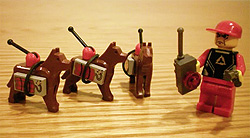 The Space Commies are well-known for their questionable attempts to train animals for warfare. The Type-9 Self-Propelled, Remotely Detonated Anti-Tank mines destroyed as many allied tanks as enemy ones.
Photo: Silent-Sigfig from "Space Commie BMD-300 IFV and Self-propelled mines. (not cool)" Elements shown: LEGO When the requirements for Usefulness aren't met, a Half-Minded Creature becomes a liability. The player controlling the Creature must choose an enemy player and hand control of the Creature to them. The enemy player, on their next turn, may then direct the Creature to take either a Movement or an Action (but not both). At the end of the turn, if the Creature has not been returned to Usefulness, then that player must hand control of the Creature to an enemy of their own. Control passes from enemy to enemy until the Creature has been made Useful again or until it is killed or otherwise removed from battle.
10.2 The Medik
Creatures are as susceptible to Damage as any other Creation - Size Damage, Component Damage, and all the other special Damage types work exactly the same way (7.2: Taking Damage). When doing Damage to a living Creature, it's important to remember that its head and body are treated as the central Structure, while any limbs, wings, tails, or tentacles are surface elements. If the Creature has an Armor of 2d10 or better, these surface elements have a Weight class one level lower (7.1: Structure). Creatures have an extra vulnerability in that their Minds have a physical location, and they can be specifically targeted like any other device. For most Creatures, destroying or severing the head is usually enough to end its adventures in a single stroke. If the location of a Mind isn't obvious from a Creature's anatomy, its owner should point it out to the other players on request. Another disadvantage of wounded Creatures is that the biological ones (like minifigs) can't be conveniently patched up or reassembled by any passing Mechanik. A Mechanik's abilities only work for mechanical devices, not living flesh. There are settings in which this rule becomes fuzzy - biomechanical alien species, Lovecraftian abominatrixes, and mad-geneticist vivisectors may occasionally pop up with attendant Mechaniks for whom biological parts are interchangeable with mechanical ones. This is entirely setting-specific, but should be discussed by players beforehand.
The Medik  Deep Space Management Mediks have no time for subtlety. A massive electric shock to the groin revives this fallen trooper in a hurry.
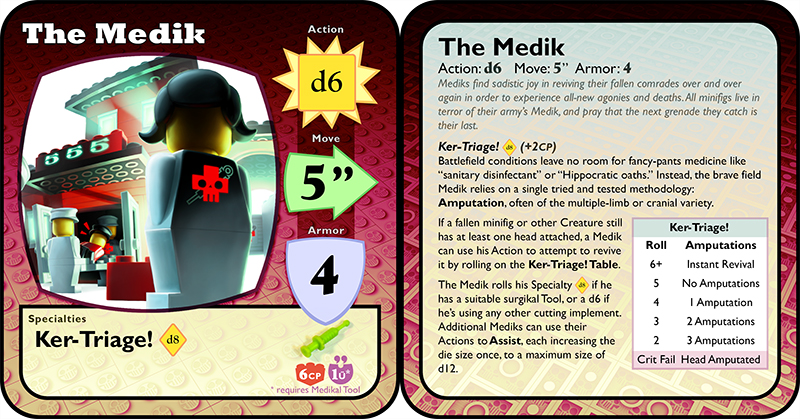
Fortunately, there are minifigs who specialize in meat-based repairs just like Mechaniks specialize in reconfiguring machinery. The Medik is a unit specially trained to perform impromptu surgeries in the field, reviving fallen soldiers over and over again so that each one can experience repeated gruesome deaths in the greatest agonizing variety. Ker-Triage! Ker-Triage! Specialty:
Lacking fancy operating facilities or any time for second opinions, the Medik uses the tried-and-true methods of Ker-Triage!, allowing him to quickly discern how many limbs need to be Amputated in order to bring fallen minifigs and Creatures back up to combat readiness.allows a Medik to perform field amputations
to revive fallen minifigs and Creatures
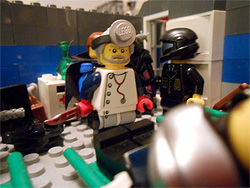 The pregnant Il-Duchessa arrives on Bas-Tyra, already in contractions. Doctor Almagna prepares his birthing knife and expertly predicts the labor will take six turns.
At the beginning of his next turn, if the Construction Action wasn't interrupted, the Medik rolls their Specialty on the Ker-Triage! Table. (If multiple Mediks are operating on the same patient, they each roll separately, and only the highest roll is used.) A Medik without his Tools can attempt impromptu Ker-Triage! with any bladed weapon instead, but he rolls a d6 rather than a d8.
If the Medik rolls a five or greater, congratulations! The minifig or Creature is revived with no ill effects. It may immediately stand up and re-equip itself as needed (so that players don't forget it's alive), and it can continue fighting as normal starting on its following turn. (On a six or better, the revived Creature can jump up and take its turn immediately.) Creatures larger than Size 1" are revived with an Effective Size of 1", along with the limitations that entails - a maximum of Armor of 1d10, in particular (7.2: Taking Damage). If the Medik rolls less than five, then the problem is more serious and he'll have to perform one or more Amputations in order to save the patient. The Amputations succeed automatically; the Medik doesn't need to make any Action or Damage rolls or spend any more Actions to remove the number of limbs indicated by the Ker-Triage! result. Each limb removed (or otherwise disabled, for Creatures whose limbs can't be removed) counts as one Amputation. Arms and legs are the most common limbs chosen; wings and tentacles will also do. Tails don't count. If there are not enough regular limbs to satisfy the Amputation requirements, the Medik has no choice but to Amputate the head. This may still save a Creature if it has extra heads in reserve, but a normal one-headed Creature will now be dead beyond any hope of Medikal revival. If the Medik's Construction Action is interrupted, he still rolls on the Ker-Triage! Table and performs the indicated amputations, but the minifig or Creature is not revived. He can continue attempting Ker-Triage! on subsequent turns. Effects of Amputation 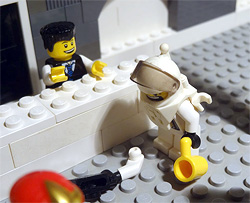 This tavern lout picked the wrong girl to drunkenly accost, as he discovered when Major Natalya offhandedly disarmed him.
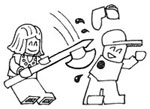
The complete loss of an arm or leg is a massive trauma that causes all surrounding tissue to swell and adrenaline to course through the body, cutting off blood loss and allowing the Creature to ignore the pain, at least until the end of the battle. Creatures who lose one or more limbs are still capable of continuing to fight. They're just differently capable.
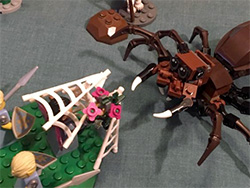 Spiders have a natural advantage when it comes to disposable limbs. Players might rule that it takes two spider legs to count as a single limb for Amputation purposes.
The loss of legs, wings, or other limbs the Creature uses to move around is treated as Propulsion Damage (9.1: Standard Propulsion). Each Propulsion limb removed or disabled reduces the Creature's Move by 1" (to a minimum of 1", if it still has at least one Propulsion limb remaining). For regular Propulsion types, if half or more of the Creature's Propulsion limbs are lost, it moves at Half Speed after applying all other penalties. For flight Propulsion, the loss of half of the Propulsion limbs means the Creature is grounded and cannot fly. If all of the Propulsion limbs are lost, the Creature is limited to dragging itself along by the length of any arms it still has attached. (For minifigs, whose arms are each 1/2" long, this means that a minifig with both arms and no legs can drag itself one inch per turn.) This uses up the Creature's Action for the turn; it may not use its arms for anything else. Even if it's still able to drag itself around, a Creature with no Propulsion limbs is treated as one that has no Move ability - it may not Sprint, Bail, or use Angry Inches, and all Close Combat attacks against it are Automatic Hits. Regardless of the state of its Propulsion limbs, a Creature who loses one or more hands or arms is limited in other obvious ways. A Creature with only one hand can't use a Two-Handed or Long-Ranged Weapon. A Creature with no hands can't use any hand-based tools or weapons at all. Less common objects have to be considered on a case-by-case basis; it may take a What I Say Goes Roll to decide whether a given armless minifig can successfully operate a door latch with his teeth or mash a self-destruct button with his face. Patching Up Wounds Where a Mechanik can use Patch Repairs to repair constructions and machinery (7.3: Field Construction), a Medik is able to Patch Up wounds for larger Creatures who've lost inches of Size Damage. In order to Patch Up an inch of Size Damage on a Creature, the Medik takes a Construction Action and performs Ker-Triage! as usual, but adds one to his Ker-Triage! Roll for each inch remaining in the Creature's Effective Size. On a Critical Failure, Patching Up fails, and the Creature takes an additional inch of Size Damage rather than being decapitated. Otherwise, as long as the Creature's final head isn't amputated, Patching Up is a success. The Medik's player attaches a random piece to the Creature as a bandage (white or red pieces are traditional), and the Creature's Effective Size goes up by one inch, up to the Creature's current actual Size. The Creature can immediately jump back into the fight if the Ker-Triage! roll is a six or greater; otherwise it spends the turn recovering. Bandages are fragile. If a bandage piece takes even a single point of Damage, it's destroyed, and its Patching Up benefits are canceled. The Creature suffers that inch of Size Damage all over again. 10.3 Dangerous Beasts The playthemes of the construction toy world offer any number of pre-molded beasts and monsters, and there's no limit to the custom species players might come up with on their own. Most of these Creatures are easily handled as variations of standard units - a dragon, for instance, is statted as a Flying Horse with a FlameThrower on its face, while a telekinetic alien is just a regular minifig with a couple of SuperNatural Dice.
Creatures are categorized by the Size measurement of their head and spinal column (or their closest anatomical equivalents), and variations are based on standardized defaults for each Size. The standard Creatures for Size 1" and 2" are the Minifig and the Horse, each described in their own chapters. The standard Size 0" Creature is a Vermin, and the standard Creature of Size 3" or larger is a Great Beast. Vermin

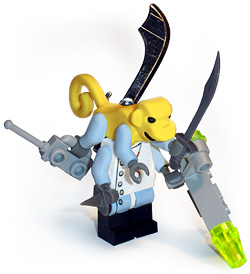
Vermin are Creatures that are so small that their Size is rounded straight down to zero. The most common Vermin are the simple one-piece pre-molded animals scattered as props in adventure settings: snakes, bats, spiders, parrots, and babies, for instance, depending on the genre. The small Size of Vermin makes them ineffective as individuals, so they are best deployed in swarms, giving them strength in numbers to harass unarmored foes and support the attacks of larger allies. All Vermin are Half-Minded: Incompetent. On any team with multiple Vermin, one of them will do something Stupid on every turn (10.1: Minds). Size Zero
Vermin are so small that they have no Size or mass at all. They can be carried like equipment items, or swung or thrown as Random Objects for Bite Damage. When throwing or Launching large bundles of Vermin, the size of the overall bundle is used, not the sum of all the Vermins' individual zero-inch Sizes. Zero weight gives crawling Vermin the Spidering ability: they can climb on any vertical or inverted surface at no penalty (although they must end their turn in a stable position for practicality's sake), and they are immune to Falling Damage (7.6: Creation Combat). A Vermin with proper appendages can carry a one-handed minifig equipment item or weapon at no penalty, or two such items (or one two-handed item) at Half Speed. It can't throw, operate, or use them in combat, or operate mounted weapons or other devices. Vermin have zero Momentum and offer zero Physical Opposition, and cannot attempt Shoves, even on other Vermin. Vermin have a Structure Level of zero and zero Armor. Any attack that hits a Vermin skips the Damage Roll and kills it automatically. Groups of Vermin are especially vulnerable to Explosions and Arc Fire. If Vermin are Disrupted, units and objects of Size 1" or greater can crush any number o fthem underfoot with Trample Damage (9.5: Collisions). If a Vermin isn't Disrupted, a unit can choose one of them to try to stomp on, but must treat this as an Attack with Use:0. The Vermin can attempt to Bail out of the way if it wishes, or hope that the stomper Critically Fails the Attack Roll. Due to their small Size, all attacks against Vermin have a -2 Action Penalty for Target Size (5.1: Making Attacks). Tiny Attacks Vermin don't have the natural attacks of larger animals. They must rely on a Tiny Bite, Tiny Spit, or Tiny Sting. A Vermin's attack is painful but not particularly dangerous - it's only effective against unarmored Creatures of Weight 1 or less, and even then it only does 1 point of Damage (or 1d4-2 Poison Damage for Venomous Vermin). A Creature with a higher Weight class or wearing armor can ignore Vermin completely, even if the Vermin are crawling around all over it. 
If a Venomous Vermin's Tiny Sting does zero points of damage or less, it fails to break the skin and the Poison effect is canceled.
Vermin attacking in cooperation with non-Vermin are subject to the usual Close Combat limit of three attackers for every inch in the target's Size, or else they risk being struck by their own allies' attacks. Vermin attacking by themselves can ignore this limit, forming a swarm that can pile as many attacks onto an unarmored Creature as there are Vermin able to reach it. The Vermin's single point of Damage isn't enough to threaten most enemies, although their Cumulative Damage can bring down a full-sized minifig if enough of them make successful Bites at the same time. Vermin are more useful for outnumbering opponents in Close Combat to inflict Action penalties, and for absorbing attacks to protect higher-value allies. Animals 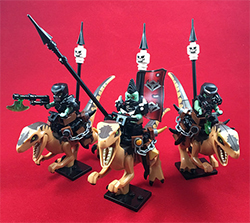 Animals of Size 2" or greater can and should be used as minifig steeds, as these Urk Raptor Cavalry demonstrate.
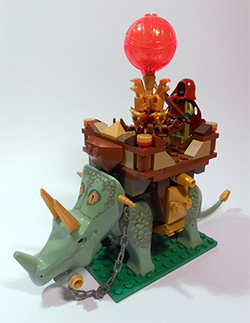 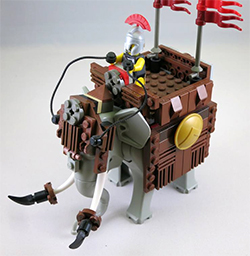 Great Beasts can be made even greater with the addition of second-story balconies and chrome trim.
Whether pre-molded or player-built, brick animals' stats and abilities are kept simple for the sake of convenience. Animals of the same Size are roughly equivalent to each other (with some room for Fudge - a monkey is strictly superior to a pig in battle, for instance, although a pig is superior in a breakfast). Animals of Size 2" or larger can be ridden as steeds, although the sea Creatures can be tricky if they lack dorsal studs for mounting. Basic animals draw from a small set of Natural Attacks. Most are equivalent to a minifig's Hand Weapon with an extra effect or two; Size 1" animals can have one such attack, while Size 2" animals sometimes have two. Great Beasts can have larger Big Attacks, if their attack appendages are large enough to justify it; these are equivalent to Size 2" Melee Weapons. 10.4 Monsters 
His 09 tentacles unorchestrate all chaos. His 37 eyes incomprehend all mayhem. BrikThulhu Ragnobloktopus, sovereign lord of entropy, lays bare the illogik underlying brik reality. With fecundating violence, he brings life to the shelf display pieces and unbuilt sets, leaving monsters and shattered minds in the wake of his passing.
(BrikWiki entry: Brikthulhu)  Ebon-clad Torquemada tries to warn a Majistik that there are more things under heaven and earth than are dreamt of by his philosophy.
 The Bavarian Kaiser decides what to do with captured Pwny specimens and their corrupting deviant magik called "Friendship."
Photo: Silverdream From "The Chain of Command and an Alliance of Friendship" Elements shown: LEGO, Hasbro
Monsters appear in limitless variety and adhere to no standards. Each Monster can have features and abilities unique among Creatures and even among other Monsters of the same type. Corrupted Minifigs 
Under the corrupted ablogical effects of Kounterfeit Leg-Ore, minifigs suffering under a KLOan Brand become warped and distorted, as if they were incompetent forgeries made victim to shoddy manufacturing practices.
Corrupted minifigs are similar to regular minifigs with a single horrifying change. Some have animal heads, some are made entirely out of bricks, and at the lunatic extreme, some have noses. While not especially dangerous individually, corrupted minifigs often travel in swarms, overwhelming defenders by force of numbers. Most corrupted minifigs have hands and can use minifig weapons and tools as well as any regular minifig. Some have an additional Bite or other Natural Attack. A corrupted minifig with a Natural Attack can't use it on a turn in which they also use hand weapons or equipment. The Dimmy  Following the death of Satan at the hands of Archangel Bob Ross, a battle for Hellish supremacy takes a diabolical turn when the Demon of Fraud self-destructs and cracks the foundations of Hell itself. The Demon of Violence is not prepared for what pours out: an endless horde of Dimmies.
A Dimmy's most horrifying features are a bulbous facial mutation (called a "nose") and a Poisonous Bite that can turn minifig victims into more Dimmies. Any minifig killed by Dimmy Poison comes back to life as a Dimmy on the Dimmies' next turn, allied with whichever Dimmy bit him. The Jaw-Jaw 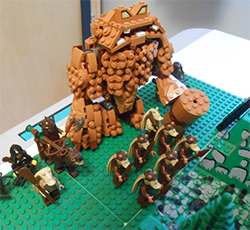 Despite their insatiable hunger, Jaw-Jaws sometimes ally themselves with giant poop monsters in battle rather than eating them immediately.
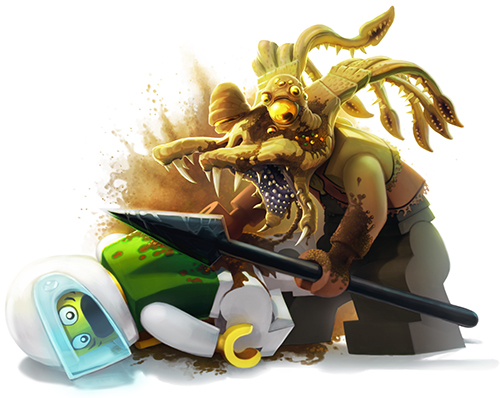
A Settanian soldier falls victim to a Jaw-Jaw's paralyzing Dungan Poison.
The ecology of Jaw-Jaws and their Dungan religion are developed entirely around feeding on the poop of minifigs. Jaw-Jaws possess the unnatural ability to regenerate from fatal injuries and dismemberment. After a Jaw-Jaw is killed in combat, its corpse attempts to revive itself on its following turn, making a roll on the Medik's Ker-Triage! Table using a . If it succeeds, any amputated limb or limbs fall off, and the Jaw-Jaw returns to combat.When drawn out of their sewer nests, Jaw-Jaws coat their weapons with paralytic Poison for the purpose of incapacitating victims before attaching suckers to feed. If a Jaw-Jaw comes across a living non-Jaw-Jaw minifig who's paralyzed or Disrupted, it can make a Suck attack on the minifig to extract the vital bodily wastes and regenerate one of its own lost limbs. Any minifig leeched in this manner is depleted of poop and cannot be used for this purpose again. The BlokBot 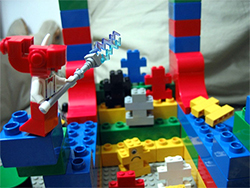 A mysterious Professor activates the ancient Duplodian ruins and summons a wave of Blokbots to invade Hellius once more. Only the Metal Warriors stand between the Professor and total Blokbot domination.
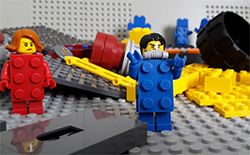 Following the BlokBot-related destruction of their chemical plant,
Dr. Aras Gabrys and Irena Mielkutėawake to discover they've mutated into BlokBot minifig hybrids. The Doctor is thrilled; Irena less so. 
A BlokBot is the most primoridial of Monsters: a cyclopean pile of bloks. The most common variety is built of six bricks assembled into the vague form of a minifig and relying on slam attacks to overwhelm its foes. In regions where the BlokBots' power is strongest, often in the presence of large double-sized blocks, there are no limits to the size, form, and abilities of the strange BlokBots that appear. BlokBots are Modular, crumbling and reconstructing themselves as they take damage. Every point of damage inflicted on a BlokBot knocks one of its bloks off, causing the usual penalties for lost limbs. Detached bloks become normal bricks again, allowing crumbled BlokBots to be used immediately as a cheap source of building materials. A BlokBot with at least one "arm" can use its Action to Reconstruct itself or another BlokBot, replacing a lost blok with any unattached single brick or corpse of the same size or larger than the lost blok. Regardless of the size or form of the new Reconstructed blok, whether a boat hull, dead horse, or standard brick, it behaves like the original blok in all regards, and can be knocked off again by another point of damage. The Furfig 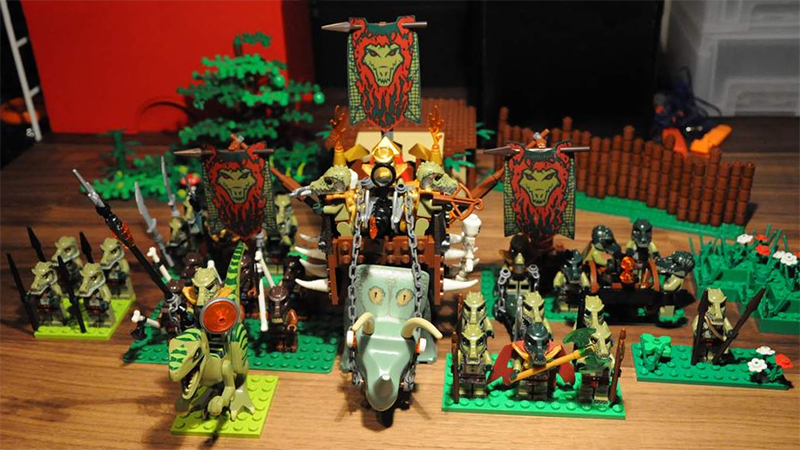
King Kroc gathers an army through the age-old technique of showing up on a sweet ride.
FurFigs are minifigpomorphized animals with the bodies of minifigs and the heads (and sometimes other parts) of beasts. FurFigs take on some of the abilities of their animal relatives where appropriate, including a single Natural Attack and an occasional alternate movement type. These are usually obvious - a RhinoFig has a Ram attack, a BirdFig has Flying movement and a Bite attack, and a StingrayFig has Swimming movement and a Sting attack, for instance. For some FurFigs, the nature of their Natural Attack may be up to the game fiction and player negotiation; an eldritch SquidFig's face tentacles might be treated as a Claw attack with a Grab, or a Sting attack with paralytic Poison to render victims helpless for convenient brain consumption, depending on what kind of SquidFig the players have in mind. Figures of Unusual Size Like Humans, minifigs whose body sizes vary even slightly from the perfect airbrushed boxcover-photo ideal are treated as monsters. Ranging from tiny Munchfig Vermin to towering Giants, mini-sized figs view these non-mini figs less with horror than with disdain, treating them as disposable weapons, beasts of burden, or snacks.
Larger and smaller figures fight like minifigs, but their hand-held weapons scale up and down along with them (8.1: Weapon Size). Large weapons carried by large figures keep their basic weapon stats, but can be wielded in hand and swung around the way minifigs swing around weapons built for their own proportions. A Bigfig might weild a pair of minifig Two-Handed Weapons as if they were sabers. A Brutefig might rip a 4" tree out of the ground to swing two-handed like a club. A large enough Giant might hold an armored tank in each hand to fire like pistols while riding two others as roller skates. The Munchfig  Supposedly named for their bite-sized stature and curious magikal properties when eaten, MunchFigs are just as likely to rise up and devour the unsuspecting novice wizard who doesn't realize he's summoned a number larger than he can control.
Elements shown: LEGO, Mega Bloks 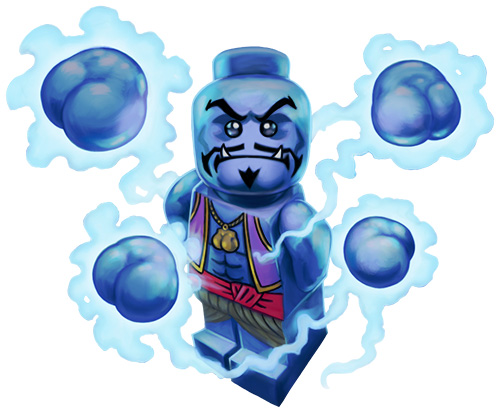
Munchfigs are a magikally created race of half half-figs, spawned from the mixed genetik material of ancient ProtoFigs, living minifigs, and fried chicken legs. Cheap and easily summoned, they serve in wizards' laboratories as diminutive servants and, occasionally, snacks. Despite having no apparent hands, Munchfigs are able to lift and carry a single small-sized minifig weapon or equipment item on their head, making them useful as gophers and edible snack trays. Munchfigs are edible. Grabbing and eating a Munchfig within arm's or bite's reach costs no Action for allied and friendly Creatures. Opposing Creatures can also eat Munchfigs if they can successfully Grab one; this Grab costs an Action as usual. Friendly or not, eating a Munchfig is instantaneous and free, and a Creature can chomp up a held Munchfig at any time. A Creature who eats a Munchfig gains the ability to re-roll a single die in one of its own die rolls. This ability can only be used once, and disappears at the beginning of the Creature's next turn. The Bastardfig
Like Bastard Weapons (8.1: Weapon Size), Bastardfigs fall halfway between the one- and two-inch Size markers, with some properties of each. With their unusual Size of 1.5", Bastardfigs are worth 1.5 Unit Inches, have Power 3 for operating weapons, and can take one and a half inches of Size Damage. When a Bastardfig is reduced to his final half inch of Effective Size, it only takes half as much damage to finish him off; his Armor is treated as a 2. The Bigfig
The Bigfig is a combat monster, as strong as a Horse and with the extra combat punch of an Action d8. Bigfigs (and their larger, dumber cousins, the Brutefigs) tend to have proportionally longer arms in comparison to their body than a minifig. Two inch arms can be treated as Size 2" Launchers, allowing the Bigfig to pick up minifigs with a successful Grab and Launch them as projectiles or use them as Random Objects to bludgeon their peers (3.4 Desperate Measures). The Brutefig
Where the Bigfig focuses on causing damage, the Brutefig excels at soaking it up. The Brutefig's high 2d10 Armor and natural Deflection lets it ignore most minifig attacks, and its diminished mental faculties let it ignore everything else. Brutefigs have a standard d6 Mind, but they are subject to Stupidity as if they were Incompetent (10.1: Minds). A Brutefig in an army with other Stupid units can be a serious liability if it's positioned next to anything important. The Giant
Any fig of Size 4" or larger is a Giant. In theory, there's no upper limit to the Size of a Giant, but in practice they rarely appear in Sizes larger than six hundred twenty-four inches.
Monstrosities Monstrosities are the Creature versions of the ludicrous death machines that make up the majority of Human children's construction-brick output. In many cases, the Monstrosity is just the same death machine with a head or an eye added. The great advantage of Monstrosities is that they suffer from no minimum design standard. In fact it's often the case that the worse the quality, the better the Monstrosity. The Dragon 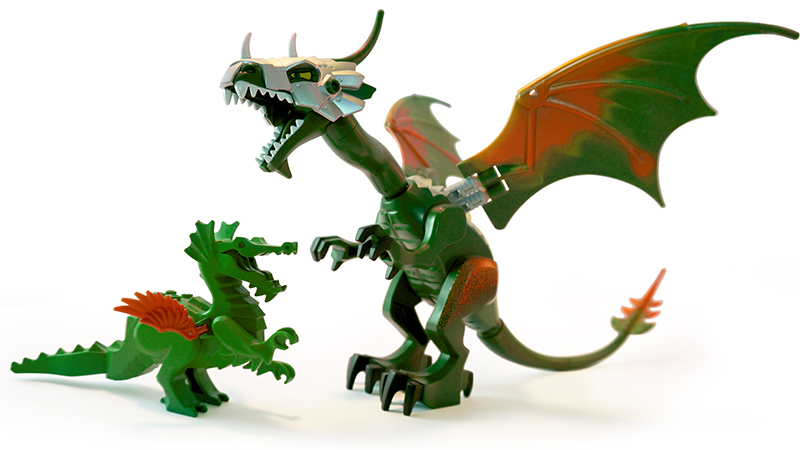
A single Monster type can have wide variations depending on their origin. Dragons, in particular, have wildly different Sizes and abilities from individual to individual.
There are no default Dragon stats because there are no default Dragons. All dragons must be built from scratch as custom Creatures. It's technically legal to have a flying green one-headed dragon that breathes fire, but such a generic monster is a wasted opportunity in a system that allows for a three-headed transparent purple dragon phasing through dimensions to breathe cones of shrapnel and lethal fireworks displays, or a no-headed floating eyeball dragon with nine other eyes on eyestalks that each shoot different breath weapons that are really gaze weapons because eyestalks don't have mouths and it's not completely clear that this thing is really a dragon at all. BrikThulhu 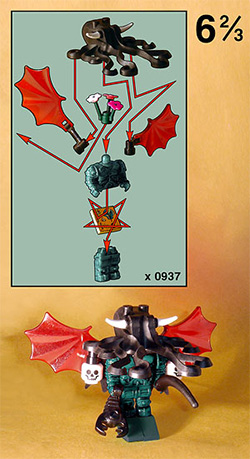 When constructing BrikThulu, it's important to grab a supply of flowers specifically for the sake of omitting them.
Elements shown: LEGO, Mega Bloks 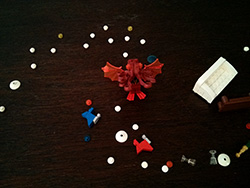 With a new Rekonstruction dawning, BrikThulhu tires of temporal and physical separation and smashes all of eternity and reality into a tiny timespace nugget. Every minifig and civilization throughout history are now packed into the same tiny existence and immediately declare war on everyone else.
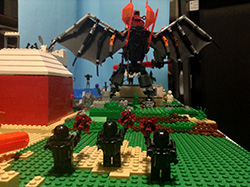 A squad of Phoenicians thinks they can get the jump on BrikThulhu by attacking from behind. But his eyes see all.
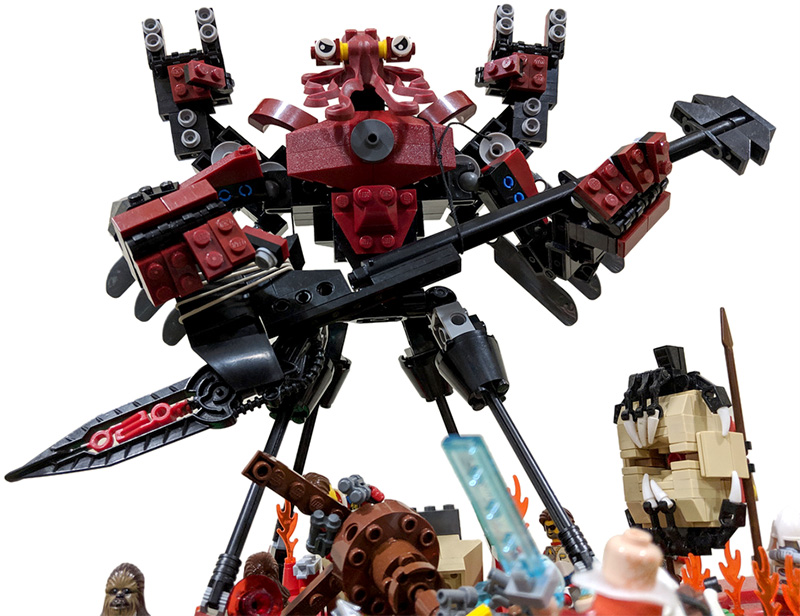
When minifigs start fingering his Buttnomikon without permission, BrikThulhu incarnates as his own built-in reality-annihilating sound system.
BrikThulhu exists outside the confines of any rule system, and the effects of his presence in a battle are impossible to predict. The lives and suffering of minifigs are irrelevant to BrikThulhu, existing only as grist for his labyrinthine cephalopodian schemes. Minifigs are the fetishized plastic bait that BrikThulhu wriggles to hook the obsessions of susceptible Humans on whose sanity he feeds. Rather than devoting their short lifespans and resources to having fulfilling relationships and improving the world, Humans who find themselves caught in the slow constriction of BrikThulhu's nine infinitely-branching tentacles compulsively sacrifice their money and psychological health on inert but ever-growing piles of brightly colored plastic. No bins of bricks, no sacks of dice, no host of minifigs can ever be enough to satisfy BrikThulhu's victims, even as their friends and relations and employers and credit rating agencies recoil from their crippling fixation and its effects. All minifigs love and celebrate BrikThulhu for the Human attention he brings them, even as they find themselves tortured and murdered by the inevitable BrikThulhu cultists among their ranks. Only BrikThulhu has the right to roll the incomprehensible Action d20, allowing him to operate on the Human plane. BrikThulhu uses this power to sabotage die rolls, derail plotlines, corrupt hard drives, and add watermarks to online image hosting services, because the strength of a Human's fixation is set by the depth of suffering they endure. BrikThulhu ensures that critical pieces are only available in two hundred fifty dollar playsets, and once purchased, can then never be found when they're needed. It's BrikThulhu who allies with the family cat to bring prized constructions crashing down, causing rare pieces to vanish eternally, and pointy pieces to reappear days later underneath the Humans' bare footsteps. Not only does BrikThulhu consume Human sanity, he has the power to re-inflict this Ensanity on minifigs by his mere presence. All minifigs bearing witness to BrikThulhu are struck permanently and cripplingly sane, incapacitated by the intolerable comprehension of their true nature as chattel plastic toys. | |||||||||||||||||||||||||||||||||||||||||||||||||||||||||||||||||||||||||||||||||||||||||||||||||||||||||||||||||||||||||||||||||||||||||||||||||||||||||||||||||||||||||||||||||||||||||||||||||||||||||||||||||||||||||||||||||||||||||||||||||||||||||||||||||||||||||||||||||||||||||||||||||||||||||||||||||||||||||||||||||||||||||||||||||||||||||||||||||||||||||||||||||||||||||||||||||||||||||||||||||||||||||||||||||||||||||||||||||||||||||||||||||||||||||||||||||||||||||||||||||||||||||||||||||||||||||||||||||||||||||||||||||||||||||||||||||||||||||||||||||||||||||||||||||||||||||||||||||||||||||||||||||||||||||||||||||||||||||||||||||||||||||||||||||||||||||||||||||||||||||||||||||||||||||||||||||||||||||||||||||||||||||||||||||||||||||||||||||||||||||||||||||||||||||||||||||||||||||||||||||||||||||||||||||||||||||||||
|
|
|


 Size
Size

 Move each
 Death
Death


 -2
-2  With their Size of zero, players might expect that Vermin have zero value as well. As true as this might be, a Vermin has a hard enough life already, and so it's assigned a pity value of ¼ Unit Inch.