
|





















|
|
|
|
|
Chapter Eleven
Battlefields
Minifig campaigns are focused on highlighting, developing, and fighting over strategic Battlefields. Battlefields are introduced as they become relevant to the campaign storyline. A war might span vast deserts and dark jungles, but until a Faction actively puts a campaign spotlight on those locations, they're background filler material rather than stars of the show. Whatever military and industrial catastophes may be transpiring in those areas, they're somebody else's problem until a Faction brings them into the campaign as Battlefields. Each Battlefield is a single, complete combat setting, isolated from other Battlefields by strategically unimportant travel space. A normal battle can't span multiple Battlefields, unless players find a way to crash mobile Battlefields into each other. If players set up a campaign where Battlefields are necessarily physically adjacent (for instance, floors of an apartment building, or wings of a hospital), they agree that it's the kind of campaign where no one has access to the kinds of weapons or tactics that would spill over between them. 11.1 The Faction Headquarters 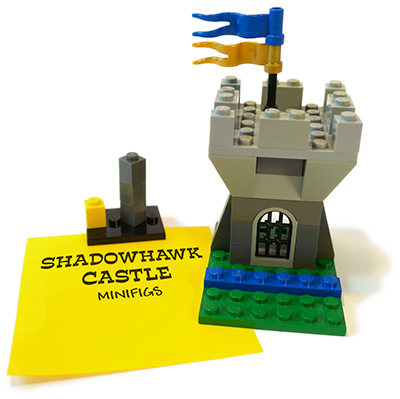 Shadowhawk Castle is the fortress Headquarters of the Shadowhawk clan, forced into exile by the schemes of their Lighthawk cousins. Calling on whichever men-at-arms are still loyal (
 Production 1) and protected by strong stone walls ( Production 1) and protected by strong stone walls ( Fortification 3), the Shadowhawks plan a violent reclaiming of their ancestral lands and titles. Fortification 3), the Shadowhawks plan a violent reclaiming of their ancestral lands and titles.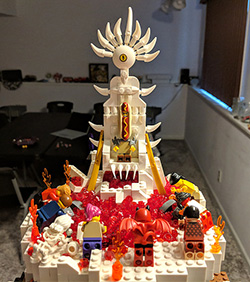 The Headquarters of Hell is ruled from the bone throne of Satan, recently deceased. The throne is currently occupied by the victorious Demon of Treachery, the spirit of an evil hot dog who gave Flamer Shaftglutton food poisoning once.
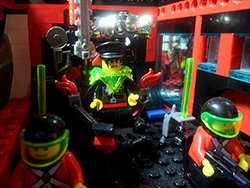 Emperor Piltogg commands the Akkadian Empire from the bridge of the flagship DethStar, surrounded by the collected Artifakts of Pre-Creation that render him too OP to bother engaging in battle himself.
The Headquarters should match the scope of the campaign. A nation's capital city wouldn't be an appropriate Headquarters for a border trade dispute over maple syrup production, any more than the three-wheeled mobile syrup command center would be an appropriate Headquarters for existential warfare between nations. Players don't need to build the physical model for their Headquarters until they're actively staging a battle there. (They can if they want, of course; a ready-built Headquarters is good for Factional scene-setting and dramatic vignettes even if it's not yet in the process of getting blown to bits.) Instead, they write the name of the Headquarters onto an index card or sticky note to serve as their first Battlefield card. As the campaign progresses, players use cards like these to keep track of the development of Battlefields as they're added to the campaign.
(11.3: Resource Production)  A Faction's Headquarters has one point of Production, giving it the ability to recruit standard minifigs armed with standard minifig weapons (Chapter 3: Minifig Weapons). The player writes "minifigs" on the Headquarters' Battlefield card to show that they're Produced here.
Minifig recruitment is a special type of Production that can only take place at the Faction Headquarters. Instead of relying on generic Workers, this Production is handled by a Campaign Leader working at a designated command center (a throne room, an executive boardroom, a starship strategic command bridge, a back room in the speakeasy). The Campaign Leader can be any Command Specialist of the player's choice (an Officer, Leader, Commander, or Great Leader, as appropriate to the story and campaign scope (S.7: Command Units)). The Campaign Leader is treated like any other Production Worker; he's not part of the Army, and he doesn't have a Unit Inch value for Budget or Balance of Power considerations (MC.4: Unit Inches). Like Heroes, a Campaign Leader killed in battle is only ever truly dead if it fits his player's storyline (6.5: Heroic Deaths). More often, he recovers from his injuries during development at the end of the campaign round, or he's captured and will need to be rescued in a Heroic Escapade, depending on which Faction has possession of the Campaign Leader's body at the end of the battle. If a Faction increases Production at its Headquarters, more Command Specialists can be added to the command structure like regular Workers. If a player decides their Campaign Leader is truly lost, any of the surviving members of the command structure can be promoted to the new Campaign Leader. As long as the Faction has its Headquarters with a Campaign Leader or other surviving member of the command structure, it can continue recruiting minifigs. If the Headquarters is lost, but the Campaign Leader escapes, the Faction can turn another one of its Battlefields into a new Headquarters by mobilizing the Campaign Leader as a new point of Production there. Fortification (11.4: Fortified Defense)  A Faction's Headquarters is Fortified, giving it defensive structures and garrisons. The Headquarters' starting degree of Fortification is based on the scope of the campaign, from one point of Fortification for an intimate campaign within a single building or academic faculty department, to four points for a multinational campaign spanning continents or star systems.
Headquarters are protected by a defensive structure, either in a perimeter wall around the Battlefield's Production Facilities (as for an army compound, a fortified village, or a high-security prison) or reinforced walls for a single main building or room (a naval flagship, a fortified inn, an executive restroom suite). The Fortification number determines both the maximum Weight class of the defensive structure and the maximum Size inches of the units in the defensive garrison (7.1: Structure). With Fortification level 2, for instance, a Wild West Fort can have a log palisade with Armor 2d10, and can garrison Size 2" rough riders and light cannon in addition to Size 1" riflemen on foot. The Headquarters inherits its starting Fortifications from previous history and past campaigns, which aren't subject to the Production restrictions that will hamper later Fortifications once the campaign is underway. A Fortification 3 Royal Castle Headquarters can start with mighty Armor 3d10 stone walls, even though the Faction hasn't mobilized any stone Production yet.
The Budget 
By the unanimous consensus of respectable minifig treasurologists, the only appropriate way to store valuables is in obvious and easily stealable containers.
 A Faction manages its campaign Budget from its Headquarters. The Budget is how many Unit Inches the Faction has available to repair and replace units lost in battle, or to build and recruit new ones. The Budget represents whatever combination of cash, weapons, supplies, and miscellaneous other resources the Faction has at its disposal for the campaign.
The larger a Faction's Budget, the longer the campaign it can wage. Once its Budget is used up, the Faction loses the ability to buy or replace units, and its campaign is approaching a final defeat. A Faction whose Budget is running low can stage a Heroic Escapade in search of alternate income, but enemy Heroes stand ever ready to thwart their efforts and steal treasures for themselves.
If a Faction's Headquarters is attacked, a portion of its Budget stockpile always happens to be lying around in the form of 1" minifig-portable crates, chests, and miscellaneous treasure items. One such treasure item is placed somewhere inside the Fortified area for every brick of Production and Fortification on the Headquarters' Battlefield card. (The number of treasure items can't exceed the number of Unit Inches remaining in the defender's Budget, however.) Apart from being placed inside the Fortified area, treasure items are left out in the open; they are the portion of the Faction's Budget that isn't locked away in a vault or hidden in some other secure location when the attack takes place. Each treasure stolen or destroyed subtracts one Unit Inch from the defender's Budget. Each treasure that is captured by an enemy, either by conquering the Headquarters or by successfully carrying it off their own edge of the Battlefield map, adds one Unit Inch to the enemy's Budget. 11.2 Spotlighting Battlefields
At the beginning of a campaign, a Faction's existing territories and resources aren't part of a campaign effort by default. Their energy and efforts are devoted to unrelated business and other agendas. A vast and powerful empire will have to spend just as much time and effort mobilizing its existing territories as an upstart invader takes to conquer new ones.  New Battlefields enter the campaign story as a Faction spends Glory to introduce them in the Development phase at the end of the campaign round. The number of Glory bricks it costs to introduce a new Battlefield is equal to the number of Battlefields the Faction already controls. If a Faction has three Battlefields (the Castle, the Stables, and the Forest) and wants to add two more (the Lumber Mill and the Clown-Face Bologna Brothel), it spends three Glory to introduce the Lumber Mill, and four Glory for the Brothel (since the addition of the Lumber Mill brought its total Battlefields up to four).
If a Faction has no Battlefields left, it can't introduce new Battlefields. If a Faction already controls more Battlefields than its Alert level, or if it has no Battlefields of its own, then it can only gain new Battlefields through conquest. In keeping with their attitude towards rules and limitations, Heroes often ignore lawfully-introduced Battlefields and pull their Heroic Escapades in some place no one has ever heard of. By the power of Ego alone, Heroes can force the campaign spotlight onto a temporary Quest Battlefield long enough to grab some sweet loot (13.1: Heroic Escapades).
Battlefield Cards When a Faction introduces a Battlefield, the player writes the name of the Battlefield on an adhesive note or index card and places it on the table. If they want, they can draw a little picture on it or build a tiny effigy out of bricks. If the Battlefield is attacked by an enemy Faction, the players will have the chance to build out the full location at minifig combat scale, but the Facilities and Fortifications of a Battlefield will grow and change from campaign round to campaign round, and it's best not to finalize Battlefield construction before it's needed. Whenever a player adds Production or Fortification to a Battlefield, they attach a Glory or Sacrifice brick directly to the Battlefield Card. If the Battlefield changes hands, the Battlefield improvements pass on to the new owners. If the Battlefield is destroyed, players tear up the card and set the pieces on fire. 11.3 Resource Production 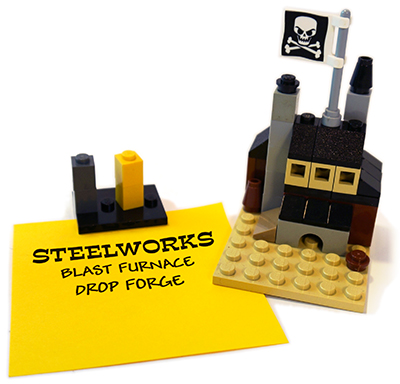 The Steelworks' two bricks of Production give it two machines for refining Steel as a Production resource: a blast furnace for smelting ore, and a drop forge to forge steel. With two Steel-producing machines, the Faction controlling this Battlefield can use Steel of Weight 1 or 2 to build its units (as well as its Fortifications, if the players decide that Steel-built Fortifications are appropriate to their campaign fiction).
None of the players have any real idea about how furnaces, forges, or metallurgy work, but they all agree that giant ovens, gratuitous pulley buckets, and comedically oversized pots of molten metal justify any harm they might do to a realistic portrayal of the steel industry.
All Battlefields are mobilized for resource and unit Production. A Battlefield that doesn't Produce anything is hardly a Battlefield at all. Conquering a non-Productive Battlefield provides little benefit to the winner or detriment to the loser, and so minifigs focus their combat attention elsewhere.
Adding Production Production is added as part of the Development phase at the end of each campaign round. When a Faction introduces a new Battlefield, the player places one of the Faction's spent Glory bricks on the Battlefield Card to represent its first point of Production. The Battlefield gains a Facility and a Worker to Produce one strategic resource, making that resource available for the Faction's campaign efforts. The Battlefield also gains its first item of resource loot for enemies to steal. Minifigs have more important things to do than tracking accounting spreadsheets of resource quantities. A Faction either Produces a resource in unlimited supply, or not at all. There are no amounts in between.
From that point forward, each new point of Production on a Battlefield costs as many bricks of Glory as the number of Production points already there (with a minimum cost of one Glory brick, even if the Battlefield has been reduced to Production level zero by enemy shenanigans). For an orbital repair factory with two Production points (a Shipyard Assembly Rig building spaceships and a Mechanik's Shop providing Mechanik training), for example, adding a third (an Alien Egg Chamber producing minifig-eating xenomorphs) would cost two points of Glory. A Faction can start using new Production resources immediately, using them to build and repair units and Fortifications in the same campaign round. Facilities, Workers, and Loot Each point of Production at a Battlefield has its own Production Facility, Workers to operate it, and stealable loot items. The improved economy also increases the number of Workers and loot items at all other Facilities at the site.
A Battlefield's Production number determines the number of active Facilities there, as well as the number of Workers and the number of loot items at each Facility. A miners' outpost with Production 2 might have two miners with two carts of ore and two blacksmiths with two iron ingots. A forested harbor with Production 4 might have four lumberjacks with four cut logs, four lumber mill workers with four piles of lumber, four shipwrights with four basic rowboats, and four press gang bartenders with four unsuspecting drunken sailors ready to be turned into pirate Workers. A larger number of Workers doesn't produce a larger amount of resources, but it does make it harder to wipe them out in an attack.
A Battlefield's Facilities, Workers, and loot are physically present in any battle that takes place there, and they take an active role in combat under the control of their Faction's player. Workers, loot items, and some types of Facilities can be removed from the Battlefield by theft, evacuation, or improbable industrial mismanagement during battle. Once removed from the Battlefield, they can't be brought back until the battle is over; they remain in possession of whichever Faction took them. As long as a Facility and at least one each of its Workers and loot items are intact and in place at the end of a battle, Production continues uninterrupted despite whatever explosions and disasters and changes of ownership occur. If a Facility or all of its Workers are killed or permanently removed, the point of Production is lost and its resource is no longer available. If the Faction wants that resource again, it has to spend Glory to remobilize the Production from scratch. If a Facility or all of its Workers are temporarily removed but can be immediately returned after the battle, or if all of a Facility's resource loot items are removed, then Production is temporarily disrupted but not destroyed. The resource is unavailable during the Development phase at the end of the campaign round, and becomes available again in the following campaign round. Any Faction that possesses resource loot items at the end of the battle (either because they control the Battlefield or because they successfully ran off with the items) can use them as temporary resources during the Development phase at the end of that campaign round only. Stolen resources don't decrease the Budget cost of new units; they only add construction options that might not have been available otherwise. A vehicle built from a stolen tank chassis, armored with stolen steel, and crewed by stolen gunners costs just as much Budget as the same vehicle built with a Faction's own Production.
After the development phase at the end of the campaign round, any resource loot left in a Faction's possession mysteriously disappears. Meddling minifig logisticians always find other non-campaign purposes to apply them to rather than letting them sit around unused. Resource Categories The campaign fiction and the whims of the players will determine the types of resources that Factions will Produce. A medieval kingdom's military efforts might depend on wood, stone, horses, and magic crystals, while a modern democracy would focus on steel, factories, and illegal bioweapons. Literalist minifig Factions might mine toy-grade plastic directly from rainbow plasteroids. Esoteric Factions might build their armies out of emergent concepts, solidified madness, and an endless supply of quasi-religious zealots. Whatever strategic resources players come up with, they each fall into one of three functional categories: materials, units, and training. Materials
 While not as versatile as military minifigs trained for battle, material-Producing Workers tend to carry the kinds of tools that are as good for harvesting skulls as they are for harvesting resources. Picks, hatchets, chainsaws, and blowtorches are deadly weapons in the right hands, and the Workers' Job Training
  Specialty (S.3: Infantry) can make them as effective as military minifigs as long as they're wielding the tools of their trade. Specialty (S.3: Infantry) can make them as effective as military minifigs as long as they're wielding the tools of their trade.
Without materials Production, a Faction is limited to building with whatever's lying around. Cobbled junk, stacked rocks, and minifig bodies are freely available, but have a maximum Weight class of ½. For anything heavier, they'll need to Produce sturdier material resources (or, in a pinch, steal some from an enemy who already did). When a Faction mobilizes Production of a material resource, they gain the ability to build their units and Fortifications out of that resource at Weight class 1 (Armor 1d10). For every additional Facility they control (usually an industrial machine) that produces the same resource, the maximum Weight class they can build with increases by one, up to the material's maximum strength (as agreed by the players). A Faction with two Stone Facilities, for example, can build Stone creations up to Weight class 2; a Faction with three Space Alloy Facilities can build Space Alloy creations up to Weight class 3. When building units and Fortifications, only the main Structure requires material resources; weapons and devices are free. A fire truck unit only requires a Steel resource for the chassis; it doesn't need a Rubber resource for tires or a Canvas resource for the fire hose or a Gasoline resource for setting fires in the first place.
A material's maximum developed Weight class depends on the specific material in question, the technical sophistication of the Faction, and the limits of the campaign fiction. Most basic materials have a maximum Weight class of 2 or 3. Weight 4 materials are exotic and rare, usually requiring a Heroic Escapade to discover, and Weight 5 materials are almost unheard of. To gain the benefits of multiple facilities for the same material resource, the Facilities can't be copies of each other. A Faction with a Logging Camp doesn't increase its Wood-crafting abilities by conquering an enemy's Logging Camp; it just produces twice as much of the Weight 1 Wood it already had an unlimited supply of. The faction must have different types of Facilities for the same Resource in order to produce it in heavier Weights.
When combat takes place on a Battlefield Producing material resources, some of the materials are left lying around their Facilities as stealable loot (often simple two-by-four bricks in an appropriate color), just like stealable Budget treasures at the Headquarters (11.1: Faction Headquarters). If an attacking enemy units steal some of these materials and escape off a friendly side of the battlefield, their Faction gains the temporary ability to build one unit or Fortification out of that material for each loot item stolen during the Development phase of that campaign round only. Units
 Unit-producing Workers aren't as likely to carry deadly implements as Materials Workers, but their Job Training can give them limited versions of
  Support Specialties (11.5: Support) as long as they're working with their category of Unit. Workers for living Units can act as limited Mediks, while Workers for manufactured Vehicles are often low-level Mechaniks or Engineers. Support Specialties (11.5: Support) as long as they're working with their category of Unit. Workers for living Units can act as limited Mediks, while Workers for manufactured Vehicles are often low-level Mechaniks or Engineers.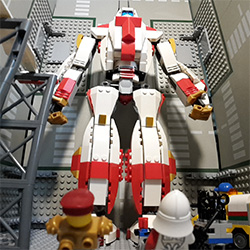 Little does Polish High Command realize that the rogue Ryszard Mazurek has built his own War Titan on Planet Vilnius.
Buildings, Facilities, Fortifications, weapons, and devices don't require any special manufacturing facilities. As long as a Faction has the necessary Alert level and materials, its minifigs will find ways to assemble these items on their own without campaign oversight or Budget. Creatures and Vehicles, on the other hand, are unit resources that require dedicated Production and maintenance facilities. The most basic unit resource in any campaign is the armed minifig, recruited by Workers at a Faction's campaign Headquarters. This single unit resource can be enough to carry a campaign all by itself, and battles without armed minifigs are all but pointless.
Construction plastic is a flexible medium, and unit resource Facilities cover broad categories rather than a single unit type. A racecar factory can be quickly refitted for building tanks, an arcane laboratory for animating stone golems can switch to animated furniture instead, and a dragon hatchery can go from training Size 1" hatchlings at the beginning of a campaign to Size 4" adults as the Alert level escalates. The type of Facilities used in unit Production depend on the campaign fiction and the types of combat environments the players find most appealing. A Faction defending its home territory might produce its fighter plane units in an airplane factory Battlefield, for example, while an invading Faction might base its air units out of a forward airbase or aircraft carrier Battlefield instead. Unit resources can act as a components for more advanced units when it makes sense to do so. A wooden horse-drawn chariot requires a Horse resource for the horse-drawing just as much as it requires the wood resource for the chariot. A team of Commandos require the Headquarters' minifig production along with the Commando training resource. If the Faction isn't producing the necessary unit resources from its Battlefields, it can pull the appropriate units out of its Army instead to be upgraded, retrofitted, or retrained. When combat takes place on a Battlefield Producing unit resources, stripped-down versions of the units are left in their Facilities as stealable loot (minifig recruits, untamed Horses, unarmored hovertank chassis, unarmed mini-copters), in as small a form as is practical. If the units have Minds, they are Half-Minded (Incompetent or Submissive) (10.1: Minds). These units have no weapons, equipment, armor, or training, but are otherwise functional. If enemy units steal some of them, they can be used as components to create units the enemy might not otherwise be able to produce. Training
 Training-focused Workers will often have the same Specialty skill as the Specialists they're training, with the Specialty die (if any) replaced with a .
The final category of strategic Resources is the training that turns regular minifigs into Specialists (Chapter S: Minifig Specialists). As long as the recruitment Workers in the Faction's Headquarters are doing their jobs, the Faction will have all the minifigs it needs for Training. If not, or if the Faction wants to save its recruitment Budget, it can pull existing minifigs from its Army for career reeducation. A minifig can only have the training and equipment for one career at a time. A Specialist pulled from the Army to train for a different Specialist role loses his original Specialty.
A Faction can mobilize Production of training resources for any Specialist role in the campaign fiction except for that of a Great Leader or Hero. The Great Leader is unique, and can only be introduced at the beginning of a campaign, either as part of the Faction's starting Army or as the starting Worker in the Faction Headquarters.
Heroes aren't produced as part of a regular development process, but instead arise when needed through Heroic Escapades. When combat takes place on a Battlefield Producing training resources, minifig trainees are hanging around the Facility as stealable loot. As trainees, they are Half-Minded (Submissive or Incompetent). If an enemy Faction captures some of them, they can capitalize on their partial training, hand them a mocked-up Certificate of Completion, and convert them into new and loyal Specialists of the appropriate type. 11.4 Fortified Defense
All Battlefields can be Fortified to withstand attacks. When a Faction spends Sacrifice bricks to increase a Battlefield's Fortification, the player attaches one of the spent Sacrifice bricks to the Battlefield card, increasing its Fortification level by 1.Fortification gives a Battlefield two advantages: a garrison force and defensive structures. The Garrison When an un-Fortified Battlefield is attacked, the defending Faction must spend Sacrifice bricks to rush units to the site. A Fortified Battlefield, by contrast, already has a garrison of defensive units in place. When selecting units for the battle, the defending player can select any units, vehicles, and weapon emplacements from their Faction's Army with Size inches (actual Size, not Effective Size or Unit Inch value) equal to the Fortification level or smaller (7.1: Structure), and place them on or inside the Fortification's defensive structures. The defending Faction can still spend Sacrifice bricks to rush other units to the site, either because their Size is larger than the Fortification level or because the player wants them to enter from a map edge rather than starting in the garrison.
Defensive Structures 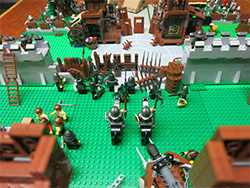 These makeshift wooden defenses aren't as strong as the stone walls around them, but they're a better option than leaving the breach open.
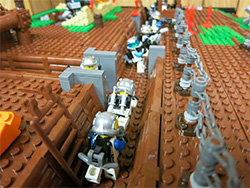 Fortifications don't have to be built upward. Dirt trenches and barbed wire make a fine Fortification 1 defensive structure.
A Fortified Battlefield is protected by reinforced walls and an occasional supporting Field Hazard (Chapter F: Field Hazards). These defensive structures might be built in a perimeter around the Battlefield and its production facilities (a medieval town wall, a prison perimeter fence, a ring of fused asteroids) or a barrier blocking the approach to the Battlefield (a walled mountain pass, razor wire and trenches, a street barricade of rubble and debris), or they might be incorporated into the facilities themselves (a concrete bunker, a zombie-proofed house, an armor-plated ice cream truck mobile command center). A Battlefield's defensive structures can have a Weight class up to the Battlefield's Fortification level. Defensive structures can take any form the players feel is appropriate to the genre and storyline, but as a loose guideline, they tend to be the height and thickness of one minifig for each level of Fortification. If the Weight class of the Battlefield's walls is less than the Fortification level, either because the Faction doesn't have strong enough materials available or because it chooses not to use them, each leftover Fortification level can be turned into a Hazard Die for a defensive Field Hazard obstacle (Chapter F: Field Hazards). Minefields, fast-flowing rivers, lava moats, and wooden spike emplacements are all attractive enhancements to a traditional wall defense. A Field Hazard's overall size and shape are up to whatever the players feel is appropriate, but as a general rule, the number of inches to cross the Field Hazard shouldn't be more than the total Fortification level of the Battlefield. A Faction can start with or capture a Battlefield with defensive structures built from any material, but when building new walls or repairing damaged ones during development, the Faction is limited to its available material resources. Holes in a strong Stone wall might have to be patched with weaker Wood palisades, for instance, until the Faction can Produce the proper materials for full repairs. | |||||||||||||||||||||||||||||||||||||||||||||||||||||||||||||||||||||||||||||||||||||||||||||||||||||||||||||||||||||||||||||||||||||||||||||||||||||
|
|
|
 Glory bricks for
  Sacrifice bricks for
  Alert level
 .
.